The Uniform Guidance does not mandate a form called an effort report. It requires a control system that produces defensible numbers. A research university extended UKG Pro HCM so grant allocation lives in the same records as the payroll it describes, and the reason was attestation risk rather than reporting convenience.



Table of Contents
- What 2 CFR 200.430 Asks For, and What It Stopped Asking For
- Attestation Without Reconciliation
- What Was Built, and What Deliberately Was Not
- The Post-Award Accountant Decides Whether This Sticks
Grant-funded labor records hold up in a federal audit only when the person certifying them can reconcile them to payroll. Every quarter, someone at a federally funded institution signs a document stating how an employee’s salary was distributed across funding sources. That signature is the compliance event, and everything upstream of it is preparation.

At many research institutions, the person signing cannot reconcile what they are signing. The payroll register lives in the HR system. The allocation percentages live in a spreadsheet kept in another office, assembled after the pay period closed. The two are connected by careful human effort rather than shared data.
A US research university whose research and clinical programs run substantially on federal awards decided that arrangement had outlived its usefulness. It runs UKG Pro HCM, and CloudApper extended that environment so grant allocation data sits in the same records as the payroll it describes. The more instructive part is what the institution had to agree on about attestation before anything was built.
What 2 CFR 200.430 Asks For, and What It Stopped Asking For
Worth being precise here, because a lot of institutional folklore has hardened around this. The Uniform Guidance does not mandate a form called an effort report. Section 200.430(i) sets an outcome standard: charges for salaries and wages must be supported by a system of internal control providing reasonable assurance that the charges are accurate, allowable and properly allocated. The records must be incorporated into the institution’s official records, must reasonably reflect the total activity for which the employee is compensated, and must account for all of that activity — not only the federally funded portion. The 2024 revisions to the guidance were largely clarifying and plain-language work; the documentation standard behind them did not change shape.
Two consequences follow, pointing in opposite directions. The liberating one: there is no prescribed template, no required signature sequence, no obligation to run the semiannual certification cycle your institution inherited in 2004. What is required is a control system that produces defensible numbers.
The less comfortable one: “incorporated into the official records” and “reasonably reflect total activity” are demanding phrases when the allocation originates in a workbook on a shared drive. A spreadsheet can be accurate. It has a harder time being an official record with internal control around it.
“We were not out of compliance. We were compliant through diligence, which is a different thing and much more expensive. Two people knew how the allocation was built, and the control was that both of them were careful.”
Director of Research Administration, research university
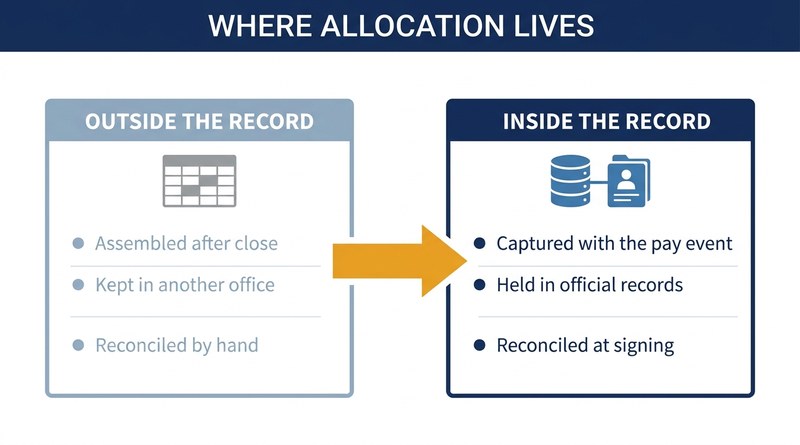
The design decision is where allocation originates: assembled after close in another office, or captured with the pay event inside the official record.
Attestation Without Reconciliation
This is the risk that does not appear on a project charter. When allocation data lives outside the system holding the payroll register, whoever certifies the distribution is attesting to figures they cannot tie out at the moment of signing. They can tie them out eventually, by request, over email, across two systems and a reconciliation step. Not while the pen is moving.
According to the university’s Controller, that was the argument that moved the project from a research-administration wish to a funded initiative: the exposure sat with the people signing, and no amount of reporting improvement addressed it as long as the numbers originated somewhere other than the official record.
“The question I could not answer well was simple. Show me, right now, without asking anyone, how this person’s pay split across four awards last month.”
HRIS Director, research university
What Was Built, and What Deliberately Was Not
CloudApper extended UKG Pro HCM with grant tracking data structures and automated reporting workflows: custom fields and relationships that carry funding source, award identifier and allocation percentage against the employee record, plus workflows that generate the distribution reporting grant administrators need without an export-and-rebuild step.
What was not built matters as much. The institution’s control framework did not change: certification policy, approval chain, who attests to what, and its own judgment about allowability all stayed where they were. Nobody claimed the software made the university compliant, because compliance remains the institution’s responsibility. The change is narrower and more useful: allocation data now sits in the same system as the payroll register it describes, so the person signing can reconcile without leaving the record.
Practitioners who have built other audit-facing extensions on UKG will recognize the pattern. It is the same discipline behind a STARK-compliant incentive pay engine with a defensible audit trail, or certified payroll for prevailing wage work, where the deliverable is not a report but a record that survives someone testing it. CloudApper AI Platform for UKG for UKG handles the structural work; the institution keeps the controls.
The Post-Award Accountant Decides Whether This Sticks
Projects like this get designed for the HRIS Director and then adopted or quietly bypassed by someone else: the post-award accountant in sponsored programs who produces the final financial report on a closing award and defends allocation percentages to a program officer.
If the new structures hand that person the same numbers in a different place, they keep their spreadsheet as a shadow copy and the project has achieved a data-entry change. The university avoided that by shaping the reporting workflow around closeout rather than around the pay period: the award is the organizing unit, and any period can be pulled without reassembling it.
“I stopped keeping my own version about two months in. Not because anyone told me to. I just could not find a question my copy answered that the system did not answer faster.”
Post-Award Grants Accountant, research university
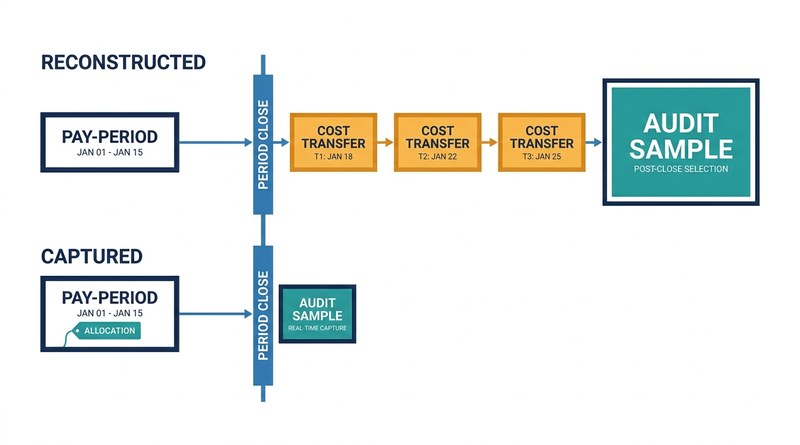
An illustration of the pattern: allocation reconstructed after close generates cost transfers, while allocation captured with the pay event reduces the population an auditor samples.
The Number That Travels Upstairs
If you are building the case for this internally, the metric that carries weight with a CFO is not hours saved in HR. It is the volume of post-close labor cost transfers.
Cost transfers after a period closes are the artifact of allocation being reconstructed rather than captured. Somebody determines later that a charge belonged to a different award, and a journal entry moves it. Each one is defensible in isolation, and a pattern of them draws attention during a Single Audit, because the transfer is documentary evidence that the original charge was wrong when it was made. Capturing allocation alongside the pay event reduces that population at the source, which cuts both the reconciliation work between payroll and grants accounting and the material an auditor has to sample.
That framing makes this a finance conversation rather than an HR one. The same logic at a different system boundary appears in this account of who owns the approval matrix once UKG feeds it, and in the way a SOX-aware delegation matrix treats traceability as the control rather than treating manual handling as safer. Any organization where daily cost center accuracy decides whether financial reporting reflects reality faces a version of this, restricted funding or not.
The transferable decision is about where allocation originates. Everything downstream of that — certification cycles, approval routing, reporting formats — is policy your institution should own. The CloudApper AI Platform for UKG is there to make the origin point the official record instead of a spreadsheet, which is a narrower promise than compliance and considerably easier to defend.
Questions Research and Payroll Teams Ask
What does 2 CFR 200.430 require for documenting salaries and wages charged to federal awards?
It requires a system of internal control that provides reasonable assurance that salary and wage charges to federal awards are accurate, allowable and properly allocated. The supporting records must be incorporated into the institution’s official records, must reasonably reflect the total activity for which the employee is compensated, and must encompass all of that activity, including work not funded by the federal award. The regulation sets an outcome standard rather than prescribing a particular form or workflow.
Is effort reporting still required, or can institutions use payroll certification and other internal controls instead?
There is no federal requirement for a document called an effort report. Institutions are free to satisfy 2 CFR 200.430(i) through payroll certification, after-the-fact activity records, or other internal controls, provided the resulting records meet the standard above and the approach is applied consistently. Many institutions retain a certification cycle by policy rather than by federal mandate, which is worth confirming before assuming a legacy process is compulsory.
If your UKG environment supports a workforce funded by federal awards or other restricted sources, and allocation still originates in a spreadsheet outside the payroll record, talk to the CloudApper team about bringing that data inside the system your certification already depends on.



October 15, 2026
Health and Welfare Pay for Military Base Stores: How a Retailer Made Every H&W Hour Traceable in UKG
A national specialty retailer with stores on US military installations moved health and welfare pay out of spreadsheets. CloudApper now applies the 40-hour weekly cap, multi-store proration and employer cost recovery against UKG time data, posting H&W pay codes to each timecard with a trail back to the hours.

September 30, 2026
When Your Best Candidates Already Worked for You: How a 50,000-Employee Home Care Organization Automated Rehire Campaigns and Geographic Filtering in UKG Pro
A 50,000-employee home health care organization extended UKG Pro Recruiting with CloudApper AI Recruiter to add geographic zip-code filtering, automated rehire outreach campaigns for former employees, and blind-ranking — reducing recruiter workload and improving hiring quality at scale.

September 29, 2026
If Your HR Events Aren’t in Slack, They Don’t Exist: How a 260-Person HR Tech Company Connected UKG Ready to Where Work Actually Happens
A 260-person HR tech company with a Slack-first culture connected UKG Ready lifecycle events to Slack using CloudApper iPaaS — so new hires, promotions, and PTO approvals appear where the organization already pays attention.

September 28, 2026
4 Integrations, One Migration Window: How a Healthcare Products Distributor Kept Every Critical System Live When They Moved to UKG Pro
A healthcare products distributor migrating from ADP to UKG Pro built four critical enterprise integrations at go-live using CloudApper iPaaS — not after cutover. Here is how treating integrations as a parallel workstream changed what migration day actually meant.