Once UKG Ready feeds manager chain, position and cost center into SAP S/4HANA Cloud, someone has to own the approval matrix. This article looks at how a global energy-sector manufacturer frames that ownership question, what a Controller needs before signing off, and why scoping the feed narrowly is what makes it auditable.



Table of Contents
- The Approval Matrix Stops Being an HR Artifact
- Scope the Claim Narrowly and the Objection Dissolves
- Why the Integration Needed More Than a Field Map
- What the Controller Needs Before Signing Off
A UKG Ready SAP S/4HANA integration usually stalls on governance long after the technical design is settled. Employee lifecycle events flow out of the HCM, the ERP picks up the manager chain and cost center, and the approval workflow routes correctly. The harder conversation comes from finance: once UKG decides who can approve a purchase order, someone has to own the approval matrix.

That ownership question is why org-data feeds into SAP can sit on roadmaps for two years. A global energy-sector manufacturer with roughly 1,150 employees across multiple countries and legal entities faces it while moving its people data onto UKG Ready. CloudApper provides the connective layer, and the more lasting work is agreeing on what the feed is allowed to decide.
The Approval Matrix Stops Being an HR Artifact
In most finance organizations the approval matrix is a controllership asset. Someone in the controller’s office maintains it, changes it deliberately, and can explain every line of it to an auditor. When it is wrong, the fix is a ticket to the SAP security team.
Point the feed at it and that changes. A transfer entered by an HR business partner in one country now silently rewrites who can release spend in an ERP that closes the books for every legal entity. Nobody in finance touched it. That is exactly the outcome the integration is designed to produce, and it is also the reason the SAP security lead has legitimate objections at design review.
The manufacturer’s Vice President of IT described why the finance hierarchy cannot simply mirror the org chart.
“From an SAP perspective when it comes to financial approvals, that hierarchy is quite often different because it’s a local financial controller or someone else who’s part of the release strategy for purchase orders and so on.”
Vice President of IT, global oilfield products manufacturer
Scope the Claim Narrowly and the Objection Dissolves
The design move that earns sign-off is refusing the broad version of the claim. UKG Ready is not declared the source of truth for SAP. It becomes the originating source for four specific objects: employee master identity, position, cost center assignment, and manager chain. SAP S/4HANA Cloud remains the system of record for financial postings, for the approval workflow logic itself, and for every threshold and delegation rule layered on top of the hierarchy.
That distinction sounds like semantics until an auditor asks who changed an approval limit. The hierarchy comes from HR. The limits, the workflow, and the segregation-of-duties rules stay with finance. Two owners, two audit trails, one feed between them.
“Our main business requirement is to ensure that SAP S/4HANA has an accurate and current view of employee, manager, cost center, and organisational relationships so that SAP-side processes can route approvals correctly and avoid manual maintenance wherever possible.”
Vice President of IT, global oilfield products manufacturer
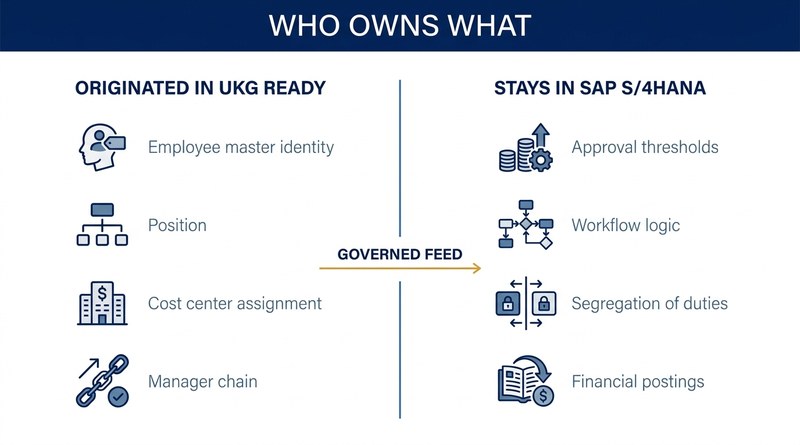
Sign-off depends on naming exactly which objects UKG Ready originates and which stay with SAP S/4HANA Cloud.
Why the Integration Needed More Than a Field Map
SAP S/4HANA Cloud’s API does not accept a blunt overwrite of an employee record. It expects a Read-Modify-Write sequence: read the record’s current state, change only the portion that actually moved, write it back without disturbing anything else. A point-to-point script that pushes a full payload on every event will either fail validation or quietly flatten attributes that another team owns.
CloudApper iPaaS for UKG implements that protocol on every lifecycle trigger. A new hire, a termination, a rehire, or a transfer in UKG Ready fires the sequence: read the SAP-side record, apply the delta for the four owned objects, write back, confirm. The same discipline appears in any well-built enterprise feed. It is why synchronizing employee demographic data between two HCM platforms is a transformation problem rather than a copy problem, and why connecting UKG to a financial system for payroll and finance automation works on deltas rather than dumps.
Identity and access provisioning follows the same shape. Organizations already running UKG Pro to Microsoft Entra ID provisioning have the pattern in place: HR events drive downstream entitlement, and the downstream system keeps its own rules. Approval hierarchy in the ERP is the same category of dependency, with money attached.
What the Controller Needs Before Signing Off
Three things, none of them technical.
First, an exception path. When a lifecycle event produces a hierarchy state finance considers implausible (a manager chain that loops, a cost center that no longer exists in the ERP, a position vacated with open approvals still routed to it), the feed holds the change and notifies a named reviewer rather than committing it. Finance keeps a hand on the brake.
Second, a change log finance can read. Not integration logs. A record of which UKG event caused which SAP hierarchy change, timestamped, retrievable during control testing without an IT ticket.
Third, agreement on quarter-end. Structural changes landing mid-close create reconciliation work that nobody budgets for, so the feed respects a close window: events queue and release after the books are closed, with an override for genuine urgency.
“We’re going back after the event to go and fix and clean up things… for people that have left the company… a month or two ago, which is certainly not ideal.”
Vice President of IT, global oilfield products manufacturer
The point of all three is the close. The requirement is to stop finding hierarchy corrections during testing and to stop re-routing approvals that have been sitting with someone who left the company in a prior period. Organizations that have already built a SOX-aware delegation matrix for manager self-service in UKG Pro will recognize the logic: the control is not the absence of automation, it is the traceability of it.
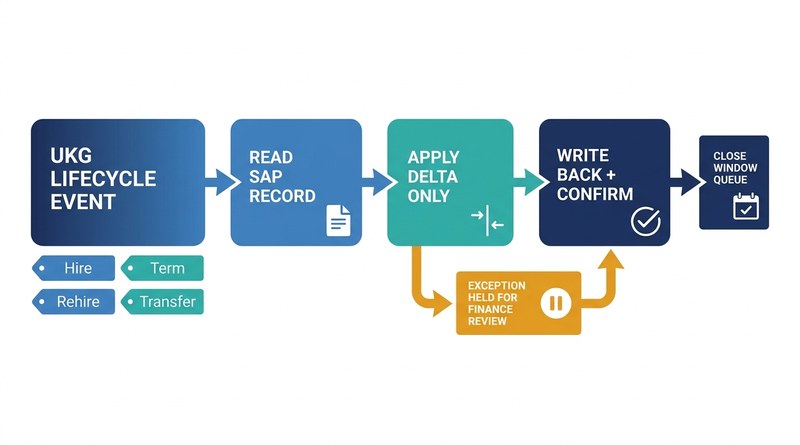
Every UKG lifecycle event triggers a Read-Modify-Write cycle, with implausible states held for finance review and structural changes queued around the close.
What Is at Stake, and What This Means Elsewhere
The manufacturer’s requirement is plain. When someone leaves, moves or changes managers, the SAP approval chain should not still point to them, and the cleanup should not depend on one person in the SAP security team. A governed feed is built so that purchase orders route on the manager chain HR recorded the same day, and so that cost center assignments in SAP reflect the current organization rather than the organization as of the last time somebody remembered to update it.
The transferable part is not the connector. It is the sequence: decide which objects HR originates, leave everything else with the system that owns it, give finance an exception path and a readable log, and respect the close calendar. That sequence works whether the downstream system is SAP, an ERP in a single country, or the procurement platform a newly acquired business unit brought with it. CloudApper builds the feed; the governance decisions above are what make it survive an audit.
The same principle applies whenever workforce data crosses a boundary into a system with different rules and a different owner, which is the situation described in this account of time data originating in a system the employer does not control. Different data, identical governance question. The CloudApper AI Platform for UKG exists to carry that data across the boundary under rules both sides have agreed to, which is a narrower and more useful promise than making one system the master of everything.
Questions IT and Finance Teams Ask About This
How can I keep SAP S/4HANA Cloud approval hierarchies in sync with UKG Ready org changes?
Trigger on UKG Ready lifecycle events (new hire, termination, rehire, transfer) and use an integration layer that implements SAP’s Read-Modify-Write protocol so only the changed portion of the employee record is written back. Limit what the feed owns to specific objects such as employee master identity, position, cost center and manager chain, and leave approval thresholds, workflow logic and financial postings with SAP. Hold implausible states in an exception queue for a named reviewer instead of committing them.
Why does stale HR data in SAP approval chains create finance and procurement risk?
Because the approval hierarchy is operational finance infrastructure. When it lags behind the organization, purchase orders route to managers who have left, invoices wait with approvers who changed departments, and cost centers point at vacated positions. Each of those is a delay to the business and a finding waiting to be written up during control testing, which is why hierarchy currency is treated as a control rather than an administrative convenience.
If your UKG environment feeds an ERP that decides who can approve spend, and the hierarchy behind it is still maintained by hand, talk to the CloudApper team about what a governed feed would look like for your close calendar and your control framework.


October 14, 2026
UKG Costpoint Integration for Defense Contractors: Who Owns the 65 Fields Between Payroll and the Audit
A defense services contractor needs its HRIS to update more than 65 Costpoint fields through an API. CloudApper iPaaS handles the UKG Costpoint integration, and the real lesson is governance: HRIS, finance and IT each own their part of the mapping rules, so labor cost data stays audit-ready as contracts change.

October 12, 2026
ATS to UKG Ready Integration: Making Every Light Industrial Staffing Placement Payroll-Ready on Day One
A light industrial staffing firm placing 20 to 40 new workers a week re-enters every hire from its ATS into payroll by hand. CloudApper's sync creates UKG Ready records at assignment and carries updates and terminations across, so every placement can be payroll-ready on day one.

October 9, 2026
UKG Pro and Mexico Payroll Integration: Keeping Cross-Border Employee Data in Sync
US employers with Mexico operations often run UKG Pro as the system of record and a local platform for Mexican payroll. CloudApper connects the two with an automated sync that sends hires, terminations and pay changes to the Mexico platform and brings payroll results back into UKG Pro.

October 7, 2026
Client-Site Employees and UKG Pro WFM: Keeping Embedded Automotive Engineers Paid Right
Engineers working inside a client’s facility log time in the client’s system, so their paycheck is the employer touchpoint that matters most. For an automotive engineering services firm, CloudApper moves those hours into UKG Pro WFM automatically, removing the manual re-entry where pay errors start.