Prevailing wage work turns an overtime rounding error into a certified statement signed under penalty of perjury. For an electrical infrastructure field services division whose multi-state daily overtime and WH-347 reporting run in Excel, one missed daily threshold means restitution. Here is what that work demands, and how CloudApper encodes the rules on top of UKG.



Table of Contents
- The Compliance Requirement Nobody Budgets For
- What a Wage Restitution Letter Actually Costs
- Why the Usual Fixes Do Not Hold
- Encoding the Rules Instead of Remembering Them
Prevailing wage work is the only kind of payroll where being approximately right is a violation. On a commercial job, an underpaid overtime hour becomes a correction on the next check. On a federally funded job, the same hour becomes a certified statement signed under penalty of perjury and retained for three years as evidence. The math is identical. The consequences are not.
That distinction is why UKG customers in electrical infrastructure, utilities, and specialty trades are rethinking how certified payroll actually gets produced. Not the timekeeping, and not the pay rates, but the part in between, where field hours have to be reshaped into state-specific overtime, matched to wage determinations, and rendered into a WH-347 that survives an audit. For most contractors, that part still runs in Excel. Excel is where the exposure lives.
The Compliance Requirement Nobody Budgets For
Contractors performing work on federally funded construction contracts above $2,000 fall under the Davis-Bacon Act, which obligates them to pay locally prevailing wages and fringe benefits and to submit weekly certified payroll records. Most states layer their own prevailing wage statutes on top, with separate wage schedules, separate reporting portals, and separate overtime thresholds.
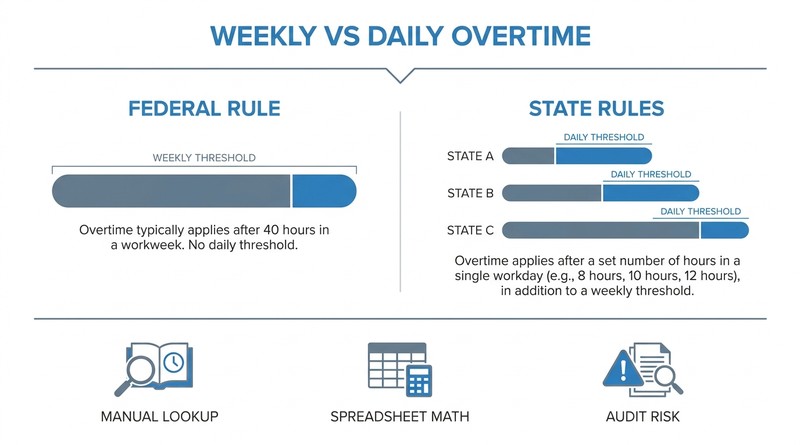
Overtime is where the arithmetic turns hostile. Federal overtime is weekly. Several states are not. California requires premium pay after eight hours in a workday, Nevada applies a daily threshold for many hourly employees, and Colorado carries a twelve-hour daily rule alongside its weekly one. A crew working four ten-hour days in one state generates no overtime; the same crew, same hours, one state line over, generates eight premium hours. Multiply that across a traveling workforce moving between jurisdictions inside a single pay period and the calculation stops being something a spreadsheet formula can hold.

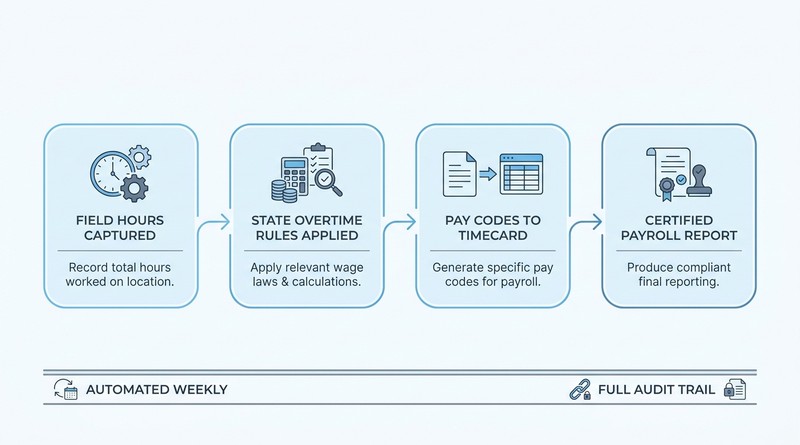
This is precisely the kind of operational requirement CloudApper was built to absorb. UKG is the system of record for time, pay rates, and labor allocation. CloudApper sits above it as the process layer, applying the state-specific rules to the hours UKG already holds, then writing the results back as clean pay codes on the timecard. No parallel system, no exported spreadsheet, no second version of the truth.
What a Wage Restitution Letter Actually Costs
An electrical infrastructure and utilities field services division, running roughly forty traveling installers across multiple states on government prevailing wage contracts, learned this the way most organizations do. Its certified payroll process runs on weekly Excel timesheets and per-job true-up workbooks, with WH-347 forms completed by hand after payroll closes. Wage determinations are looked up job by job because they are often not written into the contract, and daily overtime depends on someone knowing which states require it.
It held until it didn’t. On one state contract, a daily overtime threshold was missed, installers were underpaid, and the error surfaced in certified payrolls submitted for review. That is how a timekeeping assumption becomes a wage restitution obligation.
“When we took on the contract… the team did not know that if they worked over eight hours daily that they got daily overtime. So we have restitution on that at this point, and we have outside counsel looking at that, trying to negotiate that for us,” the company’s Corporate Payroll Lead said.
That is the real cost of manual certified payroll. Not the restitution, but the discovery that a process the organization trusted had no mechanism for catching its own errors. Forty installers is a small workforce, and it is still enough to produce real restitution exposure.
The Corporate Payroll Lead described the process plainly: “Right now it’s completely manual and on Excel spreadsheets and I want to try to take the manualness out of it.”
Why the Usual Fixes Do Not Hold
Contractors facing this generally reach for one of a few options. They hire a certified payroll service, which adds cost per employee per week and creates a data handoff that has to be reconciled anyway. They commission custom development, which turns a compliance requirement into an IT project measured in quarters. Or they add another spreadsheet reviewer, which distributes the same manual risk across two people.
None of these change the underlying condition, which is that the business rules governing prevailing wage overtime have no permanent home inside the payroll process. They live in a person’s judgment. When that person is on vacation, in a hurry, or working a pay period that spans three states, the rules degrade.
What contractors actually need is for those rules to be encoded once, executed identically every cycle, and auditable after the fact. That is a platform problem, and it is the same category of problem CloudApper solves for organizations tackling multi-state compliance at scale, where the differences between jurisdictions have to be enforced automatically rather than remembered.
Encoding the Rules Instead of Remembering Them
For a field services division like this one, CloudApper’s approach is a prevailing wage engine on top of UKG. Wage determinations are attached to each contract and state when a job is set up, installer hours flow in with their job site and state, and the engine applies the correct daily and weekly overtime treatment for that jurisdiction, matches the classification to the applicable wage determination and fringe rate, and produces a WH-347-formatted certified payroll report ready for submission. The pay codes land back in UKG, so payroll and certified reporting are generated from the same set of hours rather than two reconciled versions of them.
Getting the hours right at the source mattered as much as the calculation. Traveling installers punch from job sites, not a fixed clock, which is why CloudApper hrPad can be paired with this kind of engine to capture location-tagged punches and job assignment as work happens. The same holds for travel and mileage between job sites, another category of pay contractors handle by hand and that carries its own accuracy problems when it stays manual.
The Corporate Payroll Lead set the requirement in simple terms: “We want to just be able to have some way of knowing certain parameters when we enter in and making sure that we have all of our certified payrolls correct when we submit.”
What Changes When Compliance Becomes Infrastructure
The organizational effect goes past avoided penalties. A contractor that can produce defensible certified payroll on schedule can bid on public work it previously avoided, and the contractors positioned to win that work are the ones whose compliance capability scales without adding administrative headcount for every new jurisdiction.
For the payroll team, the stakes are more immediate. Encoded rules remove the dependence on one person’s recall of dozens of rule combinations, so the installers themselves, whose pay depends on a threshold applied correctly in a state they drove to last Tuesday, are paid right the first time. That is the outcome prevailing wage law was written to protect, and the one manual processes fail most quietly.
The Corporate Payroll Lead framed the goal in terms of accountability: “I know it’s us signing off on the certified payrolls, but just having that extra layer of certainty that we don’t have extenuating circumstances…”
Contractors that treat certified payroll as a clerical task will keep absorbing restitution findings as a cost of doing business. The ones that treat it as infrastructure, encoded once and executed the same way every week, will keep bidding while competitors reconcile workbooks. The difference is not effort. It is whether the rules live in software or in someone’s head, which is the same question organizations face when they take on location-based labor law enforcement or job-level labor cost accuracy.
CloudApper AI Platform for UKG and the broader CloudApper AI Platform for UKG exist for exactly this class of requirement: the business rules that are specific to one industry, one contract type, or one set of state statutes, and that need to run inside the system of record rather than beside it. CloudApper is the process layer that holds these rules on top of UKG. The organizations that move fastest are not the ones with the largest compliance departments. They are the ones that do not ask a spreadsheet to carry the risk.
If your organization performs prevailing wage work on UKG and certified payroll still runs on spreadsheets, talk with the CloudApper team about encoding your state-specific overtime and WH-347 reporting directly into your existing UKG environment.



October 16, 2026
Public Holiday Substitution Rules Around the World: Why UKG Pro WFM Still Needs Manual Checks
New Zealand calls it Mondayisation, the UK calls it a substitute bank holiday, Canada calls it holiday pay in lieu, and the US calls it an observed holiday. Four names, four rules, and the same manual-check problem for global UKG Pro WFM deployments.


October 16, 2026
UKG Pro Position Management at a Food Producer: Who Sets the Defaults When 75 Employees Change Jobs Every Week
A large food producer moving to UKG Pro handles about 75 internal transfers a week. CloudApper automates the position defaults behind each move, including comp codes, cost centers, standard hours and union codes, through the UKG Pro API, with HR owning and updating the rules without opening a project.

October 15, 2026
Health and Welfare Pay for Military Base Stores: Making Every H&W Hour Traceable in UKG
A national specialty retailer with stores on US military installations needs health and welfare pay it can defend. CloudApper applies the 40-hour weekly cap, multi-store proration and employer cost recovery against UKG time data, posting H&W pay codes to each timecard with a trail back to the hours.

September 30, 2026
Your Best Candidates Already Worked for You: Rehire Campaigns and Geographic Filtering in UKG Pro for Home Care
Large home care organizations hire at high volume across many territories, and former employees often re-enter the same pipeline as strangers. CloudApper AI Recruiter extends UKG Pro Recruiting with zip-code filtering, rehire outreach campaigns and blind ranking, so coordinators see the strongest local candidates first.