A national specialty retailer with stores on US military installations moved health and welfare pay out of spreadsheets. CloudApper now applies the 40-hour weekly cap, multi-store proration and employer cost recovery against UKG time data, posting H&W pay codes to each timecard with a trail back to the hours.



Table of Contents
Health and welfare pay looks simple on paper. Work an hour, earn an hour of H&W. The complexity shows up in the week where a sales associate picks up shifts at two stores on the same base, crosses 40 hours, and is already enrolled in the company health plan. Someone has to decide how many H&W hours that week produces, which store carries them, and how much of the obligation the employer’s benefit contributions already cover. On a military installation, someone also has to prove it.

A national specialty retailer with stores on US military installations faced that question every pay period. Its military contracts carry health and welfare terms, and payroll calculated them by hand. CloudApper now runs those rules as a calculation engine on top of UKG, so every H&W hour lands on the timecard with a trail back to the hours that earned it.
Three Contract Rules That Meet on One Timecard
Federal service contracts set H&W through wage determinations, and 29 CFR Part 4 generally limits the fringe obligation to hours up to 40 a week and 2,080 a year. The retailer’s military store contracts follow the same structure, which produces three rules payroll has to apply together.
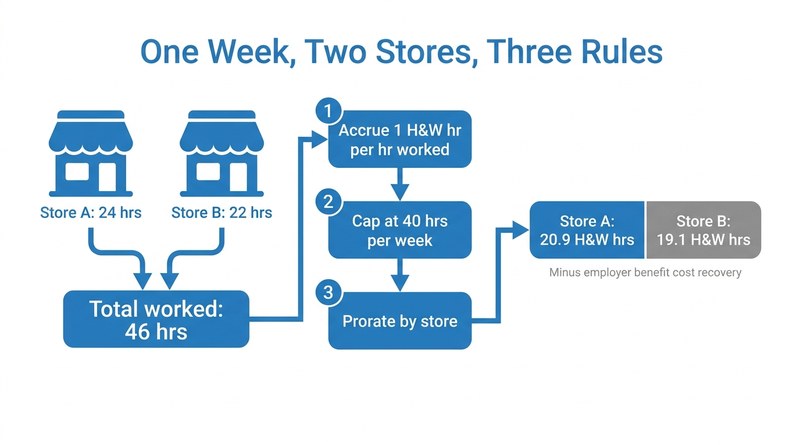
The first is the accrual: one H&W hour for each hour worked. The second is the weekly cap at 40 hours. The third is proration. When an associate works at more than one military store in a week, the capped H&W hours are split across those stores in proportion to hours worked, so each location’s contract carries its share. An associate with 24 hours at one store and 22 at another works 46 hours, earns 40 capped H&W hours, and those divide into roughly 20.9 hours for the first store and 19.1 for the second.
On top of that sits employer cost recovery. Where the retailer already pays toward an employee’s benefits, that cost is credited against the H&W obligation, and only the remainder is owed as an H&W payment. As the Payroll Manager at the specialty retailer described it, “The math was never hard for one person in one store. It was hard for every associate on every base, every week, with no room for a wrong decimal.”
Why the Controller Cared More Than Payroll Did
Manual H&W calculation was slow, but speed was not the main risk. The bigger exposure was traceability. When a contracting office or auditor asks why an associate received 19.1 H&W hours at a given store, the answer has to point to specific punches, a specific cap and a specific cost recovery amount. A spreadsheet can produce the number. It struggles to show its work six months later.
“Our question was never whether payroll got close. It was whether we could defend each store’s H&W number, line by line, to the people who hold the contract.”
Controller, national specialty retailer
That requirement shaped the design. The retailer did not want a parallel payroll system or a second record of hours. It wanted the contract rules to run against the hours already in UKG, with the results written back where payroll and auditors already look. Teams that manage employees who work for more than one entity in UKG will recognize the same need to split one person’s week cleanly.
How CloudApper Applies the Rules Inside UKG
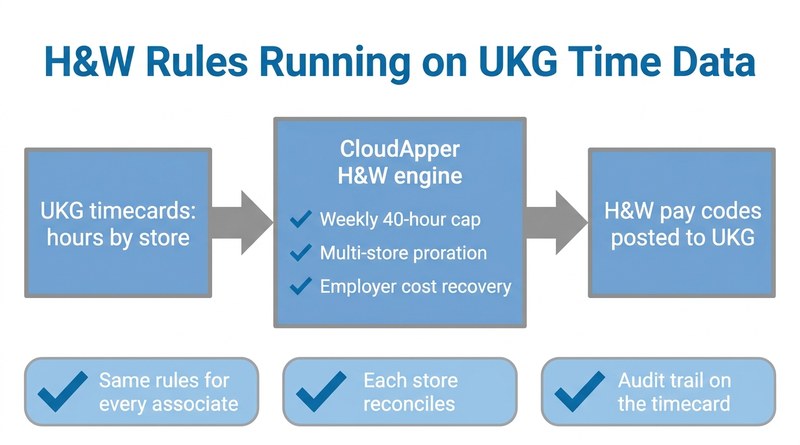
Using the CloudApper AI Platform for UKG, CloudApper built a custom H&W pay engine that reads worked hours by store from UKG at the close of each workweek. It applies the 40-hour cap, prorates capped hours across every military store the associate worked, subtracts employer benefit cost recovery, and posts the resulting H&W pay codes to the associate’s UKG timecard before payroll runs. Each posted amount keeps a reference to the inputs behind it.
“Payroll stopped building H&W in a workbook. It shows up on the timecard with the hours that produced it.”
HRIS Director, national specialty retailer
The rules are held as parameters rather than code. When a contract modification changes the H&W amount, or the retailer opens a store on another installation, the change is a configuration update that CloudApper’s personalization layer for UKG applies without touching UKG pay rules. That matters for any contractor handling wage obligations tied to the work itself, from Davis-Bacon trade classifications to project labor that feeds a contract accounting system like Costpoint.
What Changed for the Retailer
Manual H&W calculation for military stores is gone. Weekly caps and multi-store proration are applied the same way for every associate, employer cost recovery is credited consistently, and each store’s H&W obligation reconciles to its own hours. When the contracting side asks for support, payroll pulls it from UKG rather than rebuilding it, the same posture that makes a DOL wage and hour audit manageable.
“When we add a store on a new base now, H&W is a setting we review, not a spreadsheet we inherit.”
Director of Payroll, national specialty retailer
For retailers, concessionaires and service providers working under federal contracts, the lesson is to treat H&W as contract logic that runs against UKG time data, owned and reviewed like any other control. CloudApper builds that logic on top of UKG so the timecard stays the single place where hours, H&W and the audit trail meet.
If your health and welfare pay still depends on a weekly spreadsheet, talk to CloudApper about running your contract H&W rules directly against UKG time data.



September 30, 2026
When Your Best Candidates Already Worked for You: How a 50,000-Employee Home Care Organization Automated Rehire Campaigns and Geographic Filtering in UKG Pro
A 50,000-employee home health care organization extended UKG Pro Recruiting with CloudApper AI Recruiter to add geographic zip-code filtering, automated rehire outreach campaigns for former employees, and blind-ranking — reducing recruiter workload and improving hiring quality at scale.

September 29, 2026
If Your HR Events Aren’t in Slack, They Don’t Exist: How a 260-Person HR Tech Company Connected UKG Ready to Where Work Actually Happens
A 260-person HR tech company with a Slack-first culture connected UKG Ready lifecycle events to Slack using CloudApper iPaaS — so new hires, promotions, and PTO approvals appear where the organization already pays attention.

September 28, 2026
4 Integrations, One Migration Window: How a Healthcare Products Distributor Kept Every Critical System Live When They Moved to UKG Pro
A healthcare products distributor migrating from ADP to UKG Pro built four critical enterprise integrations at go-live using CloudApper iPaaS — not after cutover. Here is how treating integrations as a parallel workstream changed what migration day actually meant.
September 18, 2026
When Every Open Shift Carries Grievance Risk: How a Large Public Transit Authority Extended UKG Pro WFM for CBA-Compliant Shift Substitution Bidding
A large public transit authority automated CBA-compliant seniority-based shift substitution bidding in UKG Pro WFM with CloudApper, eliminating manual supervisor interpretation, reducing union grievance exposure, and creating a timestamped audit trail for every assignment decision.