In a Slack-first technology company, new hires, promotions and PTO approvals that stay inside UKG Ready go unseen. CloudApper iPaaS pushes UKG Ready lifecycle events into Slack as read-only cards, so HR events show up where the organization already pays attention while approvals stay in UKG.



Table of Contents
A 260-employee technology SaaS company moving onto UKG Ready has a visibility problem to solve before it shows up. Engineering deploys, incident triage and most decisions happen in Slack, while new hires, promotions, PTO approvals and offboarding events live in a system employees open only when they have a specific reason to. If those events stay inside UKG Ready alone, a Slack-first workforce will not see them. The requirement the people team brought to IT is to extend UKG Ready into the channel the company already uses, without creating a second place where approvals happen.
When the Platform Is Right and the Culture Isn’t Watching
Low HRIS adoption in knowledge-worker companies isn’t usually a configuration problem. It’s a cultural one. In organizations built around real-time communication tools, the implicit hierarchy of attention runs through those tools. A promotion announced in a Slack channel carries more organizational weight than the same event sitting in an HR system behind a login, not because the data is different, but because visibility determines whether the organization processes it as a signal or files it as a record.

For organizations exploring how to connect UKG Ready to the productivity tools employees already live in, the visibility problem is rarely named directly. It surfaces as “adoption metrics” or “system engagement”, which are symptoms of the same underlying issue: the org’s real-time communication layer and its HR system aren’t speaking to each other.
Making HR Events First-Class Organizational Signals
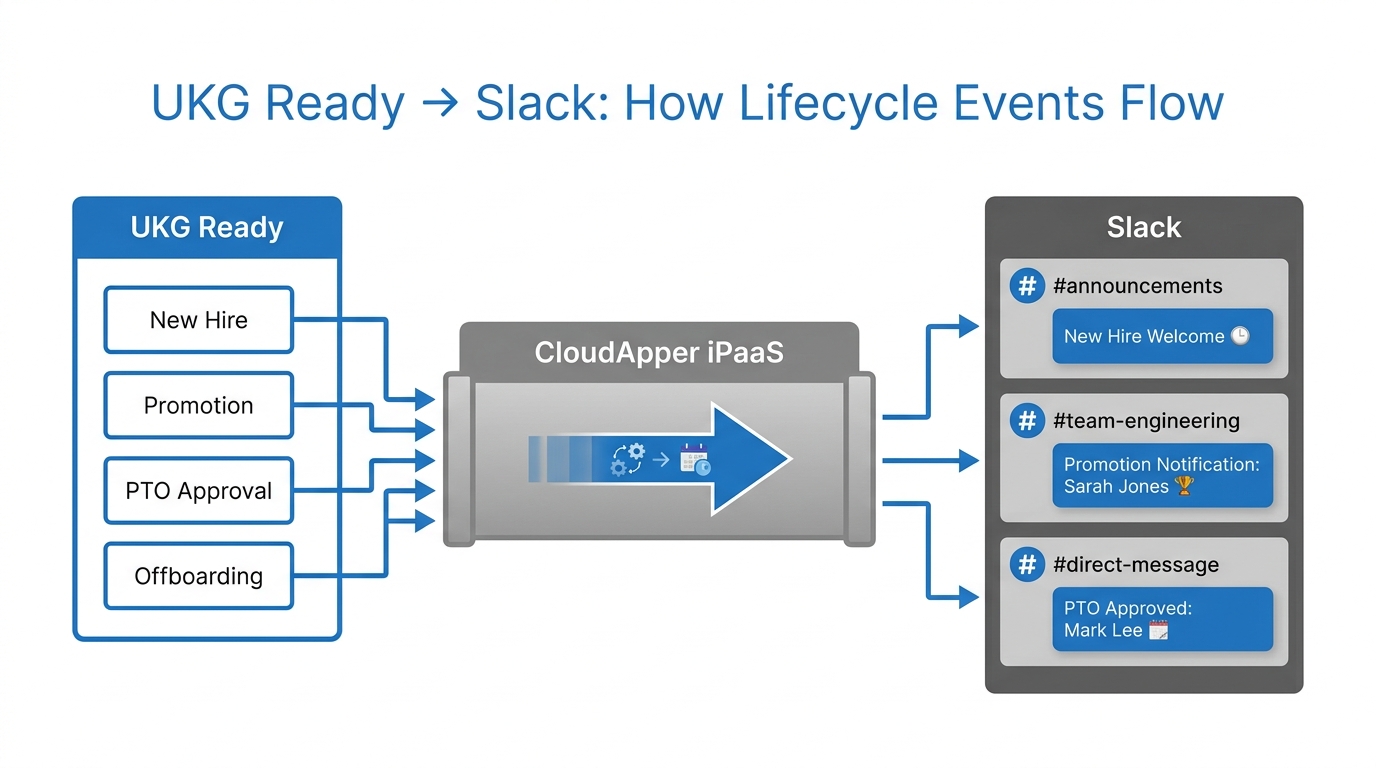
CloudApper iPaaS for UKG provides a one-way integration that listens for completed lifecycle events in UKG Ready and pushes them as formatted notification cards into designated Slack channels and direct messages. Routing is configurable by event type: a new hire card can go to the company-wide announcements channel, a promotion to the relevant team channel and the employee’s manager, a PTO approval to the employee, and an offboarding event to IT and the team lead.
The integration runs in one direction: UKG Ready remains the system of record and the system of action, and Slack receives a structured read of each event. Nothing is written back, and any button on a card links back into UKG Ready, where the approval and its audit trail belong. The goal is not to make Slack an HR system. It is to make UKG Ready’s events visible in the communication layer that actually shapes how people learn things about each other in the organization.
“I’m assuming that we could make these announcements go to different channels or specific people, right?” asked the HR leader who sponsored the project.
What the Notification Structure Actually Looks Like
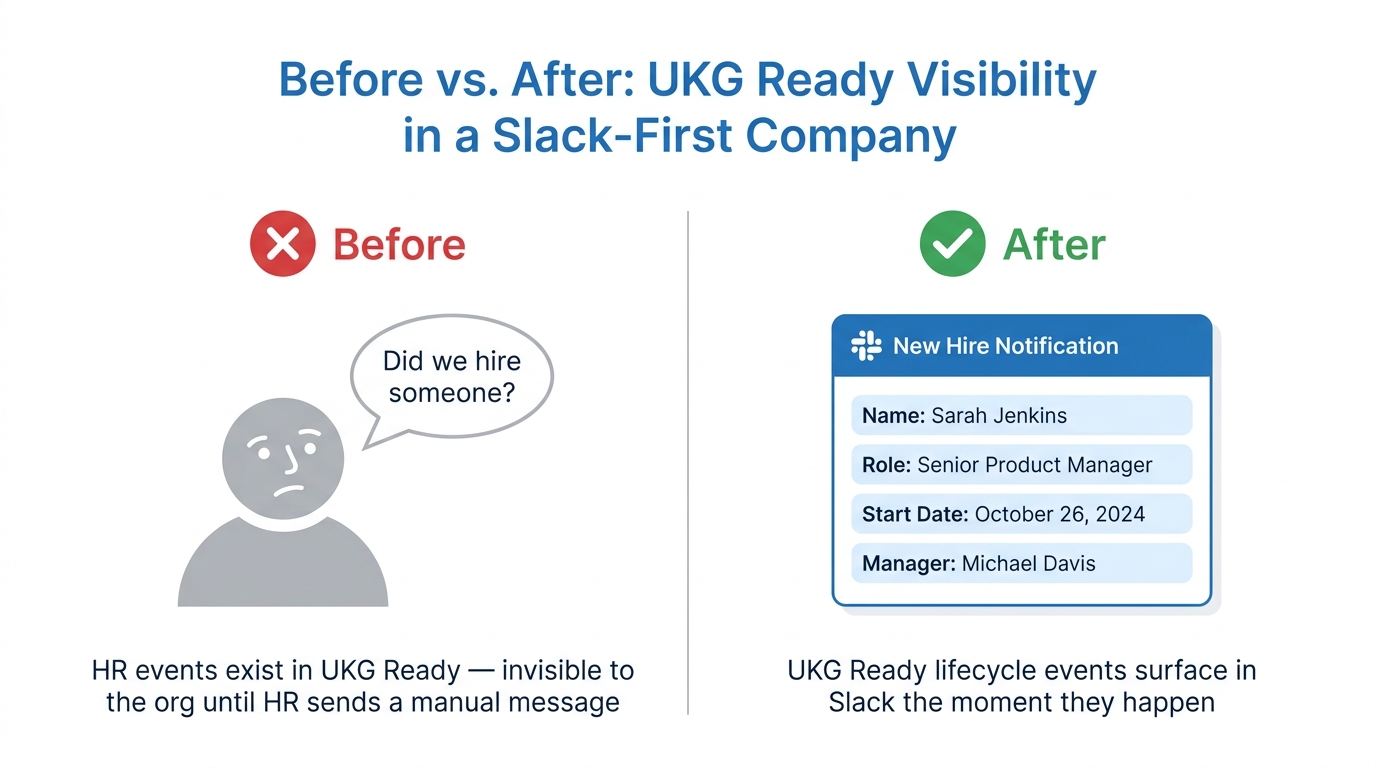
Each Slack notification is formatted as a structured card rather than a plain text message. A new hire card includes the employee’s name, role, start date, and reporting manager: enough context for a team lead to know who’s arriving and when, without navigating into UKG Ready. A PTO approval card confirms the dates and the approver. Promotion cards include the new role and effective date.
The routing logic is configured in CloudApper iPaaS: which event types trigger which Slack channel or user, and what fields from UKG Ready appear in each card. When the org structure changes, routing rules can be updated to reflect new team channels without starting a new integration project. For teams already using automated UKG notifications for shift and schedule events, the same logic extends naturally to lifecycle events. The data already exists in UKG Ready, and routing it to where the organization pays attention is a configuration decision, not a new system.
What Changes When HR Moves Into the Channel
The point is visibility, not another tool. When answers about new hires, promotions and PTO appear in Slack, employees have less reason to chase HR for them, and managers see UKG Ready’s output in the channels they already trust. Scheduled reports follow the same pattern: output from UKG Ready’s native report scheduler can land in Slack as a read-only link instead of an email attachment that gets lost in an inbox. CloudApper keeps the design one-way, which lets IT authorize a single Slack app with posting rights to approved channels only.
For UKG Ready customers in knowledge-worker environments where productivity tools shape organizational attention, the question worth asking isn’t whether employees are using the HR system. It’s whether the HR system’s events are reaching the places where the organization makes sense of what’s happening. In a Slack-first company, those are different questions. Connecting UKG lifecycle events to where employees already operate is what closes the distance between the two.
If your organization runs UKG Ready in a Slack-first or messaging-first environment and wants HR events surfaced where work actually happens, CloudApper can build the integration on your current stack.



October 16, 2026
Public Holiday Substitution Rules Around the World: Why UKG Pro WFM Still Needs Manual Checks
New Zealand calls it Mondayisation, the UK calls it a substitute bank holiday, Canada calls it holiday pay in lieu, and the US calls it an observed holiday. Four names, four rules, and the same manual-check problem for global UKG Pro WFM deployments.


October 16, 2026
UKG Pro Position Management at a Food Producer: Who Sets the Defaults When 75 Employees Change Jobs Every Week
A large food producer moving to UKG Pro handles about 75 internal transfers a week. CloudApper automates the position defaults behind each move, including comp codes, cost centers, standard hours and union codes, through the UKG Pro API, with HR owning and updating the rules without opening a project.
October 15, 2026
Health and Welfare Pay for Military Base Stores: Making Every H&W Hour Traceable in UKG
A national specialty retailer with stores on US military installations needs health and welfare pay it can defend. CloudApper applies the 40-hour weekly cap, multi-store proration and employer cost recovery against UKG time data, posting H&W pay codes to each timecard with a trail back to the hours.

September 30, 2026
Your Best Candidates Already Worked for You: Rehire Campaigns and Geographic Filtering in UKG Pro for Home Care
Large home care organizations hire at high volume across many territories, and former employees often re-enter the same pipeline as strangers. CloudApper AI Recruiter extends UKG Pro Recruiting with zip-code filtering, rehire outreach campaigns and blind ranking, so coordinators see the strongest local candidates first.