Enterprises have automated parts of the workforce change process, but the parts are scattered across email, chat, the HCM and a ticket queue, so the control exists while its evidence does not. Here is why SOX-ready manager self-service in UKG Pro starts with the delegation matrix, and how CloudApper adds a leader portal inside UKG Pro.



Table of Contents
- Manager Self-Service in UKG Pro Serves Two Audiences at Once
- The Delegation Matrix Comes Before the Forms
- What a National Mortgage Lender Needs
- What to Require If You Are Scoping This
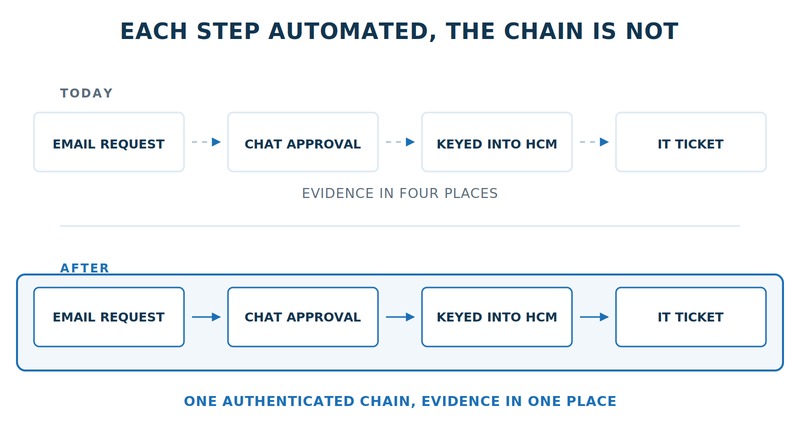
Manager self-service in UKG Pro holds up under SOX only when the delegation matrix is defined before the forms are built. Almost every enterprise has automated parts of the workforce change process, but the parts are scattered: the request arrives by email, approvals happen in a chat thread, the transaction gets keyed into the HCM, and the IT work is raised as a ticket by whoever remembered. Each step may be automated while the chain between them is not.

For a small organization that fragmentation is survivable. Where compensation and headcount feed audited financial statements, the control exists but its evidence is scattered across four systems, none designed to hold it. CloudApper connects that chain on top of UKG Pro, starting with the delegation matrix.
Manager Self-Service in UKG Pro Serves Two Audiences at Once
The HRIS Director’s problem is intake. Actions arrive in whatever format the leader chose, missing whichever fields they did not know were required. HR operations becomes a translation layer, converting requests into transactions and chasing what is missing. The work is invisible, constant, and impossible to staff for.
Spreadsheets, emails, just a couple of different ways depending on the team. And we’re just looking to kind of standardize it and make it easier on our team to get those changes from different teams throughout the business.
HR team lead, national mortgage lender
Internal audit arrives from the opposite direction with an evidence problem. Under Section 404, controls over financial reporting must be documented and testable, and compensation and headcount are direct inputs to those statements. When a pay change was approved in an email thread, the control exists but the evidence is scattered. Auditors do not ask whether the right person approved it. They ask you to demonstrate it, months later, for a sample.
Both problems share one solution: leaders initiate workforce actions inside the system of record, under the organization’s own delegation rules, with the approval chain and audit trail produced as a byproduct rather than reconstructed on request.
The reason this needs building is structural. Employee self-service assumes actor and subject are the same person, so the permission model is simple. A leader initiating a workforce action is working on someone else’s record, the action carries financial materiality, and the authority to approve it depends on position and dollar thresholds, with a path that may involve four sequential parties across HR, finance, and the reporting line. Some actions apply to one employee, others to forty at once. UKG Pro holds the record, the structure, the compensation data, and the effective-dating that makes the transaction correct. What gets added is the leader-facing layer above it.
The Delegation Matrix Comes Before the Forms
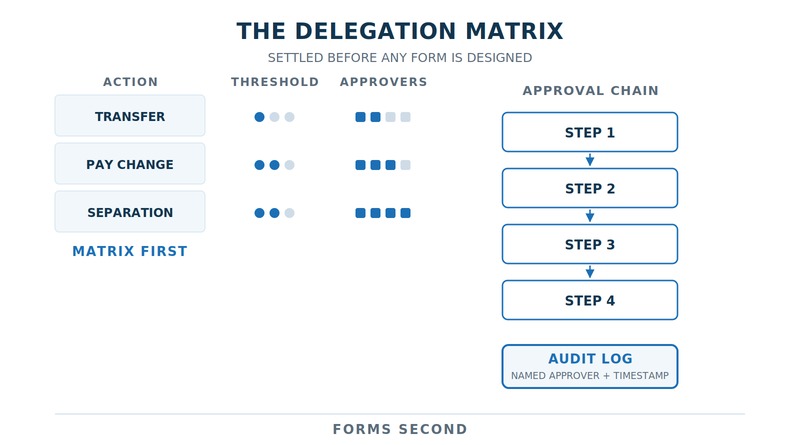
The organizations that get this right share one sequencing decision, and it is the whole argument here: define the delegation matrix before anyone designs a screen. Who may initiate a compensation change. At what threshold a second or third approver enters. Which actions require finance rather than only the reporting line. What evidence each step must leave behind.
That matrix is a controls artifact, not a configuration detail, and it usually already exists in the company’s SOX documentation as a delegation of authority. Projects stall when HRIS and internal audit negotiate over form fields instead, because a form is a proposal about authority neither party can approve until the matrix is settled. Once it is explicit, routing and logging are implementation.
What a National Mortgage Lender Needs
Consider a large national mortgage lender where leaders constantly reshape teams, from single transfers to stand-ups of more than a hundred people, and every compensation or job change has to be provable for SOX. CloudApper’s approach is a leader portal embedded directly in UKG Pro, reached through the single sign-on identity leaders already use, so it is not a separate destination with its own credentials.
The portal presents structured forms for the actions leaders initiate: team member movement, compensation changes, separations, and requests for new titles. Each submission routes through the approval chain defined for that change type, and mass movement is supported so a reorganization follows the same reviewed path as a single transfer. Every step writes to an audit log built for SOX examination rather than troubleshooting. The reorganization case is the one that matters most: a restructure moving a large group at once has to produce the same evidence per change as an individual separation, with no compensating control and no side spreadsheet. Where an action has IT consequences, such as access or equipment, the portal opens the ServiceNow ticket automatically rather than relying on someone to remember.
Be precise about the claim. The portal does not automate SOX compliance, and saying so invites an argument the organization will lose. It records the approvals and evidence the existing controls already required, captured inside an authenticated UKG session rather than in email threads. The control does not change. Where its evidence lives does.
The ServiceNow trigger is the detail HRIS teams appreciate most, because forgotten provisioning is how a completed transaction still produces an employee who cannot work on day one. Organizations solving the same problem often approach it through identity provisioning automation tied to lifecycle events, and the reasoning is identical: the system that knows the change happened should be the system that triggers what the change requires.
We would just want audit proof of approvals within CloudApper just to make sure that we’re capturing all the correct approvals for our SOX audits, all things like that.
HR team lead, national mortgage lender
The lender’s HR team lead framed the goal as intake discipline: “something that makes sense versus just leaders just throwing stuff at the wall.”
What to Require If You Are Scoping This
With the matrix settled, three requirements remain.
Evidence has to be automatic. If producing an audit trail requires anyone to do anything extra, it will be incomplete when it matters. The log should be a consequence of the transaction, capturing the named approver and timestamp at every step, not only the final one.
Mass actions need the same control path. Reorganizations are when discipline slips, because volume invites a bulk load that bypasses review. Mass movement has to be a first-class workflow.
Downstream systems should be triggered, not remembered, which is the difference between a workflow and a checklist. The same instincts drive the questions about how to extend UKG Pro without upgrade exposure and automate workflows without a development cycle, because thresholds change.
What Changes When Delegation Runs Inside the Transaction
For the organization, the return is audit posture and speed at once, which is unusual. Controls normally slow things down. Here the structured path beats email, because nothing waits on interpretation.
For HR operations it is a role change. A function that spends its capacity translating requests moves to reviewing exceptions, which is what those people were hired for. Data quality improves too, since structured intake prevents the incomplete position and cost center records that otherwise surface later as reporting problems, and it reduces the archaeology that HRIS admins do when tracing how a field came to hold the value it holds.
“Basically having like a leader hub where they can go in and take action on anything that they need to do… Someone resigned, go and submit that. And then it comes over to… our HR team, to take action on it and actually implement the change within UKG.”
HR team lead, national mortgage lender
For employees, the effect is the one nobody puts in a business case. A pay adjustment stuck in approval limbo is experienced by the person waiting on it, not the system holding it. Visible status means the change takes effect when it was meant to, and the manager who promised it can say where it stands. That is a retention matter before it is a compliance one.
UKG Pro remains the system of record throughout. What CloudApper adds is the layer where actions are initiated, routed, evidenced, and propagated. CloudApper AI Platform for UKG exists for this class of build, and organizations moving away from routing HR actions through external ticketing systems often start with the same question about where manager requests should actually live.
The CloudApper AI Platform for UKG exists for requirements like this one: specific to an organization’s approval structure, materiality thresholds, and control environment, too particular to belong in any platform’s core, and too consequential to run through a mailbox. CloudApper is the process layer that holds the work on top of UKG Pro. The organizations that move fastest are not the ones with the loosest controls. They are the ones whose controls run inside the transaction instead of alongside it.
If your leaders still initiate workforce changes by email and your audit evidence gets assembled after the request, talk with the CloudApper team about a structured leader portal inside your existing UKG Pro environment.



October 19, 2026
UKG Pro WFM Project Time Tracking for Global Agencies: One Activity Profile, Two Approval Lines, Five Languages
A global agency on UKG Pro WFM has to tie every hour to a client, project and task, across hourly, salaried, on-site and warehouse staff in five languages. This piece looks at the visibility and approval problems underneath, and how CloudApper adds a role-based time entry layer while UKG stays the system of record.

October 6, 2026
Union Vacation Accrual in UKG Ready: How Manager Self-Service Keeps Time-Off Approvals Contract-Compliant
Union contracts decide how vacation accrues and what managers may approve, yet approvals rely on the balance on screen. For a unionized envelope and packaging manufacturer moving to UKG Ready, CloudApper calculates CBA tenure tiers and carryover caps and posts contract-accurate balances that managers approve against.

October 1, 2026
12-Month Pay for 10-Month Employees in UKG Ready: Automating Pay Spreading for School-Based Nonprofits
A school-based services nonprofit pays ten-month staff over twelve months, and the pay spread math lives in a fragile spreadsheet. CloudApper adds a pay spread engine to UKG Ready that splits school-year earnings across every pay period, recalculates mid-year changes and handles true-ups when staff leave.

September 25, 2026
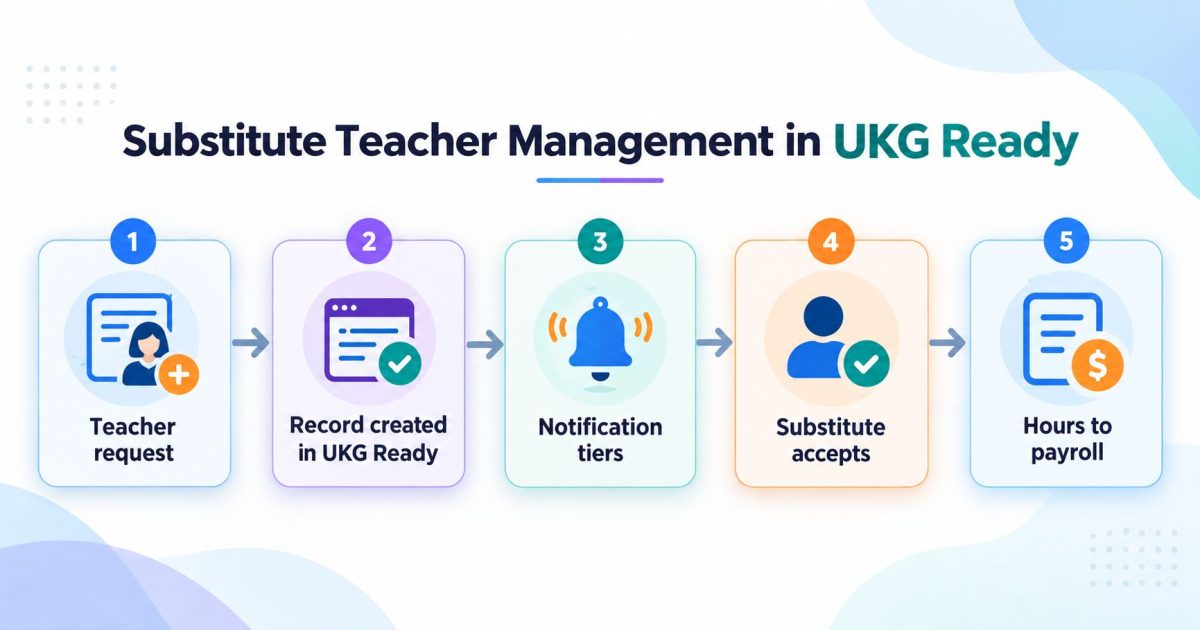
Substitute Teacher Management in UKG Ready
Substitute teacher management is the process of turning a staff absence into a covered classroom. In UKG Ready, the absence record and the approval rules already exist. What sits on top is the dispatch process: who gets asked, in what order, and how the hours reach payroll with the right code.