A multi-site diagnostic laboratory needed STARK-compliant specimen-based incentive pay — but its LIS, UKG Ready, and Microsoft Dynamics were disconnected. CloudApper AI Platform for UKG built a compliant, auditable pay engine that connected all three systems and gave finance true cost-per-specimen visibility for the first time.



Table of Contents
STARK Law compliance for diagnostic lab incentive pay starts at the timecard: bonuses for specimen collectors must be tied only to work they personally performed, and payroll has to be able to prove it. A collector’s bonus can be based on the specimens they personally collected, but not on the revenue those specimens generated or the tests ordered as a result.

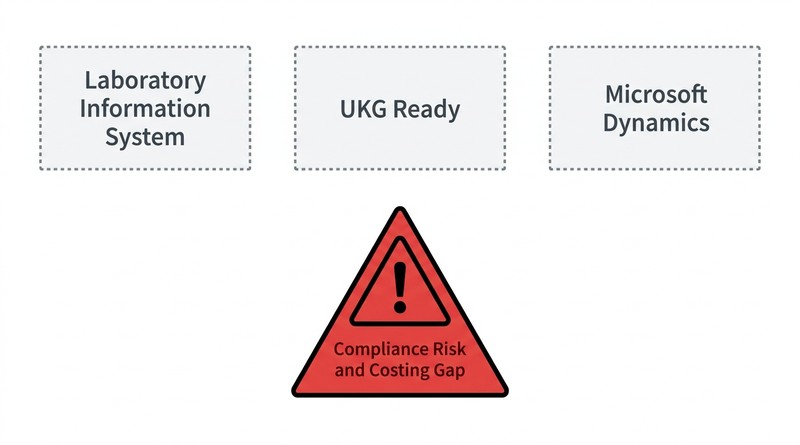
Holding that line takes connected data. At a multi-site diagnostic laboratory company, UKG Ready handled pay and timekeeping, the Laboratory Information System held specimen-level production data and Microsoft Dynamics held financials, with no connection between them. Every variable pay calculation happened by hand, which added compliance risk and left the true cost per specimen unknown.
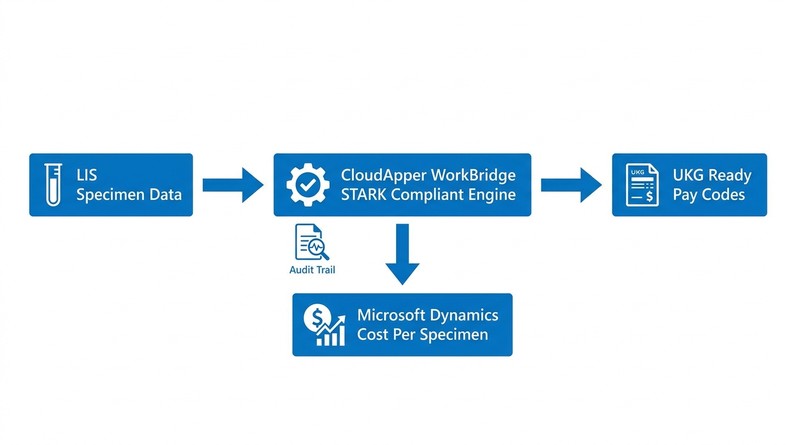
CloudApper built a STARK-compliant pay engine through CloudApper AI Platform for UKG that ingests specimen data from the LIS, applies tiered bonuses strictly to personally performed work and posts the resulting pay codes to UKG Ready with a complete audit trail.
Why Three Disconnected Systems Create Both a Compliance Problem and a Costing Problem
The compliance risk in this scenario is not hypothetical. When variable pay calculations happen in spreadsheets — pulling data from one system, applying logic manually, and entering results into another — the audit trail is whatever someone wrote down. If a regulator or auditor asks how a bonus was calculated, the answer is a spreadsheet and the person who built it. That is not a defensible position for an organization operating under STARK.
The costing problem is equally significant but less visible. Diagnostic labs operate on narrow margins. Understanding the true cost per specimen — including the labor cost of collection — is essential for pricing contract services, evaluating operational efficiency, and making decisions about staffing levels across sites. When specimen data lives in the LIS, labor cost data lives in UKG Ready, and financial reporting lives in Microsoft Dynamics, no single system can answer the question “what did it cost us to collect this specimen?” without a manual reconciliation process that is both time-consuming and imprecise.
The two problems compound each other. A manual pay calculation process that exists because the systems aren’t connected is the same process that makes cost-per-specimen invisible. Solving one requires solving both — which means the systems need to be connected, and the connection needs to be designed with compliance requirements built into the data flow, not bolted on afterward.
As discussed in the context of payroll penalty exposure for UKG users in regulated environments, the cost of compliance failures in healthcare consistently exceeds the cost of building compliant systems from the start. For diagnostic labs, where STARK violations carry both civil monetary penalties and potential exclusion from federal healthcare programs, that calculus is not close.
How CloudApper Built the Compliance Layer
The architecture CloudApper implemented treats the Laboratory Information System as the authoritative source for what work was personally performed, and UKG Ready as the system of record for how that work is compensated. CloudApper AI Platform for UKG sits between them as the calculation and compliance engine.
The data flow works as follows. At configured intervals, CloudApper ingests specimen-level records from the LIS — each record tied to a specific employee, a specific specimen type, a specific collection date, and a specific location. CloudApper cross-references this against the employee’s UKG Ready timecard to confirm the work occurred during a scheduled shift. It then applies a tiered bonus structure based exclusively on personally performed specimen counts — with no reference to revenue, test orders, or any downstream economic activity. The resulting bonus amounts are written back into UKG Ready as pay codes, with a complete record of the calculation inputs attached to each entry.
The audit trail this produces is not incidental — it is the point. Every bonus payment in UKG Ready links directly to the specimen records that justified it, the calculation logic that was applied, and the timecard data that confirmed the work was performed. If a compliance review occurs, the answer to “how was this bonus calculated?” is not a spreadsheet. It is a structured, timestamped record in the system.
“If a compliance review ever asks how we calculated a bonus, I can pull the answer in minutes. Every specimen, every pay calculation, every timecard confirmation — it’s all there. That’s not something we could say before.”
— Compliance Officer, Multi-Site Diagnostic Laboratory
A second element of the implementation addressed employee visibility. A performance tile embedded in the UKG mobile app gives employees real-time access to their specimen collection rate for the current period, their current bonus tier, and how close they are to the next threshold. For frontline lab staff, this kind of transparency functions as a direct productivity motivator — employees can see in real time how their work translates to compensation, without waiting for a paystub or asking a supervisor. That visibility did not exist before, because the data required to produce it lived in a system employees had no access to.
The Microsoft Dynamics integration, handled through CloudApper iPaaS, completed the picture from a financial reporting standpoint. With specimen-level labor cost data now flowing from CloudApper into Dynamics, finance leadership gained the ability to calculate true cost-per-specimen for the first time — by collection site, by specimen type, and by employee category. That data feeds directly into contract pricing decisions and operational efficiency reviews in a way that manual reconciliation never could.
The Broader Lesson for Diagnostics and Laboratory HR Leaders
The situation this organization faced — compliance-sensitive incentive pay calculated manually across disconnected systems — is not unusual in the diagnostic laboratory sector. Labs that have grown through acquisition often operate with LIS platforms that predate their current HR system by a decade. Pay structures that were designed when the organization was smaller become harder to administer as headcount and sites multiply. And the compliance requirements don’t simplify as the organization grows; they become more consequential.
UKG Ready is a capable platform for managing the workforce data side of this equation — timekeeping, scheduling, accruals, and pay code management. What it is not designed to do is ingest specimen-level production data from a laboratory information system, apply STARK-specific calculation constraints, and produce a defensible audit trail that ties every pay code back to a specific unit of personally performed work. That requires a layer specifically built for the purpose, as described in the broader context of connecting UKG to the operational systems that drive variable pay.
What CloudApper’s approach demonstrates is that building that layer does not require replacing UKG Ready or the LIS. Both systems continue to do what they do well. CloudApper handles the translation between them — ensuring that the specimen data in the LIS becomes the correct pay code in UKG Ready, with every calculation step documented and every STARK constraint enforced in the logic itself rather than in a manual review process that is only as reliable as the person performing it.
For compliance and HR leadership at diagnostic organizations, the practical implication is that STARK-compliant incentive pay is not an HR configuration problem. It is a data architecture problem. And the organizations that solve it correctly — by building a structured, auditable connection between their production system and their payroll platform — end up with something their peers do not: the ability to prove compliance, calculate true operational costs, and motivate frontline productivity simultaneously. Those three outcomes, from a single integration, represent a meaningful operational advantage in a sector where margins are tight and regulatory exposure is real.
If your diagnostic laboratory or healthcare organization manages specimen-based incentive pay, performance bonuses tied to clinical productivity, or other variable compensation that must comply with STARK Law or similar federal constraints, CloudApper can help you build a compliant, auditable pay engine within your existing UKG environment. Contact the CloudApper team to start the conversation.



October 15, 2026
Health and Welfare Pay for Military Base Stores: How a Retailer Made Every H&W Hour Traceable in UKG
A national specialty retailer with stores on US military installations moved health and welfare pay out of spreadsheets. CloudApper now applies the 40-hour weekly cap, multi-store proration and employer cost recovery against UKG time data, posting H&W pay codes to each timecard with a trail back to the hours.

September 30, 2026
When Your Best Candidates Already Worked for You: How a 50,000-Employee Home Care Organization Automated Rehire Campaigns and Geographic Filtering in UKG Pro
A 50,000-employee home health care organization extended UKG Pro Recruiting with CloudApper AI Recruiter to add geographic zip-code filtering, automated rehire outreach campaigns for former employees, and blind-ranking — reducing recruiter workload and improving hiring quality at scale.

September 29, 2026
If Your HR Events Aren’t in Slack, They Don’t Exist: How a 260-Person HR Tech Company Connected UKG Ready to Where Work Actually Happens
A 260-person HR tech company with a Slack-first culture connected UKG Ready lifecycle events to Slack using CloudApper iPaaS — so new hires, promotions, and PTO approvals appear where the organization already pays attention.

September 28, 2026
4 Integrations, One Migration Window: How a Healthcare Products Distributor Kept Every Critical System Live When They Moved to UKG Pro
A healthcare products distributor migrating from ADP to UKG Pro built four critical enterprise integrations at go-live using CloudApper iPaaS — not after cutover. Here is how treating integrations as a parallel workstream changed what migration day actually meant.