Child labor hour limits are usually built into UKG schedules, but violations happen at the punch. Learn the federal rules for 14 to 17 year olds, how UKG Pro WFM and UKG Ready handle minor rules, and how CloudApper AI TimeClock adds age-based checks on an affordable tablet clock.


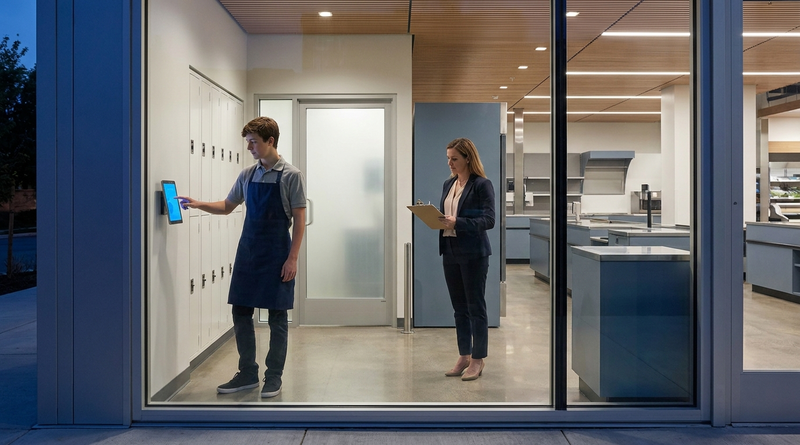
Table of Contents
- The Rules the Clock Has to Respect
- What UKG Handles Natively
- Where the Friction Shows Up
- What to Fix Inside UKG First
- Where the Clock Becomes the Control Point
- CloudApper AI TimeClock for Minor Compliance
- Frequently Asked Questions
The schedule was compliant. The punch wasn’t. A 15-year-old cashier was scheduled until 6:45 p.m. on a Tuesday, a coworker called out, and she stayed to cover until 8:10. Federal rules end school-day work for 14 and 15 year olds at 7 p.m. outside summer, and the clock accepted the punch anyway. For UKG retailers, CloudApper AI TimeClock adds a check at that exact moment, on a tablet at the punch point.
The Rules the Clock Has to Respect
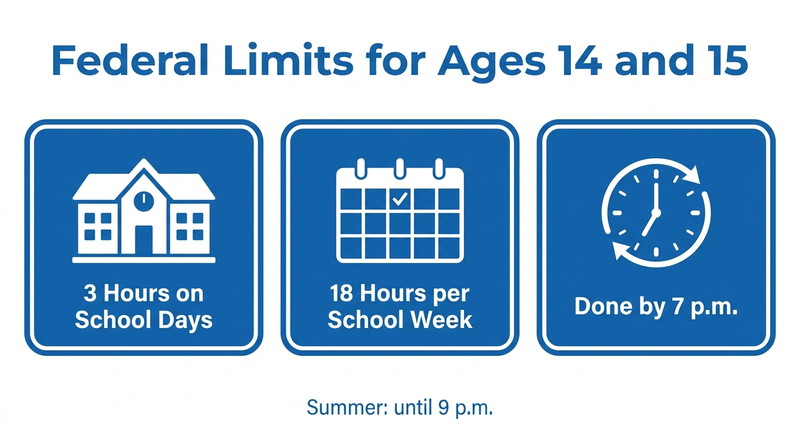
Under the FLSA child labor regulations at 29 CFR 570.35, 14 and 15 year olds may work no more than 3 hours on a school day and 18 hours in a school week, and only between 7 a.m. and 7 p.m. (9 p.m. from June 1 through Labor Day). Workers aged 16 and 17 have no federal hour limits, but Hazardous Occupations Orders bar them from tasks such as operating power-driven meat slicers, bakery mixers and balers. Many states add stricter rules. Bloomberg Law reported that documented child labor violations rose about 50% in fiscal 2023, with DOL penalties near $8 million.

What UKG Handles Natively
UKG Pro WFM includes minor rules and school calendar configuration in scheduling, so managers are warned when a shift for a minor breaks a daily, weekly or time-of-day limit. UKG Ready supports scheduling restrictions that prevent early check-ins, and both platforms keep the punch history needed to answer a DOL wage and hour audit.
Where the Friction Shows Up
Violations rarely start in the schedule. They start at shift end, when a minor stays late to help, or at a shared retail kiosk during a busy weekend. Hazardous tasks follow the same path: a 16-year-old transfers to the deli, and the slicer is the job. Seasonal hiring multiplies the exposure.
What to Fix Inside UKG First
Load school calendars and minor rules for each state, then review violation reports weekly with store managers. Pair schedule rules with predictive scheduling settings where they overlap, and set up job codes so restricted tasks are clearly labeled.
Where the Clock Becomes the Control Point
Schedule rules catch planned violations; unplanned ones happen at the punch. For retailers adding clocks for seasonal staff, more dedicated InTouch DX terminals is often where the budget stops. CloudApper AI TimeClock fits here as a tablet option at roughly 25% of the cost of traditional UKG clocking hardware.
CloudApper AI TimeClock for Minor Compliance
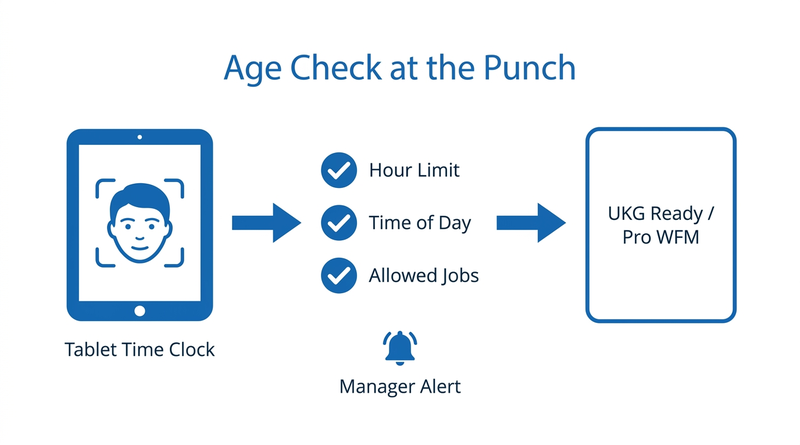
CloudApper AI TimeClock turns any Android tablet or iPad into a biometric time clock that syncs directly with UKG Ready and UKG Pro WFM. It can restrict punches by schedule, warn a minor and alert a manager as a time limit nears, and filter job transfers so restricted tasks never appear for under-18 employees. Facial recognition confirms the person punching is the minor on the schedule, and fast enrollment for seasonal hires keeps summer onboarding moving.
Frequently Asked Questions
Q: How many hours can a 15-year-old work on a school day?
Under federal rules at 29 CFR 570.35, 14 and 15 year olds may work up to 3 hours on a school day and 18 hours in a school week. State law may set stricter limits.
Q: What time must 14 and 15 year olds stop working?
Federally, they may work only between 7 a.m. and 7 p.m., extended to 9 p.m. from June 1 through Labor Day.
Q: Does UKG support minor labor rules?
Yes. UKG Pro WFM includes minor rules and school calendar configuration in scheduling, which flags shifts that break hour or time-of-day limits for minors.
Q: Can a time clock stop minors from working past legal hours?
Yes, with schedule-based punch restrictions. CloudApper AI TimeClock can restrict punches, warn employees and alert managers before a limit is reached.
Q: Which jobs can 16 and 17 year olds not do?
Federal Hazardous Occupations Orders bar them from tasks such as operating power-driven meat slicers, bakery mixers, balers and compactors.
If minor hour limits stop at the schedule, see how CloudApper AI TimeClock adds that check on a UKG-connected tablet at the CloudApper AI TimeClock for UKG page.



October 13, 2026
Security Screening and Bag Check Time in UKG: Where Post-Shift Minutes Become Payable
Exit bag checks and security screening can be paid time under California and Pennsylvania law. Learn how UKG Ready and UKG Pro WFM handle screening time, what to configure first, and how CloudApper AI TimeClock places an affordable tablet clock past every checkpoint.
October 12, 2026
Donning and Doffing Time in UKG: Where the Workday Starts for PPE-Heavy Crews
Donning and doffing PPE can be compensable time under the FLSA. Learn how UKG Ready and UKG Pro WFM handle it natively, what to configure first, and how CloudApper AI TimeClock puts an affordable tablet time clock in every changing room so the first punch matches the start of the workday.
October 9, 2026
Biometric Time Clocks in Canada: Quebec Law 25, PIPEDA, and Provincial Rules for UKG Sites
Biometric time clock rules in Canada change at provincial borders. Learn what Quebec Law 25 and its 60-day CAI notice require, when PIPEDA applies, how Alberta and BC PIPA treat employee information, and a five-step plan for consent and audit at UKG sites using Intouch devices or CloudApper AI TimeClock.

October 8, 2026
Locking a Tablet Down as a Dedicated UKG Time Clock: Kiosk Mode with Jamf, Intune, and Android Enterprise
IT's first objection to a tablet time clock is that someone will misuse it. Learn how to lock an iPad or Android tablet into a dedicated UKG time clock with Jamf, Intune, or Android Enterprise, a five-step day-one checklist, and what IT should manage after go-live alongside Intouch DX devices.