A school-based services nonprofit pays ten-month staff over twelve months, and the pay spread math lives in a fragile spreadsheet. CloudApper adds a pay spread engine to UKG Ready that splits school-year earnings across every pay period, recalculates mid-year changes and handles true-ups when staff leave.



Table of Contents
Every June, a school-based services nonprofit faces the same payroll question. Its counselors, aides and program specialists work inside partner schools, so when classrooms close, their hours stop. Their paychecks are expected to keep coming through July and August. With UKG Ready as the foundation for time and payroll, what the organization needs is a reliable way to take ten months of earnings and pay them out over twelve. CloudApper handles that calculation as an extension on top of UKG Ready, so the logic no longer has to live in a spreadsheet.
Why Pay Spreading Lived in a Spreadsheet
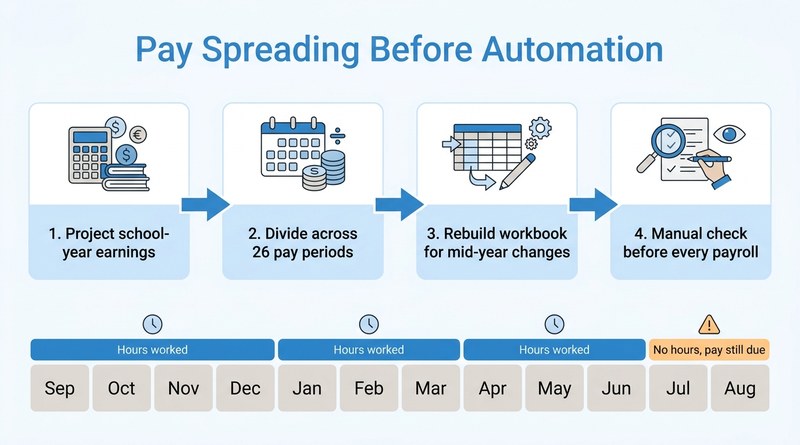
Pay spreading sounds simple until you run it for a few hundred people. Each employee’s school-year earnings have to be projected, divided across every pay period in the year, and adjusted whenever something changes: a mid-year hire, a February raise, a leave of absence, a resignation in April. That logic is a custom business rule specific to the school calendar, so the payroll team kept it in a workbook and rebuilt and checked it by hand before every cycle.

As the HR/Payroll Lead at the nonprofit put it, “It’s just like an Excel spreadsheet that the old CFO made… In my mind, I feel like it’s a percentage. But when I kind of test it out, it doesn’t always work out perfectly.”
Mistakes are expensive. An underpaid employee comes up short in summer, and one who leaves mid-year may already have been paid through breaks they had not yet earned.
Building the Pay Spread Engine on Top of UKG Ready
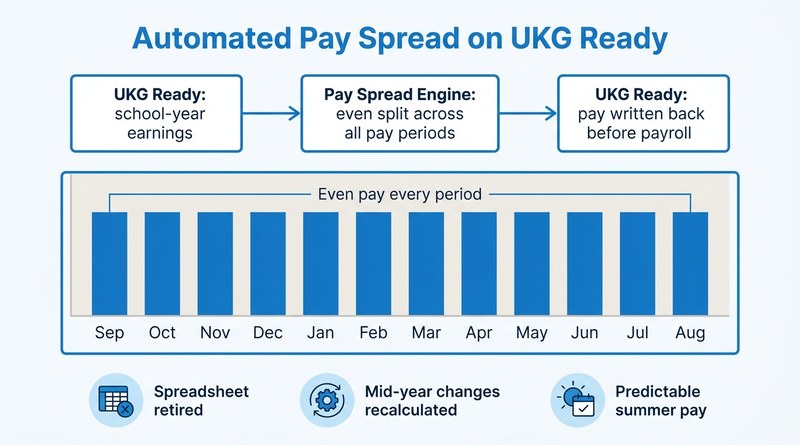
CloudApper connects a custom pay spread engine directly to UKG Ready using CloudApper AI for UKG Personalization. The engine reads each employee’s school-year earnings from UKG Ready, calculates an even distribution across all pay periods, including the summer months when no hours are recorded, and writes the result back into UKG Ready before payroll runs. UKG Ready stays the system of record, and the payroll team reviews everything in the screens it already uses. The HR/Payroll Lead wants each employee’s banked balance to be visible along the way.
“That’s mostly my idea of having a bucket for them that we can visually see.”
HR/Payroll Lead, school-based services nonprofit
CloudApper has used the same pattern for other custom earnings rules, from piecework pay at a large manufacturer to retro pay corrections. The business rule lives in a dedicated engine, and the payroll record stays in UKG.
What Changes for Payroll and for Staff
The design takes the workbook out of the cycle. When a rate changes mid-year, the engine recalculates the spread for the remaining periods on its own. When someone resigns or changes roles, it compares what was earned with what was already paid, so the true-up does not have to be rebuilt by hand.
“It’s kind of like our way of assisting them and allowing them to get paid through this summer instead of forcing them to find a second job.”
HR/Payroll Lead, school-based services nonprofit
For employees, the goal is predictable income. Many school-based staff are hourly or modestly paid, and a short check in August is a real problem for a household budget.
“It’s more confusing now that a lot of the people that created the system, they’re not here anymore.”
HR/Payroll Lead, school-based services nonprofit
The Lesson for Every School-Calendar Employer
School districts, education nonprofits and contractors that place staff in schools all run on the same calendar. Many already use UKG for time tracking across school buildings and regional substitute and absence management. Pay spreading is often the last school-calendar process still running outside the platform.
If that describes your organization, start with three questions. Who owns the spreadsheet today, and what happens if they leave? How does the spread respond to a mid-year rate change? And how are hours outside the base schedule handled? Under the federal overtime rules, overtime generally has to be paid on the regular payday for the period in which it was earned, so any spread logic needs to keep deferrable base pay separate from overtime that has to be paid right away. CloudApper builds that kind of rule into the engine itself, not into a workbook.
If your organization pays school-year staff over twelve months and the math still lives in a spreadsheet, talk to CloudApper about extending UKG Ready to handle it automatically, without changing how your payroll team works.



October 19, 2026
UKG Pro WFM Project Time Tracking for Global Agencies: One Activity Profile, Two Approval Lines, Five Languages
A global agency on UKG Pro WFM has to tie every hour to a client, project and task, across hourly, salaried, on-site and warehouse staff in five languages. This piece looks at the visibility and approval problems underneath, and how CloudApper adds a role-based time entry layer while UKG stays the system of record.

October 6, 2026
Union Vacation Accrual in UKG Ready: How Manager Self-Service Keeps Time-Off Approvals Contract-Compliant
Union contracts decide how vacation accrues and what managers may approve, yet approvals rely on the balance on screen. For a unionized envelope and packaging manufacturer moving to UKG Ready, CloudApper calculates CBA tenure tiers and carryover caps and posts contract-accurate balances that managers approve against.

September 25, 2026
Substitute Teacher Management in UKG Ready
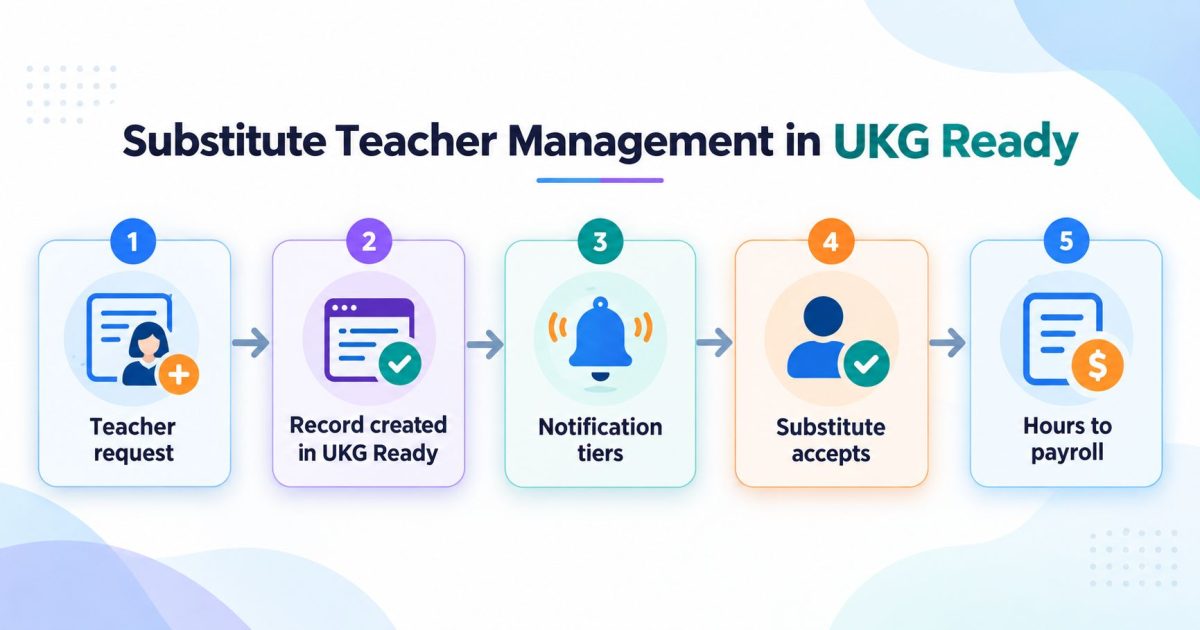
Substitute teacher management is the process of turning a staff absence into a covered classroom. In UKG Ready, the absence record and the approval rules already exist. What sits on top is the dispatch process: who gets asked, in what order, and how the hours reach payroll with the right code.

August 25, 2026
Manager Self-Service in UKG Pro Built for SOX: Why the Delegation Matrix Comes Before the Forms
Enterprises have automated parts of the workforce change process, but the parts are scattered across email, chat, the HCM and a ticket queue, so the control exists while its evidence does not. Here is why SOX-ready manager self-service in UKG Pro starts with the delegation matrix, and how CloudApper adds a leader portal inside UKG Pro.