Eleven districts drawing substitutes from one regional labor market through eleven disconnected systems leave classrooms uncovered while neighbors have subs to spare. Here is why intermediate school districts should consolidate the coordination layer rather than the policy, and how CloudApper keeps every district's contract rules intact on UKG.



Table of Contents
- Why Fragmentation Persists in Regional Structures
- Consolidating Coordination, Not Policy
- What Regional Consolidation Actually Changes
- What ISDs Should Require Before Consolidating
A substitute teacher shortage looks like a staffing problem. In districts organized under a regional service agency, it is often something else: a coordination problem wearing a staffing problem’s clothes.

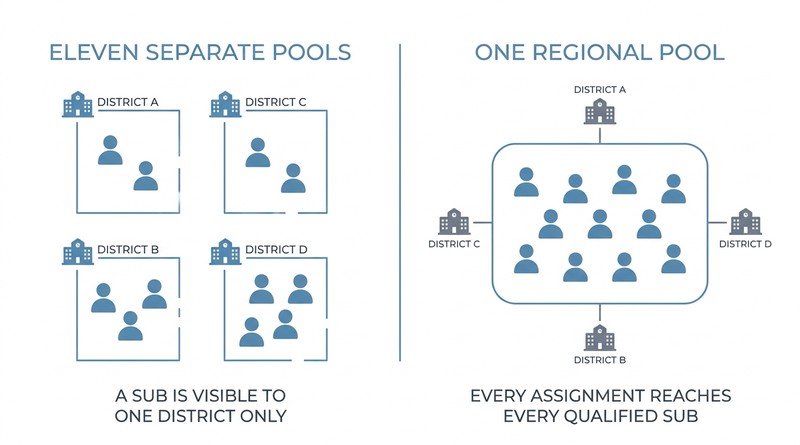
Consider what happens when eleven neighboring districts each run their own absence management. A substitute who is qualified to cover a middle school science class in one district is invisible to the district four miles away that needs exactly that coverage tomorrow morning. Each district maintains its own sub list, its own calling routine, and its own relationship with the same regional pool of people. On any given morning, one district leaves a classroom uncovered while a neighbor has three available subs it does not need.
Nobody designed that. It accumulates, one district at a time, because absence management has always been purchased and operated at the district level even when the labor pool is regional.
Why Fragmentation Persists in Regional Structures
Intermediate school districts and regional education service agencies exist precisely to consolidate what individual districts cannot run efficiently alone. Special education services, transportation, professional development, and business services are routinely operated at the ISD level. Absence and substitute management usually is not, and the reasons are structural rather than strategic.
Each member district typically has its own contracts, its own accrual rules, and its own payroll calendar. Some run ten-month employee groups; others carry twelve-month staff on different accrual accumulations. Building administrators have their own preferences about which substitutes they want in their classrooms, and those preferences are legitimate rather than obstructive. A regional solution that flattened all of it would fail on contact with the first collective bargaining agreement.
So districts keep their own systems, and the ISD ends up coordinating across tools rather than operating one. Reconciliation becomes the ISD’s job: substitute pay flowing through eleven payrolls, absence data landing in eleven places, and no consolidated view of coverage anywhere in the region.
An intermediate school district buying on behalf of eleven constituent districts sits in exactly that position. Each local district can sign on its own and keeps its own contracts, so the workable approach is not to ask member districts to standardize but to consolidate the coordination layer beneath them while leaving each district’s rules intact. The distinction matters politically as much as technically.
The [district] seeks to both improve service and lower costs. Lower costs could be achieved through direct savings, reduced staff time, or a combination of the two.
Director of Purchasing, regional intermediate school district
Consolidating Coordination, Not Policy
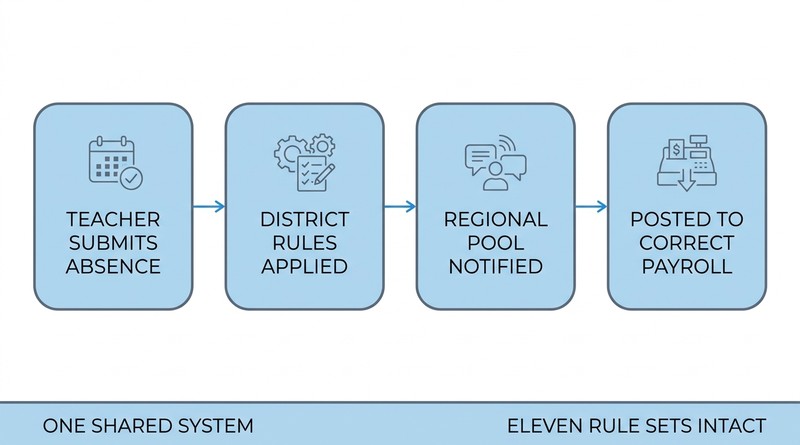
CloudApper SubConnect is designed as a shared substitute placement and absence management layer across member districts, built on UKG and connected to the PowerSchool ERP that runs district payroll. A teacher submits an absence in their own district under their own contract rules. The placement engine identifies qualified and available substitutes across the whole regional pool, applies that district’s preferred-substitute routing and direct-assign rules, notifies candidates, and posts the accepted assignment to the correct payroll for both the absent teacher and the substitute.
What each district experiences is its own process. The ISD’s Director of Purchasing set that expectation in writing, asking for a system that “allows for the creation of district and school-level preference lists and even lets teachers pick their preferred substitutes.” What the region gains is a single pool and a single reconciliation path.
Alongside it, CloudApper hrPad handles time capture across member district buildings, including staff who leave for field work and return, which matters more to substitute management than it sounds. Substitute and extra-duty pay is among the most error-prone categories in district payroll because the work is irregular by definition. Capturing it at the building, tied to the assignment that generated it, removes the downstream correction cycle that otherwise lands on business office staff. The same logic applies to the extra-duty approval workflows that districts have historically run on paper.
Any time tracking system under consideration must meet several critical requirements. These include the ability to interface existing software platforms such as substitute staff assignment systems, employee attendance systems, and the PowerSchool ERP.
Director of Purchasing, regional intermediate school district
What Regional Consolidation Actually Changes
The first effect is fill rate, and it comes from arithmetic rather than technology. A substitute pool of a given size fills more assignments when every assignment can reach every qualified member of it. Eleven separate pools drawn from the same regional labor market are, in aggregate, less effective than one, and the difference shows up as covered classrooms.
The second effect is on the substitutes themselves, who are the group most often left out of this analysis. Substitute teaching is contingent work with irregular income. A substitute registered with three districts has to monitor three systems and answer three sets of calls to assemble a full week. Regional visibility means more available work reaching them with less effort, which is the difference between substitute teaching being viable and being a fallback. Districts competing for the same scarce pool tend to overlook that the pool’s experience determines its size next year.
The third effect is administrative and lands on the people who feel it most. Campus secretaries and building administrators spend a meaningful share of early morning on coverage, and that time is unrecoverable. Automating placement returns it, which is the same return districts see when they automate reference checking for district hiring or when a district gives principals their time back by removing a manual process from their morning.
What ISDs Should Require Before Consolidating
Regional consolidation fails when it is attempted as standardization. If you are evaluating this for a service agency, a few requirements protect the arrangement.
District rules must remain district rules. Preferred-substitute routing, direct-assign rights, seniority provisions, and accrual treatment differ by contract and must be configurable per district rather than harmonized into a regional average.
Payroll must land in the right place automatically. Substitute and absence pay has to post to the correct district’s payroll with the correct codes without a reconciliation step, or the ISD has simply moved the manual work upstream.
Ten-month and twelve-month employee groups must both be handled natively. Accrual behavior across a summer is where district payroll processes most often break, and a regional system that handles only one calendar shape will need workarounds within a year.
Building-level discretion must survive. Administrators who lose the ability to request a specific substitute will route around the system, and a bypassed system produces worse data than the paper process it replaced.
These are the same requirements individual districts face when they move off a legacy substitute vendor, which is why single-district deployments of substitute request automation in UKG and regional ones share most of their configuration work. The difference is multiplicity, not kind, and the districts that have already worked through absence coverage automation on their own tend to be the easiest members to bring into a regional pool.
The Broader Case for the Service Agency Model
Regional education service agencies were created on the premise that some functions are too expensive for a single district to run well. Substitute management has quietly become one of them. Legacy vendor costs, the administrative load of maintaining a pool, and the coverage penalty of pool fragmentation are all costs that shrink when eleven districts operate one system rather than eleven.
The organizations that will manage the substitute shortage best are not the ones that pay the most per assignment. They are the ones that stopped letting district boundaries determine which classrooms get covered. For an ISD, that is a direct extension of the mandate it already has.
The CloudApper AI Platform for UKG exists for requirements like this one: specific to a governance structure, a set of bargaining agreements, and a regional operating model, too particular to belong in any platform’s core, and too consequential to coordinate by phone at 6 a.m. CloudApper is the process layer that holds the work on top of UKG. The districts that move fastest are not the ones with the largest central offices. They are the ones that consolidated the coordination and left the policy alone.
If your service agency or district group is running separate absence and substitute systems on top of UKG, talk with the CloudApper team about consolidating placement across districts while keeping each district’s rules intact.



October 16, 2026
Public Holiday Substitution Rules Around the World: Why UKG Pro WFM Still Needs Manual Checks
New Zealand calls it Mondayisation, the UK calls it a substitute bank holiday, Canada calls it holiday pay in lieu, and the US calls it an observed holiday. Four names, four rules, and the same manual-check problem for global UKG Pro WFM deployments.


October 16, 2026
UKG Pro Position Management at a Food Producer: Who Sets the Defaults When 75 Employees Change Jobs Every Week
A large food producer moving to UKG Pro handles about 75 internal transfers a week. CloudApper automates the position defaults behind each move, including comp codes, cost centers, standard hours and union codes, through the UKG Pro API, with HR owning and updating the rules without opening a project.

October 15, 2026
Health and Welfare Pay for Military Base Stores: Making Every H&W Hour Traceable in UKG
A national specialty retailer with stores on US military installations needs health and welfare pay it can defend. CloudApper applies the 40-hour weekly cap, multi-store proration and employer cost recovery against UKG time data, posting H&W pay codes to each timecard with a trail back to the hours.

September 30, 2026
Your Best Candidates Already Worked for You: Rehire Campaigns and Geographic Filtering in UKG Pro for Home Care
Large home care organizations hire at high volume across many territories, and former employees often re-enter the same pipeline as strangers. CloudApper AI Recruiter extends UKG Pro Recruiting with zip-code filtering, rehire outreach campaigns and blind ranking, so coordinators see the strongest local candidates first.