A large manufacturer moving to UKG Pro WFM runs its pay-for-performance piecework model on decades-old PL/SQL inside its MES. Here is why that logic is the riskiest part of the migration and how CloudApper AI Platform for UKG moves the math into a decoupled engine that posts results to UKG.



Table of Contents
A large manufacturer moving to UKG Pro WFM needs to retire thirty years of piecework pay code without losing its pay-for-performance culture. Pre-go-live conversations usually center on scheduling, compliance and time capture. What gets underestimated is pay calculation logic that has run quietly for decades inside a legacy MES, a custom database or spreadsheets one person in payroll understands.

At this manufacturer, that logic lives in more than thirty pages of PL/SQL inside a legacy manufacturing execution system, and only an estimated 20 to 30 people still understand it because most of the original experts have retired. Keeping the piecework culture is not in doubt. Getting the pay math out of a system the company wants to return to simply capturing events is the real task.
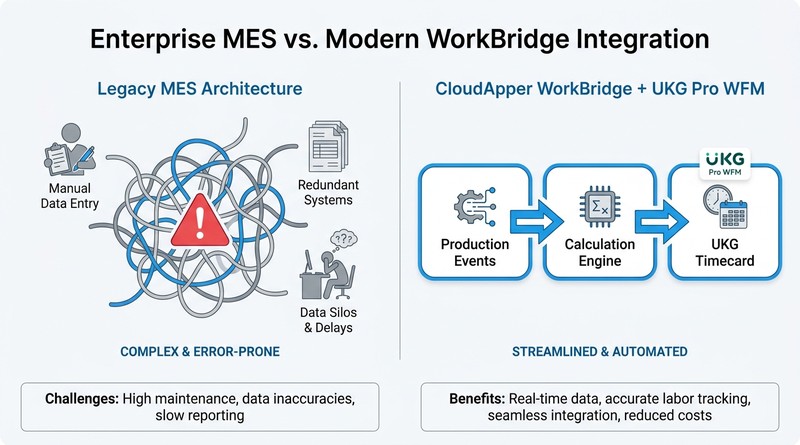
CloudApper’s approach positions CloudApper AI Platform for UKG as a dedicated piecework calculation engine between the MES and UKG Pro WFM. The more important decision comes first: recognizing that this pay logic belongs in its own maintainable layer rather than inside WFM configuration.
Why Piecework Pay Is the Last Thing UKG Touches, and the First Thing That Breaks During Migration
Pay-for-performance manufacturing cultures are built over years. They shape how employees think about their work, how supervisors manage their teams, and how finance models labor costs. A piecework system that pays employees based on units produced, factoring in multipliers, shift premiums, team proration, indirect time categories, and minimum wage guarantees, is not a payroll feature. It is a business philosophy that happens to run through payroll.
UKG Pro WFM is an extraordinarily capable platform for scheduling, timekeeping, leave management, and labor cost analysis. Custom pay calculation logic that a manufacturer built over multiple decades to reflect its compensation model is a different kind of requirement: a specialized calculation engine tied to unique labor economics. Treating it as a custom business rule that builds on UKG, rather than assuming the platform migration will absorb it, is what keeps the risk under control.
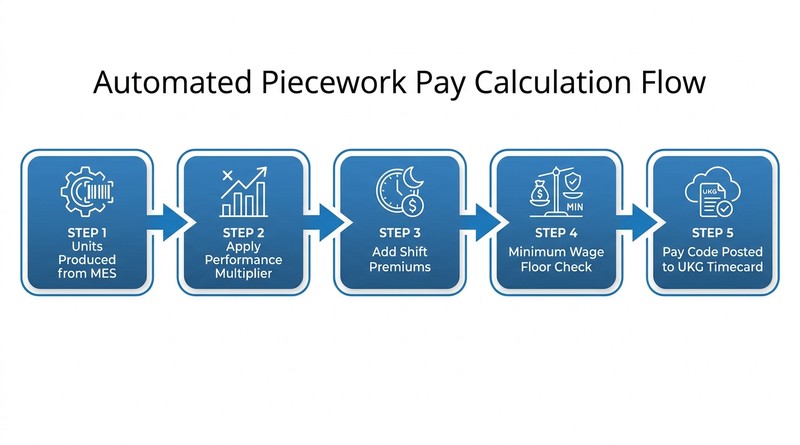
In this company’s case, the piecework formula multiplies units produced by a piecework price, applies a company-wide dollar multiplier introduced decades ago to manage inflation, prorates team earnings by hours on the job, and then layers shift premiums, indirect time for non-production hours, and a minimum wage and base-rate guarantee for any period where calculated earnings fall short. Every one of those elements requires data that lives in the MES, such as job start and end times, units produced, scrap counts and team assignments, not in UKG.
The original PL/SQL code has calculated all of this for decades. Migrating to UKG Pro WFM without a plan for that logic would mean either forcing it into standard pay rule configuration or redesigning the pay plan. Neither is acceptable.
Decoupling the Math from the System
The approach CloudApper takes is architectural rather than configurational. Rather than pushing piecework calculation into UKG Pro WFM pay rules, CloudApper AI Platform for UKG acts as a fully decoupled calculation layer between the two systems. The MES goes back to what it does best: capturing production events. UKG Pro WFM does what it is designed for: managing workforce records and payroll. CloudApper sits in the middle and owns the math.
The integration works on a webhook model. When a production event occurs in the MES, such as a job start, a job completion, a unit count or a scrap entry, the event is sent to CloudApper in real time or as an end-of-shift batch. CloudApper applies the full piecework calculation logic: unit counts, the dollar multiplier, team proration rules, indirect time, shift premiums, and the minimum wage and base-rate checks. The result is a pay amount attached to the correct pay code, posted to the employee’s UKG Pro WFM timecard.
From a payroll processing perspective, the timecard works the way payroll expects. From an audit perspective, every calculation is designed to be logged, traceable and explainable, which is a very different position from PL/SQL that only a shrinking group of people can read.
An additional element of the design is a piecework audit tile embedded in UKG. Employees and supervisors can see the jobs worked, units posted, multipliers applied and resulting pay without waiting for a paystub. In a culture built on pay-for-performance, that transparency is not cosmetic. It is part of how people understand their relationship to the work.
As described in the broader context of customizing UKG Pro without disrupting future updates, the most sustainable approach is always to build custom logic outside the core platform rather than inside it, so that platform updates don’t break business-critical calculations.
What This Means for Other Manufacturers Considering UKG Pro WFM
The problem this company faces is not unusual. Manufacturing organizations that have operated for decades have almost certainly built pay calculation logic somewhere it was never supposed to live permanently: an MES, an ERP, a set of Access databases, a collection of Excel macros. That logic reflects years of negotiation, iteration, and institutional knowledge. It works. And it will not survive a platform migration unless someone plans for it deliberately.
The standard advice in WFM implementation circles is to simplify pay rules before go-live. That advice is often correct for rules that exist because of organizational complexity that no longer applies. It is almost never correct for rules that exist because of a workforce agreement or a compensation philosophy. Simplifying a piecework multiplier to make an implementation easier is not a configuration decision. It is a labor relations decision with real downstream consequences.
CloudApper’s approach rests on the view that the alternative to simplification is not manual workarounds or months of delay. CloudApper AI Platform for UKG creates a structured, maintainable layer for exactly this category of problem: pay logic that is too specific for standard WFM configuration, but too important to abandon or approximate. The logic is preserved, documented, and decoupled from both the legacy system and the new platform, which means it survives future upgrades on both sides.
For IT and HRIS teams managing UKG Pro WFM implementations at manufacturing sites, the practical takeaway is to treat pay calculation logic as a distinct workstream in the implementation plan, not an assumption that the platform will absorb. CloudApper iPaaS and the CloudApper AI Platform for UKG platform are specifically designed for this category of requirement, extending UKG’s capabilities without modifying its core, and creating clean, auditable data flows between production systems and the WFM platform.
The manufacturer in this story does not want to simplify its pay culture to fit a new system. The approach preserves the culture and builds a system that can support it: retiring thirty years of pay logic while carrying every calculation rule forward, with a cleaner architecture, a more auditable process, and a workforce that can see exactly how its earnings are calculated inside UKG.
For any manufacturing organization where compensation is tied to production output and workforce trust depends on pay accuracy, that goal is worth planning for from day one of the implementation.
If your organization is planning a UKG Pro WFM implementation and you have complex piecework, performance-based pay, or legacy calculation logic built around your own pay rules, CloudApper can help you assess the right approach before go-live. Reach out to the CloudApper team to start the conversation.



October 19, 2026
UKG Pro WFM Project Time Tracking for Global Agencies: One Activity Profile, Two Approval Lines, Five Languages
A global agency on UKG Pro WFM has to tie every hour to a client, project and task, across hourly, salaried, on-site and warehouse staff in five languages. This piece looks at the visibility and approval problems underneath, and how CloudApper adds a role-based time entry layer while UKG stays the system of record.

October 6, 2026
Union Vacation Accrual in UKG Ready: How Manager Self-Service Keeps Time-Off Approvals Contract-Compliant
Union contracts decide how vacation accrues and what managers may approve, yet approvals rely on the balance on screen. For a unionized envelope and packaging manufacturer moving to UKG Ready, CloudApper calculates CBA tenure tiers and carryover caps and posts contract-accurate balances that managers approve against.

October 1, 2026
12-Month Pay for 10-Month Employees in UKG Ready: Automating Pay Spreading for School-Based Nonprofits
A school-based services nonprofit pays ten-month staff over twelve months, and the pay spread math lives in a fragile spreadsheet. CloudApper adds a pay spread engine to UKG Ready that splits school-year earnings across every pay period, recalculates mid-year changes and handles true-ups when staff leave.

September 25, 2026
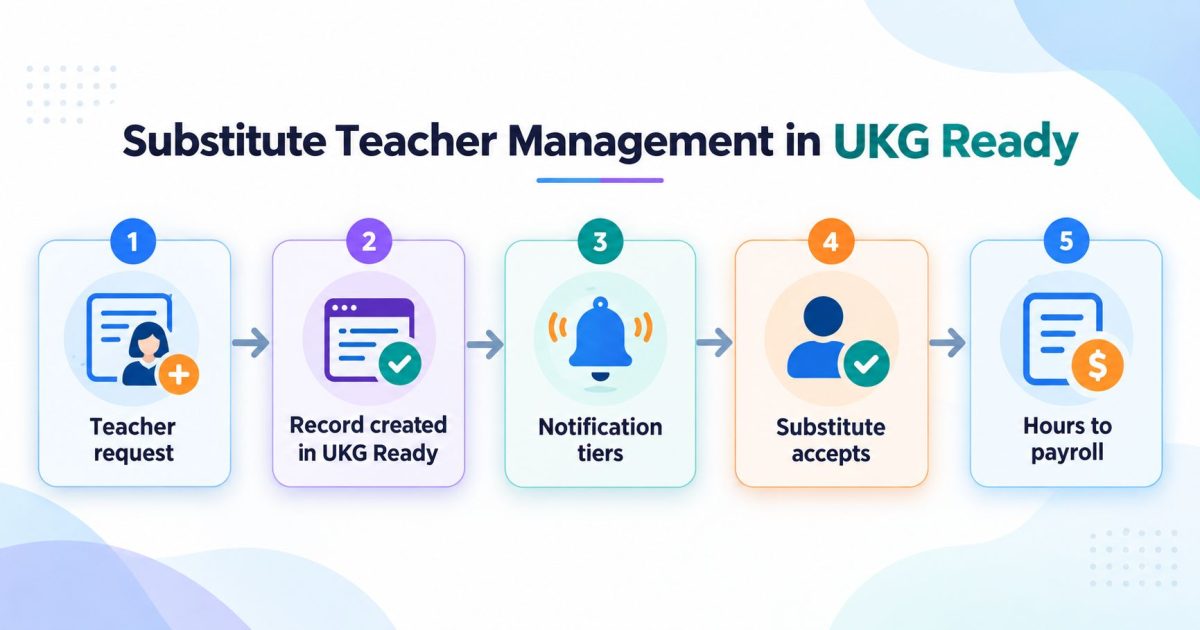
Substitute Teacher Management in UKG Ready
Substitute teacher management is the process of turning a staff absence into a covered classroom. In UKG Ready, the absence record and the approval rules already exist. What sits on top is the dispatch process: who gets asked, in what order, and how the hours reach payroll with the right code.