Paying by the piece does not remove the obligation to meet the minimum wage for every hour worked, and a floor check that runs on a sample is not a floor check. Here is why a resort paying housekeeping per room needs the comparison automated in UKG Pro WFM, and how CloudApper posts makeup pay before payroll closes.



Table of Contents
Piece-rate pay is one of the oldest ideas in workforce compensation and one of the least forgiving. Pay someone per unit of output and you align their earnings with their productivity, which works for both sides right up until the output is low. Then the arrangement runs into a floor it cannot see, and the employer, not the employee, is responsible for noticing.

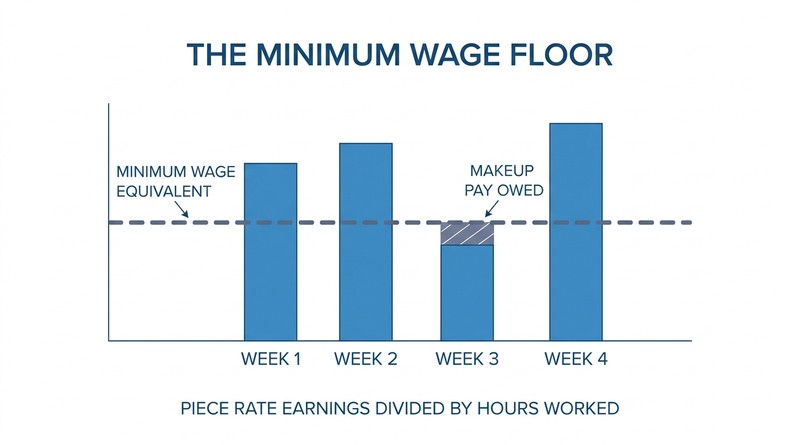
The floor is the minimum wage. Under the Fair Labor Standards Act, an employer paying by the piece still owes at least the applicable minimum wage for every hour worked in the workweek. If piece-rate earnings fall short, the employer must add makeup pay to close the difference. The obligation is unconditional. It applies to a slow shift, a difficult assignment, a new hire still learning the work, and a week when the volume simply was not there.
Every organization running piece rate knows this. The question is whether the check happens automatically or whether it depends on someone remembering to run it.
Why the Floor Check Gets Skipped
The calculation itself is not hard. Total piece-rate earnings for the week, divided by hours worked, compared against the applicable minimum. If the quotient is lower, the difference is owed.
What makes it fragile is that the check has to happen for every employee, every pay period, before payroll closes, and the answer is usually no. Most weeks, most employees clear the floor comfortably. A process whose output is almost always “no action required” is a process people stop performing carefully. It gets batched, eyeballed, sampled, or run only for the employees a supervisor flags.
The exposure concentrates exactly where the review is weakest. New hires have the lowest output and the highest likelihood of falling below. So do employees on unusually difficult assignments, and anyone whose hours were higher than their output justified. These are individually small amounts, which is why they go unnoticed, and they are also the amounts that accumulate into a back-wage finding covering every affected employee across the whole lookback period.
State law widens it further. Several states set minimums above the federal rate, and some require the floor to be evaluated per workday rather than across the week, a materially stricter calculation. Employers operating in more than one state are running more than one rule.
A Resort That Needs the Floor to Be Automatic
Consider a mid-size vacation resort that pays its housekeeping department per room cleaned. The model suits the work. Room attendants who are efficient earn more, the department can forecast labor cost against occupancy, and the staff generally prefer it to an hourly rate.
The resort’s exposure is the same one every piece-rate employer carries. On a low-occupancy week, or for a new attendant still building speed, per-room earnings can land below the minimum wage equivalent for the hours worked. Somebody has to catch that before the Monday afternoon payroll lock, and the in-house rate application behind the process is old enough that every rate change or new room type has needed IT involvement.
The inputs do not arrive on a clean schedule either. “The units don’t always get put in on the day they get cleaned… They sometimes don’t get put in till Sunday for the week, Monday through Saturday,” the resort’s Director of Resort HR said.
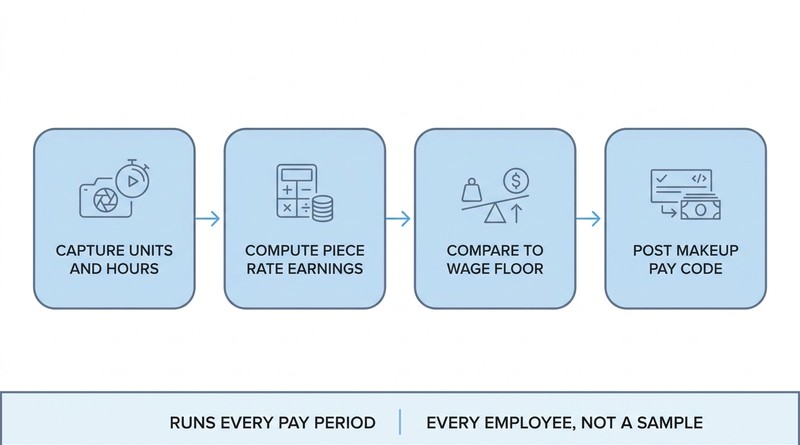
CloudApper’s approach is a piece-rate pay engine on top of UKG Pro and UKG Pro WFM. Room completion counts feed in against each attendant’s recorded hours, the engine computes total piece-rate earnings, compares them against the applicable minimum wage for those hours, and where earnings fall short it writes a makeup pay code directly onto the UKG Pro WFM timecard before payroll closes. UKG Pro and UKG Pro WFM remain the systems of record for time, earnings, and pay. The point of the design is that the floor check runs on every attendant, every period, without anyone deciding to run it.
The resort’s CTO described the intent in terms that had nothing to do with compliance. “We always want to give whatever works out best for the employee. If they’re cranking out units that’s worth more than their hourly rate, then that’s their incentive to crank out units that fast.”
That is worth sitting with, because it is the part most compliance conversations miss. An unreliable floor check does not just create legal exposure. It quietly changes how managers schedule. Supervisors who are unsure whether a new hire’s short week will be caught tend to keep new hires off the slow assignments, which slows their training and pushes the difficult work onto experienced staff. A manual process ends up shaping the schedule.
The Same Structure, Different Industries
This pattern is not specific to hospitality. Any organization paying for output rather than time carries the same obligation with the same failure mode. A large manufacturer running a decades-old piecework culture has to guarantee the floor beneath its incentive structure. An agricultural operation paying harvest productivity bonuses to field crews faces it across variable conditions and remote locations. Construction trades paying by square footage installed face it on every job.
In each case the enterprise platform holds what the calculation needs. Hours are in the timekeeping system. Output is in a production system, a property management system, or a job costing platform. Earnings codes are ready to receive a result. The piece that has usually never existed is the automated comparison between the two, executed every period with a record of what it found.
This is the class of requirement CloudApper AI Platform for UKG is built for. Not a report that tells payroll to go check something, but a rule that runs against the platform’s own data and posts its result as a pay code. Where the output data originates at the point of work, as room counts and job metrics usually do, CloudApper hrPad captures it alongside the punch so the comparison is working from the same record the employee generated rather than a tally reconstructed later.
What Automating the Floor Actually Buys
The obvious return is avoided liability, and it is real. Back-wage exposure on piece-rate work compounds quietly across employees and pay periods, and it surfaces at the worst possible moment, which is why audit readiness depends on records produced as work happens rather than assembled under pressure. Manual pay calculations remain one of the more common contributors to avoidable payroll penalty exposure, and a floor check that runs on a sample rather than a population is a manual calculation regardless of how it is described internally.
The less obvious return is that automating the floor makes piece rate defensible as a model. Organizations abandon piece-rate pay not usually because the incentive stops working but because the administrative burden and the compliance risk outgrow the benefit. A resort that can guarantee the floor mechanically can keep an incentive structure its housekeeping staff prefer. One that cannot eventually moves everyone to hourly and loses the productivity relationship along with the risk.
For the employees themselves, the stakes are plain and not small. With the check automated, a room attendant on a slow week receives the floor without asking for it, without knowing the rule existed, and without depending on whether a manager remembered. These are among the lowest-paid workers in an organization, and the difference between a rule that runs automatically and one that runs when someone gets to it is the difference between a protection and a promise.
As the resort’s HR Administrator put it, “the reason that we take the higher of the two is because we want to ensure that minimum wage rates are hit.”
Piece rate rewards output. The minimum wage floor is the condition on which that trade stays legitimate, and conditions that depend on human diligence at the end of a payroll cycle are not conditions, they are intentions. Organizations that treat the floor as infrastructure keep the incentive model and the protection at the same time. It is the same judgment that separates deliberate overtime management from overtime discovered after the fact.
The CloudApper AI Platform for UKG exists for rules like this one: specific to a pay model, an industry, or a set of state statutes, too particular to belong in any platform’s core, and too consequential to run on memory. CloudApper is the process layer that holds the work on top of UKG. The organizations that move fastest are not the ones with the largest payroll teams. They are the ones whose obligations run whether anyone remembers them or not.
If your organization pays by the piece on UKG and the minimum wage floor check still happens in a spreadsheet before payroll closes, talk with the CloudApper team about encoding that comparison directly into your existing UKG environment.



October 16, 2026
Public Holiday Substitution Rules Around the World: Why UKG Pro WFM Still Needs Manual Checks
New Zealand calls it Mondayisation, the UK calls it a substitute bank holiday, Canada calls it holiday pay in lieu, and the US calls it an observed holiday. Four names, four rules, and the same manual-check problem for global UKG Pro WFM deployments.


October 16, 2026
UKG Pro Position Management at a Food Producer: Who Sets the Defaults When 75 Employees Change Jobs Every Week
A large food producer moving to UKG Pro handles about 75 internal transfers a week. CloudApper automates the position defaults behind each move, including comp codes, cost centers, standard hours and union codes, through the UKG Pro API, with HR owning and updating the rules without opening a project.

October 15, 2026
Health and Welfare Pay for Military Base Stores: Making Every H&W Hour Traceable in UKG
A national specialty retailer with stores on US military installations needs health and welfare pay it can defend. CloudApper applies the 40-hour weekly cap, multi-store proration and employer cost recovery against UKG time data, posting H&W pay codes to each timecard with a trail back to the hours.

September 30, 2026
Your Best Candidates Already Worked for You: Rehire Campaigns and Geographic Filtering in UKG Pro for Home Care
Large home care organizations hire at high volume across many territories, and former employees often re-enter the same pipeline as strangers. CloudApper AI Recruiter extends UKG Pro Recruiting with zip-code filtering, rehire outreach campaigns and blind ranking, so coordinators see the strongest local candidates first.