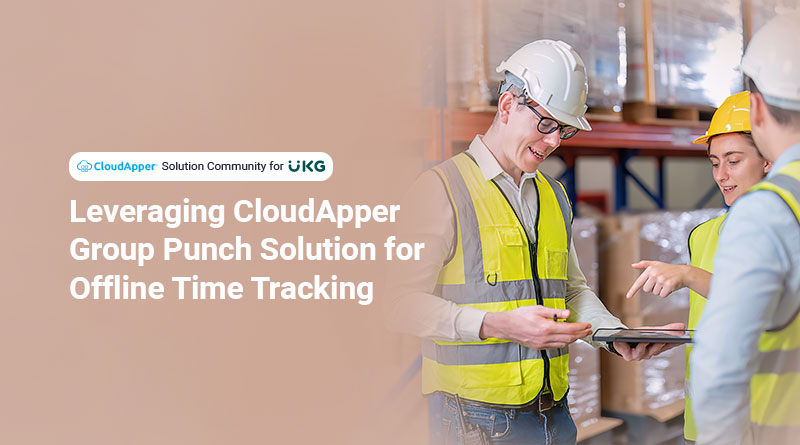
Agricultural field crews work without Wi-Fi, move as groups, and earn bonuses tied to harvest output across multiple countries. Here is how one of the world's largest berry producers solved all three challenges using UKG Pro WFM and CloudApper Crew Punch.


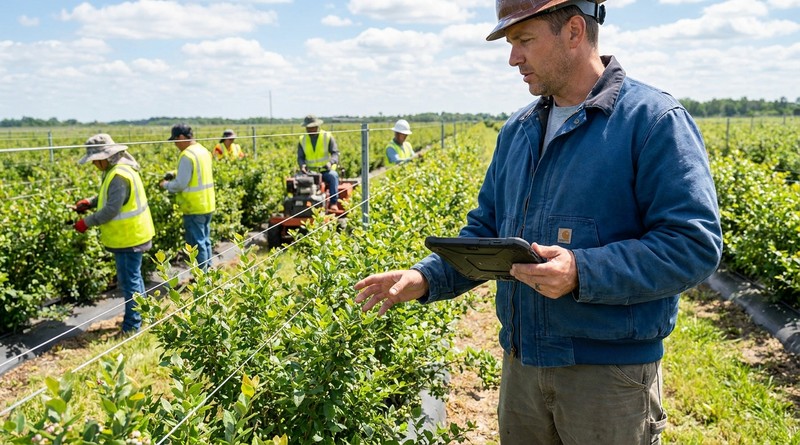
Table of Contents
Agricultural workforce management does not look like warehouse workforce management. It does not look like healthcare workforce management, or manufacturing floor management, or any of the other industries for which standard time and attendance platforms are designed. The workers are in fields. The locations are remote. The connectivity is absent. The crews move together, start together, and stop together — which means individual punch-based timekeeping creates a category of friction that simply does not exist for a desk-based or badge-tap-at-the-door workforce. And when the operation spans two or three countries, each with its own compensation rules, the complexity of calculating what someone earned on a given day grows in ways that no standard payroll platform handles out of the box.
One of the world’s largest fresh berry producers encountered every layer of this problem simultaneously. With R&D and nursery agricultural operations across the United States and Mexico — and expanding into Peru as of 2026 — the company needed UKG Pro WFM to serve as the workforce management backbone for field crews whose working conditions made standard timekeeping infrastructure unusable. CloudApper Crew Punch, deployed on the CloudApper hrPad platform, became the layer that made it work — capturing accurate crew-based time across remote fields, syncing to UKG Pro WFM regardless of connectivity, and automating complex Mexico productivity bonus calculations that UKG cannot perform natively.
Why Standard UKG Timekeeping Fails in the Field
The problem begins with the environment. Agricultural field crews operate at locations that may have no Wi-Fi, no reliable cellular signal, and no fixed physical infrastructure to anchor a time clock to. Standard UKG time clocks — whether hardware-based or soft clock installations — assume a connectivity baseline that simply does not exist in remote agricultural settings. A crew that cannot reach the network cannot punch in. An organization that cannot capture punches in real time ends up falling back on paper timesheets, which introduces the data entry delay, transcription error, and audit trail gap that a workforce management system is specifically meant to eliminate.
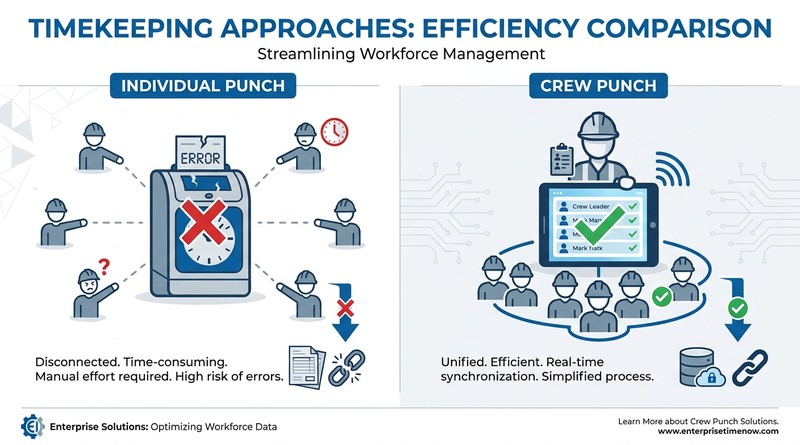
The second problem is structural. Agricultural crews work as units. A crew leader brings a group of workers to a field location, starts the work, supervises it, and closes it out. Expecting each individual worker in a crew of fifteen or twenty people to interact separately with a timekeeping device — at a remote field site, before or after physical labor — is an impractical requirement that creates the kind of friction that results in missed punches, incomplete records, and payroll corrections later. As explored in the context of group time tracking for UKG customers, the architecture of individual punch-in punch-out was designed for a fixed-location, individually accountable workforce — not for the crew-based, supervisor-led structure that defines field agricultural operations.
The third problem emerges when productivity compensation enters the picture. Agricultural pay models — particularly for harvest and R&D nursery operations — are often tied to output: what was harvested, in what quantity, at what quality level, by which crew, measured against a target. That kind of pay logic requires tracking multiple data dimensions per shift (berry variety, activity type, harvest volume, quality percentage) and applying calculation rules that may differ by country, by operation type, and by individual versus group performance thresholds. UKG Pro WFM is not built to run that math natively. The result, for most agricultural organizations, is that the productivity bonus piece lives in Excel — which introduces the same reliability and accuracy problems it introduces everywhere else it is used as a substitute for real automation.
What a Crew Punch Platform Actually Requires
The solution this organization implemented through CloudApper rests on a different operating model for time capture. Rather than requiring individual workers to interact with a device, the crew leader operates the system on behalf of the group. Using a tablet running CloudApper hrPad, the crew leader starts the shift for the entire crew at the beginning of the day — logging the project, job type, and location combination that applies to that day’s work. At the end of the shift, the same crew leader closes the group out. The individual workers receive accurate, timestamped timecard records in UKG Pro WFM without each having interacted with a device individually.
The offline capability is what makes this viable for remote field operations. CloudApper hrPad stores punch data locally on the device when connectivity is unavailable and syncs automatically to UKG Pro WFM when a connection is restored. The crew leader does not need to wait for signal, does not need to retry failed submissions, and does not need to maintain a paper backup. The data captured in the field — project, job, location, shift start, shift end, crew members — travels to UKG intact, with the same structure and accuracy as if the punch had occurred in a connected facility.
“We had people doing manual timesheets in the field for years because the standard tools just didn’t work in that environment. Now a crew leader closes out a shift on a tablet and it’s in UKG by the time they get back to the office. The record is clean from day one.”
— HR Operations Manager, Global Fresh Produce Company
The activity entry layer adds the dimension that field operations require and that standard timekeeping does not capture. Beyond start and stop times, the platform records what the crew was doing and where — project code, job type, location — giving operations leadership and HR a timecard record that reflects not just hours worked but the context of those hours. For organizations that allocate labor costs across research projects, nursery programs, or geographic locations, that context is not optional data. It is the foundation of accurate job costing, and without it, the timecard becomes an input to payroll but not an input to operational analysis. As discussed in the context of job costing and cost center management with UKG, the gap between hours captured and hours allocated is where labor cost visibility breaks down.
Cross-Border Complexity: Automating Mexico Productivity Bonuses
The US timekeeping problem, once solved by the crew punch architecture, is tractable. The Mexico productivity bonus problem is in a different category of complexity.
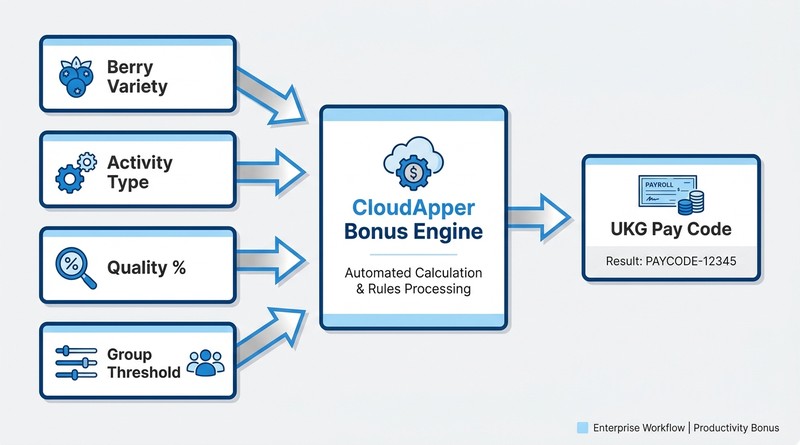
For Mexico agricultural operations, workers earn bonuses tied to harvest performance — but the calculation is not a simple multiplier of units produced. The relevant variables include the berry variety being harvested (which carries different baseline targets), the activity type (picking, thinning, planting each carry different rate structures), the individual worker’s performance against a minimum threshold, and the quality percentage of the harvest — the proportion of what was picked that meets grade standards. Bonuses may be calculated at the individual level, the group level, or both, with the group dimension introducing a shared-accountability component that changes how individual compensation is computed depending on collective performance.
None of this math lives inside UKG Pro WFM. The platform does not have a native mechanism for multi-variable productivity bonus calculations that vary by crop, activity, quality grade, and individual-versus-group threshold simultaneously. For organizations trying to run this in UKG, the calculation either gets pushed to a spreadsheet or pushed to a custom data entry step that manually posts a bonus amount after the fact. Both approaches introduce lag, expose accuracy risk, and remove the auditability that a compliance environment requires.
CloudApper’s productivity bonus engine handles the full calculation automatically. The inputs — berry variety, activity type, harvest volumes, quality percentages, crew composition, and individual performance records — are captured through the same hrPad workflow the crew leader uses for time capture. CloudApper applies the applicable bonus logic, calculates individual and group-level amounts, and injects the correct pay codes directly into UKG Pro WFM timecards. By the time payroll runs, the bonus is already in the system at the right rate, against the right record, with a full audit trail of how it was calculated. This is the same principle that drives accurate piecework pay automation in UKG Pro WFM — calculation logic that belongs in a purpose-built engine rather than a spreadsheet that no one fully trusts by the time payroll closes.
What Expansion to a Third Country Reveals About Platform Design
The solution this berry producer deployed across US and Mexico operations expanded to Peru R&D operations in 2026. That expansion is worth examining not just as a business fact but as a design indicator. When a timekeeping and compensation platform is genuinely built for field agricultural operations — offline-capable, crew-based, activity-aware, and configurable for country-specific pay rules — adding a new country does not require a new system. It requires configuring the existing one for the new operational context.
The alternative model — point solutions for each country, spreadsheet-based bonus calculations that are rebuilt for each jurisdiction, manual timekeeping processes that depend on whoever is on the ground — does not scale. It produces HR infrastructure that grows in complexity with each new location, creates reconciliation overhead that multiplies as operations expand, and leaves leadership without a consistent data view across geographies.
For agricultural enterprises managing R&D operations, nursery programs, or harvest operations across multiple countries under UKG Pro WFM, the core infrastructure requirement is the same in every location: accurate crew-based time capture that works without connectivity, activity-level data that supports job costing, and compensation logic that can handle the country-specific pay rules that govern each operation. CloudApper Crew Punch was built to meet that requirement as a UKG extension — adding the field-specific capability that UKG Pro WFM does not include natively, without replacing the core workforce management platform that already governs scheduling, leave, and HR records. As described in the context of eliminating the attendance blind spot for UKG customers, the gap between what the WFM platform can track and what field operations actually require is a structural problem — and a structural problem has a structural solution.
The berry producer in this story did not replace UKG. It added the layer that made UKG functional for the workforce it actually has: crews in remote fields, in multiple countries, earning pay that depends on how much they harvested, how well they harvested it, and how the group performed against a shared goal. That combination is not exotic in agriculture. It is the norm. And it deserves timekeeping and compensation infrastructure that treats it as such.
If your organization manages agricultural, R&D, or field operations under UKG Pro WFM and needs crew-based timekeeping, offline punch capability, or country-specific productivity bonus automation, CloudApper can design the right extension for your specific operational environment. Contact the CloudApper team to discuss what your field workforce requires.


January 7, 2026
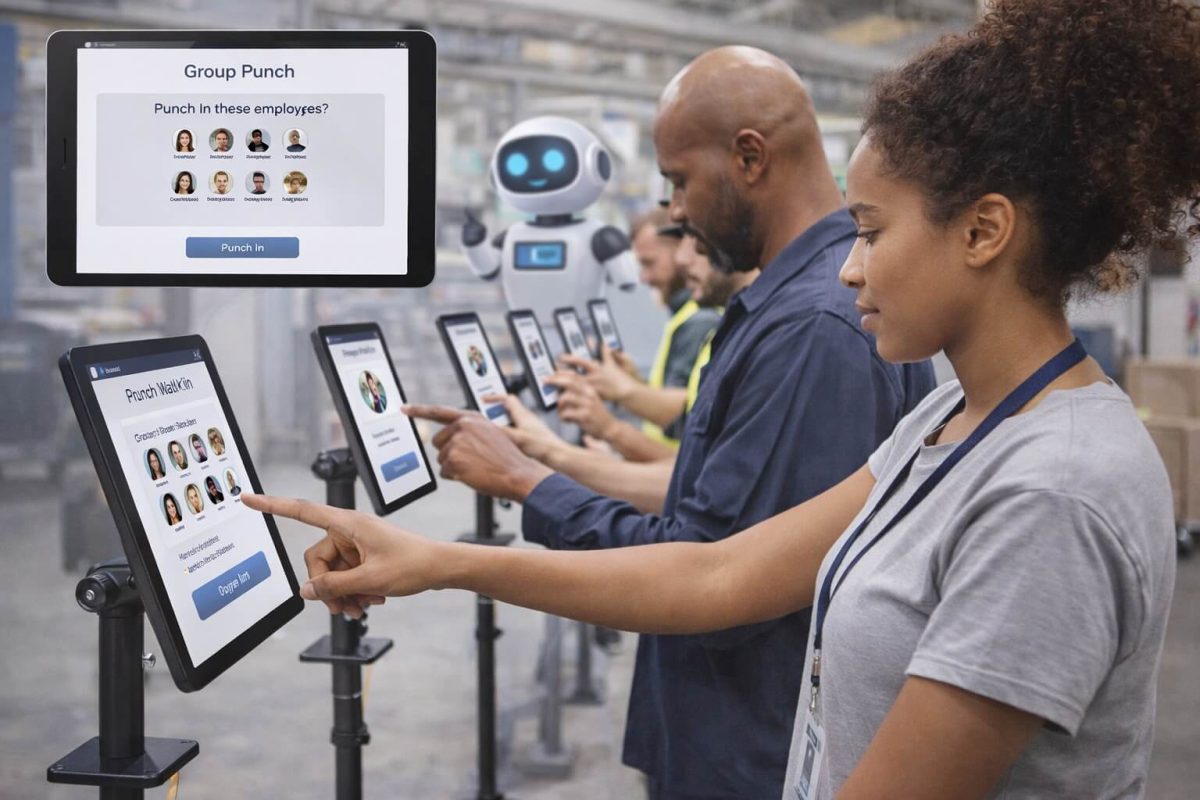
Understanding UKG/Kronos Roll Call: How AI-Powered Tablets Transform Group Time Tracking for Workforce Management
UKG/Kronos Roll Call enables rapid group attendance verification for emergencies and daily operations. CloudApper AI tablets supercharge UKG/Kronos Roll Call with secure one-tap group clock-ins, facial recognition, location controls, and instant UKG sync—delivering accurate muster reports, improved safety compliance, and operational efficiency.
December 26, 2025
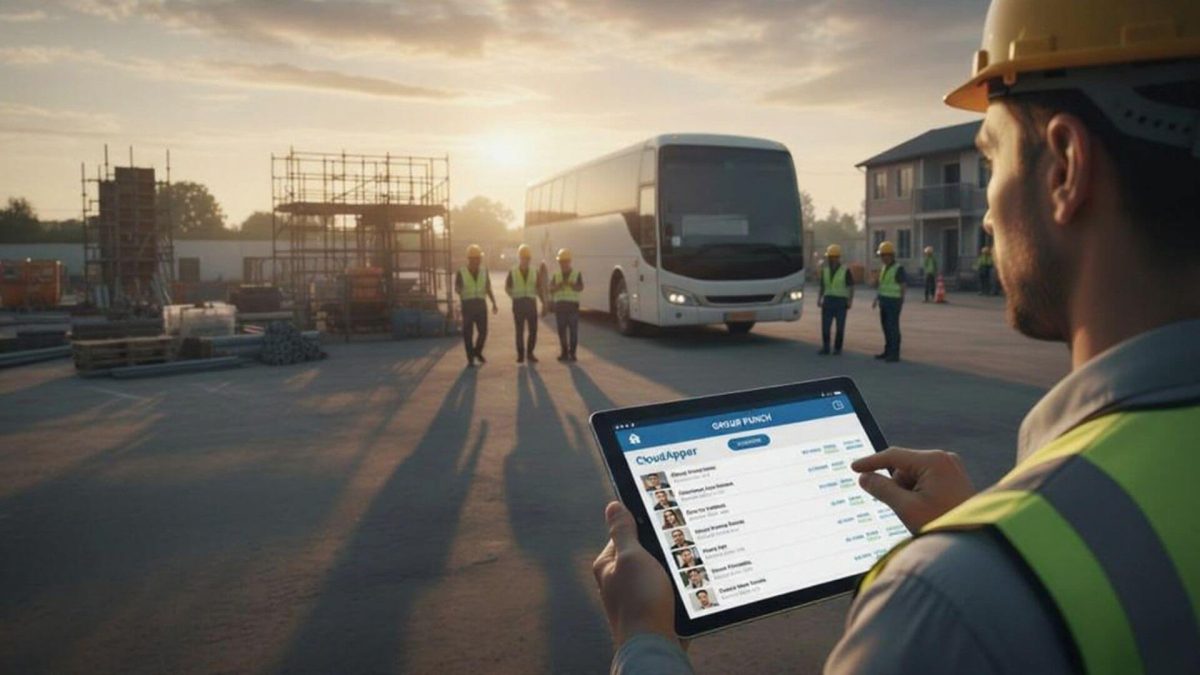
Eliminating the Attendance “Blind Spot”: How UKG Customers Use CloudApper hrPad for Seamless Workforce Tracking
Many UKG customers struggle with tracking mobile workforces in transit. By deploying CloudApper hrPad with Group Punch, organizations can move attendance tracking from stationary clocks to mobile tablets. This ensures accurate, verified data from the moment workers leave their dormitory, eliminating "blind spots" and manual administrative bottlenecks in UKG.

April 18, 2024
Capture Group Punches Offline With Activity Transfers in UKG Pro WFM (Dimensions)
Easily capture group punches and job transfers offline with CloudApper AI. It integrates seamlessly with UKG Pro WFM (Dimensions) and enables supervisors to capture group punches and assign activities to employees offline, even in remote locations.