A residential drywall subcontractor that keeps time, piecework and inspections on paper runs two month-end reconciliations: whether the square footage claimed for piece-rate pay is right, and whether inspections were done and signed. CloudApper captures both at the same UKG Ready punch so they travel as one record.


Table of Contents
Month-end at a residential drywall and painting subcontractor involves two reconciliations when time, piecework and inspections live on paper. Payroll checks whether the square footage claimed for piece-rate pay matches what the crews reported. Operations checks whether the pre-drywall and post-hang inspections were done and signed. Two questions, two filing systems, two people asking crews about the same workday weeks later.

CloudApper’s approach is to make those one record, which changes the controller’s job more than anybody’s data entry.
Two Audits, One Capture Point
In this design, the subcontractor’s several hundred field employees work through one flow on CloudApper hrPad: facial recognition punch-in, job and cost center from searchable UKG Ready dropdowns, square footage at punch-out, the inspection checklist on the same device, and the foreman’s signature before anyone leaves.
What CloudApper AI Platform for UKG does next is what changes the controller’s month: the completed checklist becomes a PDF and lands on the employee’s UKG Ready profile, attached to the same punch that carries the piece count.
Not a single audit trail, and the distinction matters. Pay evidence and quality evidence stay separate records, neither replacing the other. They travel together in UKG Ready from the moment of capture instead of sitting in different places and being matched later from memory and a date range.
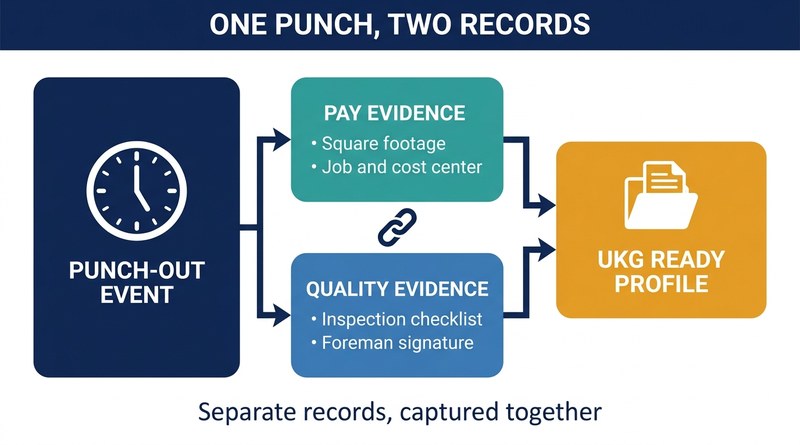
Two separate records, created at one punch-out and filed together on the employee’s UKG Ready profile.
Why the Piece Count Has to Be Exact
Piece-rate pay in California makes the captured quantity more than a productivity figure. Employers must separately compensate rest and recovery periods and other nonproductive time: rest and recovery at the higher of the employee’s average hourly rate for the workweek or the applicable minimum wage, other nonproductive time at no less than the applicable minimum wage, itemized on the wage statement.
So the square footage entered at punch-out feeds a calculation that has to hold up, and getting it from the person who did the work, when the work ended, on the same record as their hours beats reconstructing it later. The same logic sits behind automatic minimum wage makeup pay and piecework engines that keep the arithmetic auditable, alongside the separate California meal and rest break requirements that apply regardless of pay basis.
One precision worth keeping straight: the inspection documentation is not part of that wage regulation. It exists because general contractors, owners and insurers require it. Two obligations, captured in the same minute.
“This inspection is intended to increase the quality of a drywall ready home… ensuring the level, plumb and flatness of the wall board.”
Pre-drywall inspection form, residential drywall and painting subcontractor
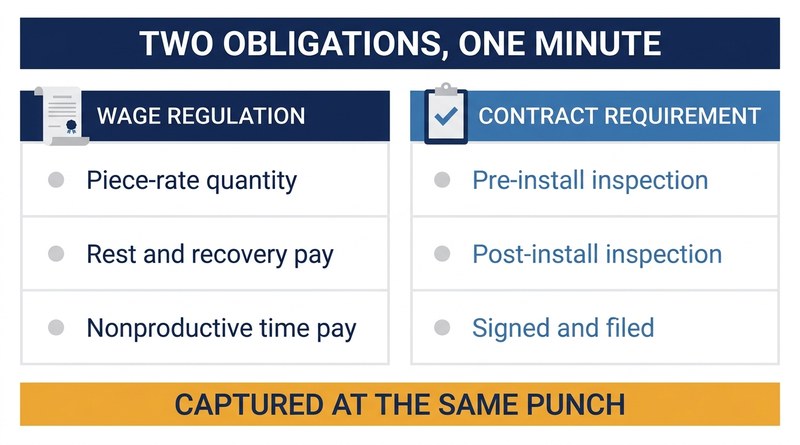
Piece-rate wage rules and general contractor inspection requirements are different obligations that happen to be satisfied in the same minute.
The Signature the Design Did Not Cover
One stakeholder sits outside this flow, and anyone planning something similar should account for them early. The foreman signs on the device. The general contractor or building inspector who has to accept that inspection still works in their own system, on their own forms, on their own schedule.
The subcontractor’s own pre-drywall inspection form already places part of that loop with the builder: “Omission, additions and options added after the pre-drywall inspection will be… communicated by the responsible party (builder)… for proper identification and remedy.” That is the piece a design like this leaves open: the internal record can be complete while the acceptance workflow with whoever commissioned the job is still a phone call. Job and cost center allocation falls out of the same capture, which is what makes labor cost per job defensible when a dispute gets that far.
One Question Contractors Ask
Can piece-rate quantities and jobsite inspection documentation be captured in the same UKG Ready flow?
Yes. Piece quantity is entered at punch-out against the selected job and cost center, the checklist is completed on the same device with a foreman signature, and the resulting PDF attaches to the employee’s UKG Ready profile alongside that punch. Pay evidence and quality evidence stay distinct records that travel together rather than being matched afterwards.
If your field crews are paid on piece rate and your inspection records live in a different system from your timecards, talk to the CloudApper team about capturing both at the punch.



October 16, 2026
Public Holiday Substitution Rules Around the World: Why UKG Pro WFM Still Needs Manual Checks
New Zealand calls it Mondayisation, the UK calls it a substitute bank holiday, Canada calls it holiday pay in lieu, and the US calls it an observed holiday. Four names, four rules, and the same manual-check problem for global UKG Pro WFM deployments.


October 16, 2026
UKG Pro Position Management at a Food Producer: Who Sets the Defaults When 75 Employees Change Jobs Every Week
A large food producer moving to UKG Pro handles about 75 internal transfers a week. CloudApper automates the position defaults behind each move, including comp codes, cost centers, standard hours and union codes, through the UKG Pro API, with HR owning and updating the rules without opening a project.

October 15, 2026
Health and Welfare Pay for Military Base Stores: Making Every H&W Hour Traceable in UKG
A national specialty retailer with stores on US military installations needs health and welfare pay it can defend. CloudApper applies the 40-hour weekly cap, multi-store proration and employer cost recovery against UKG time data, posting H&W pay codes to each timecard with a trail back to the hours.

September 30, 2026
Your Best Candidates Already Worked for You: Rehire Campaigns and Geographic Filtering in UKG Pro for Home Care
Large home care organizations hire at high volume across many territories, and former employees often re-enter the same pipeline as strangers. CloudApper AI Recruiter extends UKG Pro Recruiting with zip-code filtering, rehire outreach campaigns and blind ranking, so coordinators see the strongest local candidates first.