A guaranteed daily route rate still carries overtime obligations, and the regular rate moves with every hour worked. See how CloudApper extends UKG Ready with a route-pay engine that calculates help time, overtime and guarantees, then writes each earning component back for payroll review, line by line, every week.



Table of Contents
A route driver is hired at a daily rate, and nobody quotes an hourly wage. That works until a full route load runs toward 50 hours in a week, which is what the pay design assumes at a waste collection company of about 300 employees. CloudApper AI for UKG Personalization is how CloudApper adds this kind of custom pay rule on top of UKG Ready.
One Rate Cannot Do Two Jobs
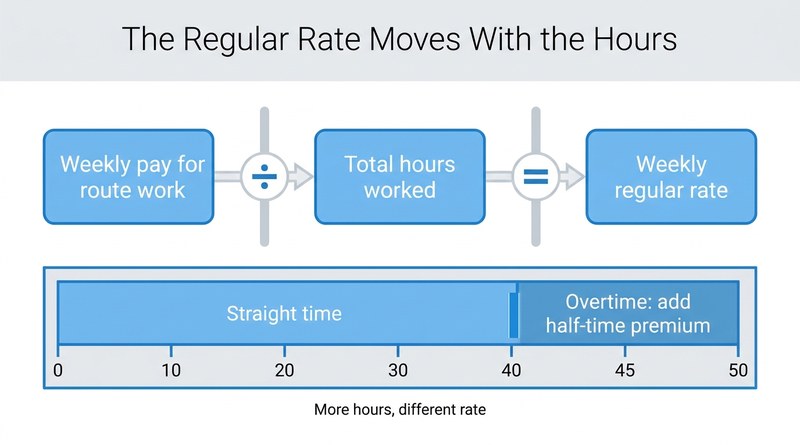
Under US federal rules, a day rate does not remove the overtime obligation. The regular rate is the week’s pay for that work divided by the hours actually worked, and overtime hours then earn an additional half-time premium, since straight pay is already inside the day rate. So the hourly rate moves with the hours. The HR and payroll lead at the company learned this directly: “We kind of found out, I should say the hard way, that we needed to make sure we came up with an hourly rate for these guys when we’re factoring in overtime.”

The shortcut fails in both directions:
“If we just took their route rate, divided it by 40, then whatever overtime they worked from 40 to 50 would be astronomical, right? They’d be making what we couldn’t afford.”
HR and Payroll Lead, waste collection and sanitation company
Ignoring overtime creates wage and hour exposure. The company’s route pay model, built by ownership and the legal team rather than HR, sits between the two: a weekly regular rate, a 0.5 premium on route overtime, and a true-up to the guaranteed route rate up to 50 hours without paying anything twice.
When a Two-Minute Change Moves the Rate
“Because if they work 43 hours versus 43 hours and two minutes, it’s a different rate.”
HR and Payroll Lead, waste collection and sanitation company
Help time adds another layer. When a truck breaks down, an operations manager sends another driver to help on someone else’s route, and that time is a different job paid at the greater of a configured minimum or 1.5 times the route regular rate. Drivers cannot switch jobs on a phone while driving, so help hours are best entered by a manager. CloudApper lets that manager record the hours in UKG Ready, the same system that holds the punches, in the spirit of landing driver hours in UKG Ready timecards before the payroll cut-off.
Earnings as Components, Not a Lump
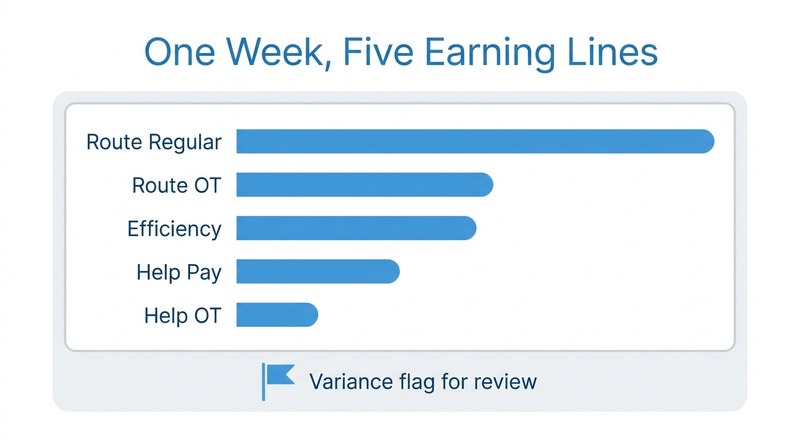
CloudApper’s route-pay engine reads days worked, total hours, holiday and vacation hours and help hours from UKG Ready counters through CloudApper iPaaS for UKG. It runs the calculation in sequence and writes separate earning lines back for payroll: Route Regular, Route OT, Efficiency, Help Pay and Help OT. UKG Ready Payroll continues to handle taxes, deductions and pay statements.
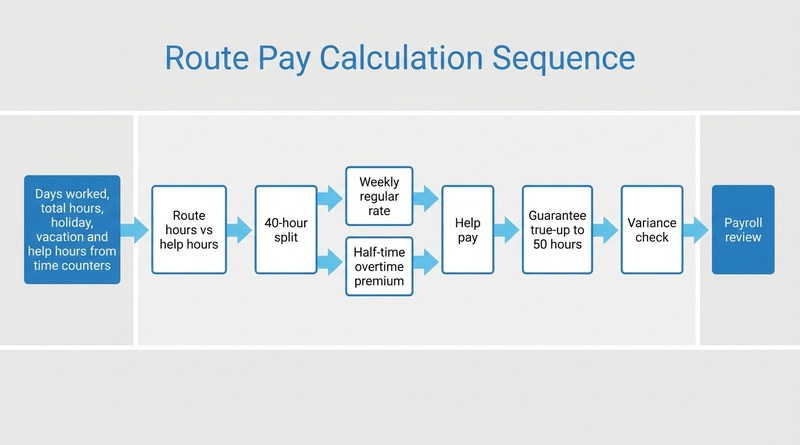
A variance check flags any result far above the employee’s standard route total, so an outlier is reviewed before the check is approved. The approach resembles automating Ontario statutory holiday pay in UKG Ready, where an engine reads what UKG holds and returns a pay code.
What the Driver Sees
Drivers question a stub where route pay is smaller than the promised daily rate, because overtime and the true-up arrive on other lines. Separate components let HR explain the week line by line, the principle behind making a minimum wage floor automatic.
For payroll and HR leaders, the takeaway is that a guaranteed daily rate stays defensible when the regular rate, the premium and the true-up are calculated the same way every week and each piece is recorded on its own line. CloudApper extends UKG Ready to carry that logic, as it does for the flat-rate technician plans that face a similar structure.
If your route or crew pay lives in a weekly spreadsheet, the CloudApper team can show how the calculation would run on top of UKG.



November 3, 2026
Flat-Rate Technician Pay in UKG Pro WFM: Eligibility Hours, Productivity Hours and the Audit Record Between Them
A regional tire and automotive service retailer pays flat-rate technicians on billed hours from point of sale and clocked hours in UKG Pro WFM. CloudApper applies a thirteen-scenario incentive plan on top of UKG, posts results to existing pay codes, and keeps an auditable record of every pay decision.

October 30, 2026
Promotion Pay-Band Rules in UKG Pro: Letting Leaders Request Raises Without Seeing the Pay Table
At a national mortgage lender, leaders request promotions and transfers but never see compensation. Here is how CloudApper enforces pay-band caps, out-of-band attestation and FLSA flags at the moment of submission inside UKG Pro, while Senior Leadership, Team Relations and People Analytics still review every change.


October 16, 2026
Public Holiday Substitution Rules Around the World: Why UKG Pro WFM Still Needs Manual Checks
New Zealand calls it Mondayisation, the UK calls it a substitute bank holiday, Canada calls it holiday pay in lieu, and the US calls it an observed holiday. Four names, four rules, and the same manual-check problem for global UKG Pro WFM deployments.

October 16, 2026
UKG Pro Position Management at a Food Producer: Who Sets the Defaults When 75 Employees Change Jobs Every Week
A large food producer moving to UKG Pro handles about 75 internal transfers a week. CloudApper automates the position defaults behind each move, including comp codes, cost centers, standard hours and union codes, through the UKG Pro API, with HR owning and updating the rules without opening a project.