A regional tire and automotive service retailer pays flat-rate technicians on billed hours from point of sale and clocked hours in UKG Pro WFM. CloudApper applies a thirteen-scenario incentive plan on top of UKG, posts results to existing pay codes, and keeps an auditable record of every pay decision.



Table of Contents
A flat-rate technician’s paycheck depends on two numbers that live in different systems. Clocked hours sit in UKG Pro WFM. Billed hours sit in the shop’s point-of-sale platform. Every week someone has to bring them together, apply the incentive plan, and finish before the payroll cutoff.

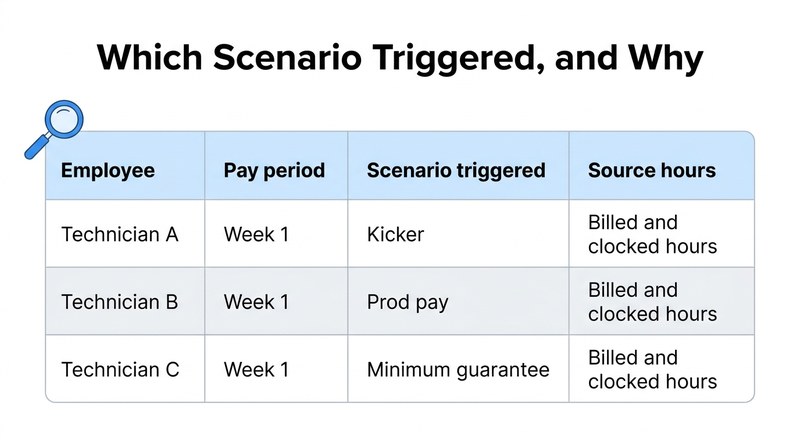
At a regional tire and automotive service retailer, that plan runs to thirteen documented pay scenarios. A kicker applies to the whole pay bucket at the right productivity. A prod pay top-up covers a middle band. A state minimum rate guarantee applies below the floor and resolves from the employee’s home location. Add new-hire guarantees, offer-letter guarantees, light duty and holiday exceptions, and the plan stops being a formula and becomes a decision tree. CloudApper applies that tree on top of UKG Pro WFM with CloudApper AI for UKG Personalization.
Two Kinds of Hours
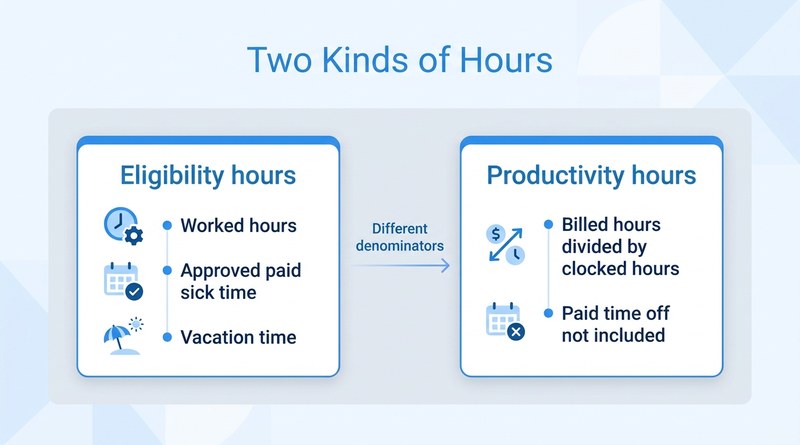
The hardest rule is not arithmetic. It is a definition. The payroll and operations lead explained that approved sick time counts toward kicker eligibility, “But when the productivity kicker is actually calculated, paid time off is not part of that.” The company’s IT and integration lead put the vacation side this way:
“We say yes, you did work 40 hours to be eligible for a kicker. However, we’re not going to penalize you for taking that vacation.”
Systems and Integration Lead, IT, regional tire and automotive service retailer
Eligibility hours and productivity hours are two different denominators, and vacation, sick, holiday and training time each count differently toward one or the other. A spreadsheet can hold that distinction only as long as its author remembers it. The CloudApper calculation engine holds it as a rule, much like the automatic floor described in piece-rate pay and the minimum wage makeup.
From Billed Hours to a Pay Code
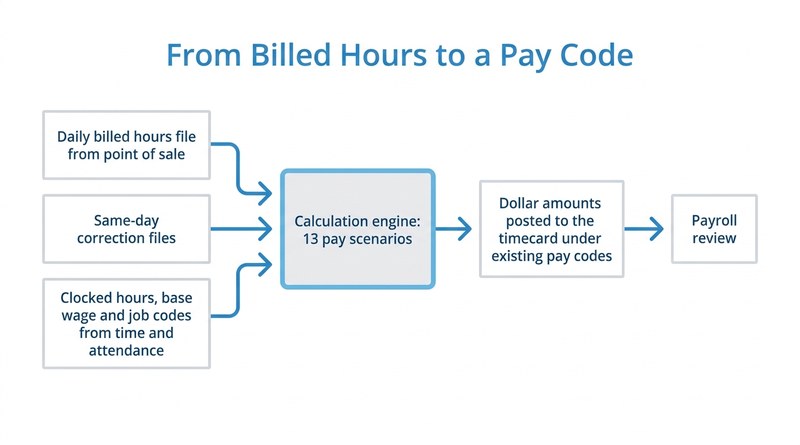
CloudApper’s integration layer takes the point-of-sale file of billed hours each day. Same-day correction files are handled so that re-running a file never double-counts. The engine matches billed hours to employees in UKG Pro WFM, reads clocked hours, base wage, job codes, labor categories and user-defined fields such as light duty or a guarantee designation, and posts dollar amounts to the timecard under the existing pay codes. UKG’s native process carries pay forward from there.
Anyone who has reconciled one system’s hours against another’s will recognize the problem in two definitions of the same hour. Here the definitions are written down as rules.
The Record Is the Product
For each employee and period, the engine keeps an auditable record of which scenario triggered. When a technician asks why a week paid a guarantee instead of a kicker, the answer is a stored decision, not a reconstruction. The HR systems lead described a finance process that depends on stable inputs:
“There’s this process that our finance team has… it gets loaded into all this historical table information and sometimes if stuff isn’t exactly how it’s always been it’ll break it.”
HR Systems Lead, regional tire and automotive service retailer
See how roll-ups make technician commissions audit-ready for the same principle in a different setting.
Showing the Rate Before the Pay Stub
That difference usually appears only on the pay stub. CloudApper adds a productivity tile inside UKG Pro WFM, opened through single sign-on, that shows weekly productivity, daily clocked and billed hours, and an average effective rate for completed weeks, so a technician sees where the week stands before payday.
The takeaway for payroll and HR leaders is that a complicated incentive plan stays manageable when hours have clear definitions, every posting lands on an existing pay code, and every decision leaves a trace. CloudApper extends UKG Pro WFM with that layer so the plan lives in rules rather than in one person’s memory.
If your technician pay plan depends on a spreadsheet and a few people who know the exceptions, the CloudApper team can show how it would run on top of UKG.



October 30, 2026
Promotion Pay-Band Rules in UKG Pro: Letting Leaders Request Raises Without Seeing the Pay Table
At a national mortgage lender, leaders request promotions and transfers but never see compensation. Here is how CloudApper enforces pay-band caps, out-of-band attestation and FLSA flags at the moment of submission inside UKG Pro, while Senior Leadership, Team Relations and People Analytics still review every change.


October 16, 2026
Public Holiday Substitution Rules Around the World: Why UKG Pro WFM Still Needs Manual Checks
New Zealand calls it Mondayisation, the UK calls it a substitute bank holiday, Canada calls it holiday pay in lieu, and the US calls it an observed holiday. Four names, four rules, and the same manual-check problem for global UKG Pro WFM deployments.

October 16, 2026
UKG Pro Position Management at a Food Producer: Who Sets the Defaults When 75 Employees Change Jobs Every Week
A large food producer moving to UKG Pro handles about 75 internal transfers a week. CloudApper automates the position defaults behind each move, including comp codes, cost centers, standard hours and union codes, through the UKG Pro API, with HR owning and updating the rules without opening a project.

October 15, 2026
Health and Welfare Pay for Military Base Stores: Making Every H&W Hour Traceable in UKG
A national specialty retailer with stores on US military installations needs health and welfare pay it can defend. CloudApper applies the 40-hour weekly cap, multi-store proration and employer cost recovery against UKG time data, posting H&W pay codes to each timecard with a trail back to the hours.