Physician pay at a large public hospital runs on monthly shift minimums, specialty on-call rates, callback pay and night differentials, while payroll runs biweekly. Here is why paper attestations and emailed lump sums persist, and how CloudApper AI Platform for UKG applies those rules alongside UKG Pro WFM.



Table of Contents
Physician incentive pay in UKG Pro WFM gets hard when compensation rules run by calendar month and payroll runs biweekly. Consider a large public hospital whose employed physicians do not clock in or out. A full-time provider is expected to work a minimum number of shifts each month, prorated by FTE, and shifts beyond that minimum earn extra shift pay. On top of that sit hourly on-call rates set by group and specialty, callback pay, a night differential for scheduled on-site shifts starting at or after 7:00 PM, and an Annual Leave Day bank sized to each provider’s shift length. Much of it still runs on paper attestation forms and emailed pay requests. CloudApper AI Platform for UKG addresses this by applying those rules alongside the hospital’s existing UKG Pro WFM environment, without replacing its HR systems.
Why Paper Can’t Track a Monthly Shift Minimum
Physician compensation agreements have become structurally complex. The current model, at this hospital and at many like it, combines a base rate with threshold-based bonuses, specialty pay for nights and call-backs, and leave banks that accrue on different schedules than standard employee PTO. According to Ernst & Young research, one in five payrolls contains errors, with time and attendance mistakes occurring more than once per employee per year. For physician pay, where a missed shift count means a miscalculated bonus, those errors don’t stay invisible. They generate pay disputes.

“When the timekeepers are going in and just trying to figure out if they have extra shifts, they might have to pull three time sheets, the current pay period and two previous that overlap the calendar month and count shifts back. And it’s really cumbersome right now and not efficient at all,” said the Assistant Controller at the large public hospital.
The same challenge appears across healthcare wherever complex provider pay sits outside native UKG configuration, including hospitals where physician pay rates change depending on which facility a doctor is working that shift. The calculation isn’t impossible. It just requires logic that lives above standard timekeeping.
What the Rules Engine Actually Does
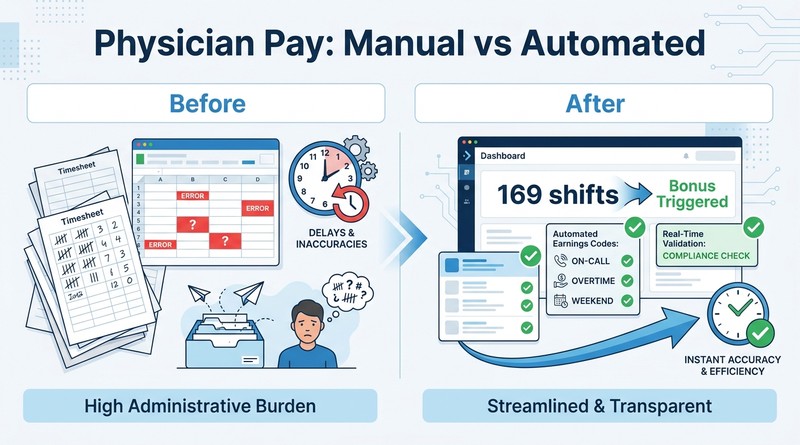
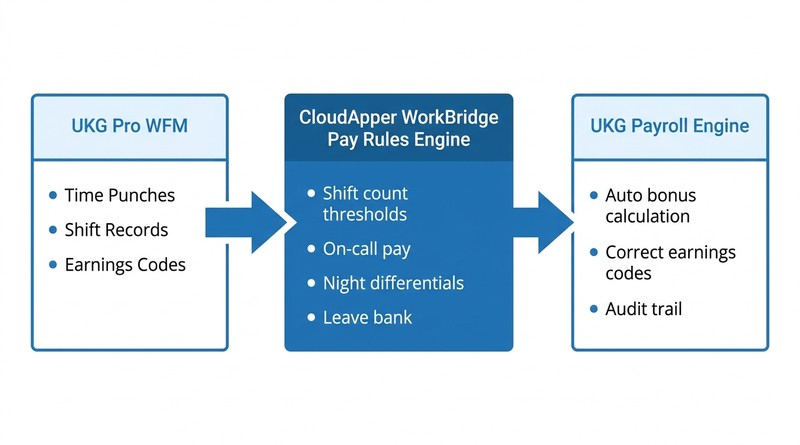
Built on UKG Pro WFM’s existing timekeeping and payroll tables, CloudApper AI Platform for UKG adds only the threshold logic hospitals need. It reads schedule and shift data, applies the hospital’s specific physician pay rules, and writes the correct pay code entries back to the UKG timecard so the existing payroll flow carries them downstream. No new interface for the payroll team to manage. No separate data entry point alongside the platform they already run.
In this design, the engine counts each provider’s shifts against the calendar month, checks averaging, and flags extra shifts and stays of more than two hours past a scheduled shift. On-call and callback hours are priced by the specialty of the shift rather than the provider’s title, and the night differential applies only where it qualifies. Each posts to its own pay code without manual lookup or spreadsheet reference.
That addresses a process the Assistant Controller at the hospital describes this way: “Right now the call pay is done manually. If they have a work call shift… we get an email from the department sent to our payroll staff and then they manually go in and do an additional payment under one single pay code based on a total dollar amount.”
EY benchmarks put the cost of time and attendance inaccuracies at approximately $71,705 annually per 1,000 employees. For physician payroll, the workforce is smaller but the compensation rules per person are far more involved, so each error carries more weight. The same principle applies in adjacent contexts: organizations managing complex public safety pay cycles inside UKG Pro WFM address FLSA calculation requirements through embedded automation using the same principle. Let UKG hold the data. Let the rules layer apply the contract logic. The same thinking applies to environments where compensation accuracy requirements mean the audit trail matters as much as the calculation itself.
Compensation Accuracy as a Staffing Lever
For hospital leadership, this matters beyond the payroll department. Physician contracts are renegotiated. When pay accuracy and period-close speed match what the employment agreement specifies, it removes a recurring source of administrative friction from the medical staff office.
The Payroll Manager at the hospital described the goal from the provider side: “They’re actually tracking all of their time on paper time attestation sheets and so one of the things we’d like is for them to be able to approve their time in UKG and kind of get rid of the paper tracking.”
The model is also built to grow. A rules layer that handles one group’s shift expectations can extend to residents and, if ambulatory physicians move to a similar plan, to a much larger provider population.
For payroll teams still managing provider incentive pay on paper or in spreadsheets running alongside UKG, the architectural case is clear. A solution that reads from UKG’s existing data and writes back to its payroll engine doesn’t require new integrations, additional training, or a secondary system to maintain. It extends what the hospital already has. The same path applies to equally complex calculations, including certified payroll and prevailing wage requirements: embed the rule in the platform rather than run the rule beside it.
If your health system manages physician incentive pay on top of UKG Pro WFM and paper timesheets are still part of that process, CloudApper AI Platform for UKG can extend your existing UKG environment to handle it, without modifying what you already have in place.



October 16, 2026
Public Holiday Substitution Rules Around the World: Why UKG Pro WFM Still Needs Manual Checks
New Zealand calls it Mondayisation, the UK calls it a substitute bank holiday, Canada calls it holiday pay in lieu, and the US calls it an observed holiday. Four names, four rules, and the same manual-check problem for global UKG Pro WFM deployments.


October 16, 2026
UKG Pro Position Management at a Food Producer: Who Sets the Defaults When 75 Employees Change Jobs Every Week
A large food producer moving to UKG Pro handles about 75 internal transfers a week. CloudApper automates the position defaults behind each move, including comp codes, cost centers, standard hours and union codes, through the UKG Pro API, with HR owning and updating the rules without opening a project.

October 15, 2026
Health and Welfare Pay for Military Base Stores: Making Every H&W Hour Traceable in UKG
A national specialty retailer with stores on US military installations needs health and welfare pay it can defend. CloudApper applies the 40-hour weekly cap, multi-store proration and employer cost recovery against UKG time data, posting H&W pay codes to each timecard with a trail back to the hours.

September 30, 2026
Your Best Candidates Already Worked for You: Rehire Campaigns and Geographic Filtering in UKG Pro for Home Care
Large home care organizations hire at high volume across many territories, and former employees often re-enter the same pipeline as strangers. CloudApper AI Recruiter extends UKG Pro Recruiting with zip-code filtering, rehire outreach campaigns and blind ranking, so coordinators see the strongest local candidates first.