A national physician staffing firm pays each shift at a facility-specific contract rate, with premiums that start after a cumulative shift threshold. Here is why that is hard to get right every payroll cycle and how CloudApper connects Salesforce contract data to UKG Pro WFM timecards.



Table of Contents
Physician pay automation in UKG gets difficult when the rate depends on which hospital a physician worked at and how many shifts they have already logged this year. A large physician staffing firm faces exactly that. Each physician works under an individually negotiated contract with a facility-specific pay rate, picks up shifts across hundreds of hospitals during the year, and earns premium incentives once a cumulative shift count crosses a threshold.

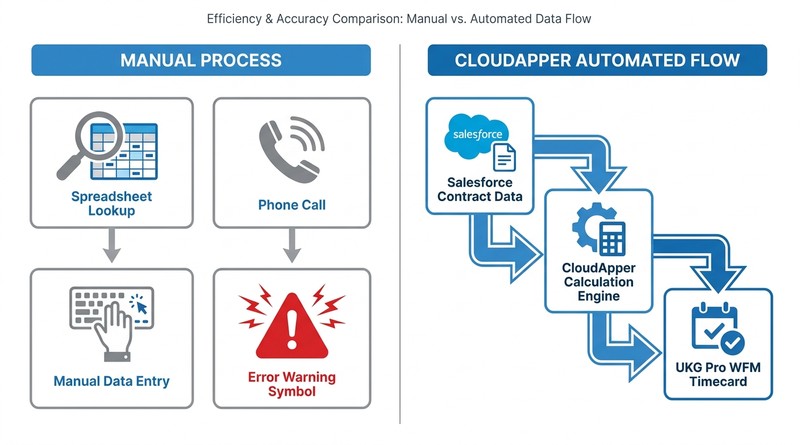
Today a separate calculation step sits between scheduling and payroll: someone has to cross-reference which physician worked at which hospital, that facility’s contract rate, the year-to-date shift count and whether a threshold has been crossed. Pay inconsistencies are found after the fact rather than prevented when the timecard is created.
CloudApper iPaaS addresses this by connecting Salesforce contract data with UKG Pro WFM scheduling, turning manual pay lookup into automated pay code generation, with each calculation completed when the shift is scheduled.
The Problem With Paying Physicians Accurately at Scale
Physician staffing organizations operate at a level of contract granularity that most healthcare HR systems were not designed to support. When a physician takes a shift at a hospital, the applicable pay rate is not a function of the physician’s employment category or seniority. It is a function of the specific contract between the staffing organization and that facility. Two physicians working identical shifts on the same night at different hospitals might be paid meaningfully different amounts, based on terms negotiated independently with each client.
UKG Pro WFM manages scheduling, timekeeping, and payroll execution with precision. The contract data that sets each rate lives in Salesforce, and the running count of cumulative physician shifts across all facilities for the current year is a custom business rule tied to each contract. Applying a location-specific rate when a shift is created means bringing that outside data into UKG at the right moment.
The result is a compensation workflow that requires significant human intervention every payroll cycle. Someone has to pull the facility from the schedule, look up the correct contract rate, check the physician’s year-to-date shift count against the incentive threshold, determine whether a premium applies, and run the result through a separate calculation tool before gross pay reaches UKG. Multiply that by a workforce deployed across hundreds of hospitals and thousands of shifts per year, and the administrative burden becomes both substantial and prone to error. As documented in related analyses of healthcare pay miscalculations and their downstream costs, errors in physician compensation rarely surface immediately. They accumulate, and they are expensive to correct.
There is also a secondary problem: 1099 contractors are paid from a separate system, and contract rates, shifts and gross pay each live in different places. Because nothing connects them at the moment of scheduling, the shift count that triggers an incentive premium is reconciled afterward rather than verified up front.
How CloudApper Connects the Contract to the Timecard
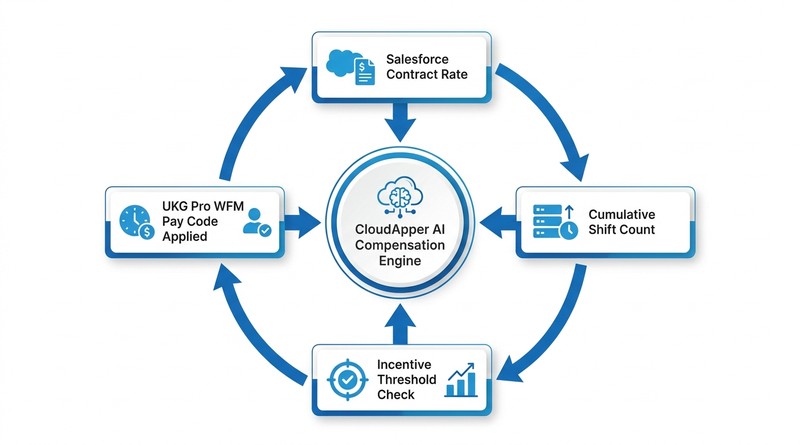
The approach CloudApper takes treats shift scheduling as the moment of truth for physician compensation, not a data-entry event to be corrected later. When a shift is created in UKG Pro WFM, the CloudApper AI Compensation Engine triggers automatically. It reads the facility identifier from the scheduled shift, queries Salesforce to retrieve the applicable contract rate for that hospital, checks the physician’s cumulative shift count in real time, and evaluates whether the shift crosses an incentive threshold. The correct pay code (base rate, incentive premium, or a combination) is applied to the UKG timecard before the physician ever clocks in.
This matters for several reasons beyond accuracy. Physician incentive structures are typically designed to encourage engagement with the staffing organization over the long term: cumulative shift thresholds reward physicians for sustained commitment to a client relationship. When those thresholds are tracked manually and applied inconsistently, they stop functioning as designed. Physicians who have earned a premium and don’t see it lose confidence in the organization’s administrative reliability. The CloudApper iPaaS integration between Salesforce and UKG Pro WFM is designed so the contract terms an organization negotiated are reflected automatically in every timecard, not as an audit after the fact, but at the point of scheduling.
A secondary element of the design addresses physician-facing transparency directly. A 24/7 AI Concierge embedded in UKG gives physicians self-service access to their compensation status: current facility rate, year-to-date shift count, distance to the next incentive threshold. For an independent contractor workforce accustomed to managing their own career decisions, that visibility matters. It is meant to reduce inbound inquiries to the payroll team and gives physicians the information they need to make informed decisions about where and how often they work.
What This Means for Finance and Operations Leadership
The downstream benefits of automated physician pay calculation extend beyond payroll accuracy. Hospital CFOs working with physician staffing organizations have a direct interest in labor cost predictability: they need to forecast what staffing will cost per facility, per quarter, before they commit to coverage agreements. When pay calculations are manual and error-prone, that predictability disappears. Corrected timecards, retroactive adjustments, and untracked incentive premiums create variance that is difficult to explain and harder to budget around.
With an integration like CloudApper’s, every shift carries a contract-confirmed pay amount from the moment it is scheduled. Finance teams can pull UKG data with confidence that what they see reflects the actual contract terms, not an approximation that will require correction after payroll closes. Labor cost reports by facility become usable for contract renewal negotiations, because the underlying data is clean.
In this design, cumulative shift counts are maintained within the CloudApper layer, updated as shifts are scheduled and completed, and used to drive incentive calculations automatically. The separate calculation step between scheduling and payroll drops out, because the data that drove it is accurate at the source.
For organizations managing similarly complex physician compensation structures, the practical question is not whether UKG Pro WFM can handle the workload. It handles the payroll execution exactly as designed. The question is what sits upstream of UKG and ensures that the data feeding the timecard is correct before payroll runs. As discussed in the context of payroll penalty risk for UKG users, the cost of downstream errors in complex compensation environments consistently exceeds the cost of building the right upstream layer. CloudApper’s approach, treating the moment of scheduling as the point where compensation is determined, is designed specifically for that reality.
The goal is to move this organization from a calculation step to a system.
If your organization manages location-dependent physician pay, cumulative shift incentives, or compensation logic that lives outside UKG, CloudApper can help you design an integration that makes UKG the accurate payroll system of record it’s intended to be. Contact the CloudApper team to discuss your specific compensation structure.



October 16, 2026
Public Holiday Substitution Rules Around the World: Why UKG Pro WFM Still Needs Manual Checks
New Zealand calls it Mondayisation, the UK calls it a substitute bank holiday, Canada calls it holiday pay in lieu, and the US calls it an observed holiday. Four names, four rules, and the same manual-check problem for global UKG Pro WFM deployments.


October 16, 2026
UKG Pro Position Management at a Food Producer: Who Sets the Defaults When 75 Employees Change Jobs Every Week
A large food producer moving to UKG Pro handles about 75 internal transfers a week. CloudApper automates the position defaults behind each move, including comp codes, cost centers, standard hours and union codes, through the UKG Pro API, with HR owning and updating the rules without opening a project.

October 15, 2026
Health and Welfare Pay for Military Base Stores: Making Every H&W Hour Traceable in UKG
A national specialty retailer with stores on US military installations needs health and welfare pay it can defend. CloudApper applies the 40-hour weekly cap, multi-store proration and employer cost recovery against UKG time data, posting H&W pay codes to each timecard with a trail back to the hours.

September 30, 2026
Your Best Candidates Already Worked for You: Rehire Campaigns and Geographic Filtering in UKG Pro for Home Care
Large home care organizations hire at high volume across many territories, and former employees often re-enter the same pipeline as strangers. CloudApper AI Recruiter extends UKG Pro Recruiting with zip-code filtering, rehire outreach campaigns and blind ranking, so coordinators see the strongest local candidates first.