A major airport authority runs its FLSA 28-day pay period calculation for firefighters and police on CloudApper AI Platform for UKG, writing cross-period carryover hours back to UKG Pro WFM after each pay period instead of rebuilding them by hand.



Table of Contents
A major US airport authority automated FLSA 28-day pay cycle calculations for its firefighters and police in UKG Pro WFM. Most payroll runs biweekly, and workforce platforms are built around that rhythm. The FLSA also lets public agencies use a work period of up to 28 days for fire protection and law enforcement employees, with a higher overtime threshold that fits their irregular shifts. Running that cycle alongside biweekly payroll takes cross-period math beyond a standard biweekly setup.
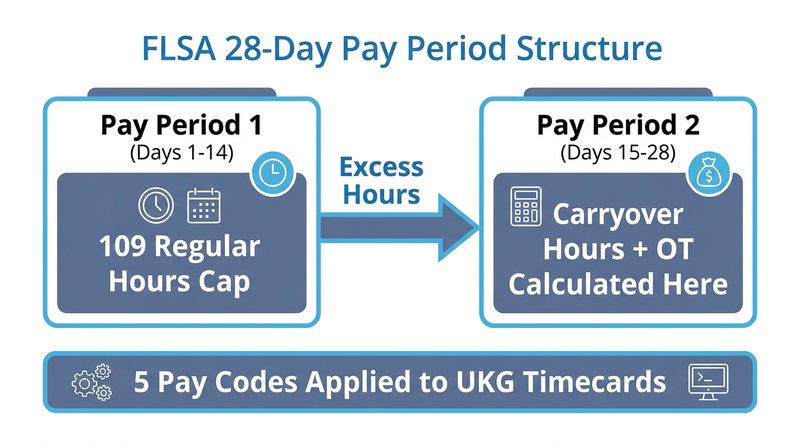
At this authority, the 28-day period spans two biweekly pay periods. Pay Period 1 caps regular hours at 109, and anything above that carries into Pay Period 2, where overtime is calculated on the full 28 days. Five pay codes govern how hours are classified and posted. UKG Pro WFM captures the time accurately, and every cycle someone used to do the carryover calculation by hand. CloudApper AI Platform for UKG now runs that calculation on top of UKG Pro WFM after each pay period, with payroll reviewing the results before they are relied on.
Why the 28-day pay period creates a structural problem for WFM platforms
The FLSA 7(k) exemption lets public safety employers set a work period of 7 to 28 days for overtime purposes. A 28-day period is common among municipal fire and police departments because it smooths out the uneven shift patterns these roles carry: 24-hour shifts, rotating schedules, mandatory coverage minimums. The practical effect is that overtime doesn’t trigger at 40 hours per week. For firefighters, the FLSA threshold is 212 hours in a 28-day period. For law enforcement, it’s 171 hours.
That’s the overtime threshold. The pay period structure is a separate matter. Most organizations still run payroll biweekly: HR systems, payroll vendors, and banks all operate on 14-day cycles. So you end up with two 14-day pay periods nested inside a single 28-day FLSA work period. Hours and overtime have to be tracked across both periods as a single unit, but pay has to post within each biweekly period in the amounts correct for that portion of the overall cycle.

For this airport authority, that meant: a cap of 109 regular hours in Pay Period 1. If a firefighter or officer works more than 109 regular hours in the first 14 days, the excess doesn’t simply become PP1 overtime. It carries into Pay Period 2, where it’s combined with PP2 hours to determine the full-period overtime picture. The final overtime determination and pay code assignments for both periods depend on what happened across the entire 28 days.
That cross-period logic is a custom business rule that sits outside a standard biweekly setup. As explored in the context of extending UKG without touching its core configuration, the platform handles standard payroll logic reliably, and non-standard structures like cross-period carryover are best served by an engine that reads from UKG, applies the custom math, and writes back clean results.
“The next pay cycle is only for the 109 hours. Typically that one works out just fine … the next 28 days we’ll have to find out if the calculations are working correctly because that’s when all the overtime and the vacation time are paid out for fire.”
HR Systems Project Manager, Major Airport Authority
How CloudApper AI Platform for UKG handles the bi-period calculation
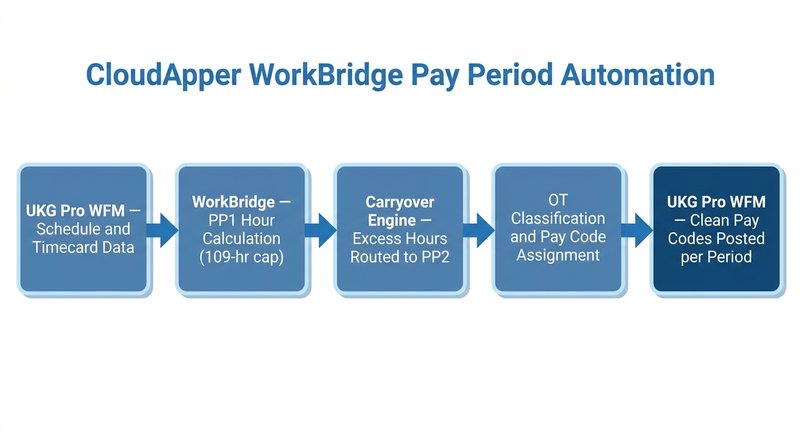
The CloudApper AI Platform for UKG automation runs as a calculation engine layered on top of UKG Pro WFM. At the close of Pay Period 1, it pulls schedule and timecard data for every firefighter and officer. It calculates total regular hours worked against the 109-hour cap. For any employee who exceeded the cap, it flags the excess hours and holds them for PP2 processing.
When Pay Period 2 closes, CloudApper AI Platform for UKG runs the full 28-day calculation: PP2 hours are combined with the PP1 carryover, overtime is determined based on the combined picture, and pay codes are assigned. The five pay codes this authority uses, covering regular time, carryover hours, overtime, and other classifications, are then posted back to UKG Pro WFM timecards at the correct period. Calculated results are also emailed as a report to authority staff with admin access, so payroll can review each cycle.
Payroll no longer re-keys carryover hours or rebuilds the fire department spreadsheet. The staff review the emailed report and the timecards in UKG instead. Getting there took several rounds of correction during rollout, including a date filter added in September 2026, and payroll validates each fix by rerunning a prior cycle as a report before anything posts.
“That’s very fancy … what you’ve got up there. That’s pretty involved.”
HR Systems Project Manager, Airport Authority
What this kind of error actually costs in a public safety context
Payroll errors in public safety organizations carry consequences beyond the immediate correction. Firefighters and police officers work under collective bargaining agreements that specify pay rates, overtime rules, and dispute resolution processes. An error in the carryover calculation (a firefighter paid regular time for hours that should have been overtime, or overtime posted to the wrong pay period) is a grievable event. The correction requires documentation. In some cases, it requires back pay. Repeated errors erode trust in a way that takes time to rebuild.
The FLSA 7(k) calculation is also auditable by the Department of Labor. An organization that can’t produce a clean, timestamped record of how hours were classified across each 28-day period is not in a good position if a wage and hour question arises. Manual processes don’t produce audit trails. They produce spreadsheets, which are modifiable.
Public safety automation more broadly follows this pattern: the audit trail is often as important as the operational outcome. Emergency services organizations building shift fill processes on top of UKG Pro WFM find the same thing: the log of who was offered what, when, and in what order is what resolves grievances. The same principle applies to pay. A timestamped, automated calculation record is defensible. A spreadsheet someone ran during a busy payroll week is not.
That record also gives payroll a way to check the engine before trusting it. When the payroll team wanted to verify a full cycle, the request was simple:
“If you could rerun the report for the previous 28 day pay cycle and that way we could validate all of them to make sure that they’re all adding up. That would be very helpful.”
HR Systems Project Manager at a metropolitan airport authority
The broader pattern: public safety payroll complexity inside UKG Pro WFM
The 28-day pay period is one configuration. Public safety organizations running UKG Pro WFM encounter a range of payroll requirements that call for logic built on top of UKG: shift-based incentive structures, step pay across multiple sworn and non-sworn categories, callback and on-call pay rules that vary by role, and cross-period overtime calculations. The common thread is that public safety compensation is governed by a combination of FLSA rules, state labor law, and collective bargaining agreements, a three-layer structure that produces highly specific operational requirements.
CloudApper’s HCM automation approach for these organizations works the same way it does for the airport authority: read the time and schedule data from UKG, apply whatever rule logic the labor agreement requires, and write results back to UKG Pro WFM as clean, auditable pay code entries. The integration is standard. The logic is configurable to the specific policy, whether that’s a 28-day FLSA period, a step-based incentive structure, or a shift premium calculation that varies by assignment type.
For this airport authority, CloudApper AI Platform for UKG extends UKG Pro WFM with a bi-period payroll calculation that directly affects the pay of firefighters and police officers every 28 days. Since the March 2026 go-live it runs after each pay period on its own, and payroll keeps a validation path by rerunning past cycles as reports.
If your government or public safety organization runs UKG Pro WFM and manages FLSA 7(k) pay periods, complex pay code structures, or cross-period payroll calculations that require custom automation, CloudApper can build the right solution. Contact the CloudApper team to start the conversation.



October 16, 2026
Public Holiday Substitution Rules Around the World: Why UKG Pro WFM Still Needs Manual Checks
New Zealand calls it Mondayisation, the UK calls it a substitute bank holiday, Canada calls it holiday pay in lieu, and the US calls it an observed holiday. Four names, four rules, and the same manual-check problem for global UKG Pro WFM deployments.


October 16, 2026
UKG Pro Position Management at a Food Producer: Who Sets the Defaults When 75 Employees Change Jobs Every Week
A large food producer moving to UKG Pro handles about 75 internal transfers a week. CloudApper automates the position defaults behind each move, including comp codes, cost centers, standard hours and union codes, through the UKG Pro API, with HR owning and updating the rules without opening a project.

October 15, 2026
Health and Welfare Pay for Military Base Stores: Making Every H&W Hour Traceable in UKG
A national specialty retailer with stores on US military installations needs health and welfare pay it can defend. CloudApper applies the 40-hour weekly cap, multi-store proration and employer cost recovery against UKG time data, posting H&W pay codes to each timecard with a trail back to the hours.

September 30, 2026
Your Best Candidates Already Worked for You: Rehire Campaigns and Geographic Filtering in UKG Pro for Home Care
Large home care organizations hire at high volume across many territories, and former employees often re-enter the same pipeline as strangers. CloudApper AI Recruiter extends UKG Pro Recruiting with zip-code filtering, rehire outreach campaigns and blind ranking, so coordinators see the strongest local candidates first.