Ontario's public holiday pay rule is calculated from four work weeks of closed payroll rather than the current timecard. For a specialty grocery retailer with roughly 400 employees, that lookback lives in a spreadsheet. Here is why, and how CloudApper runs it inside UKG Ready with an audit record and a new-hire exception list before every payroll cutoff.



Table of Contents
Almost every payroll calculation looks forward. Hours are worked, rules are applied, a pay code lands on the current timecard. The logic runs on data the system already has in front of it, which is why workforce platforms are built the way they are.

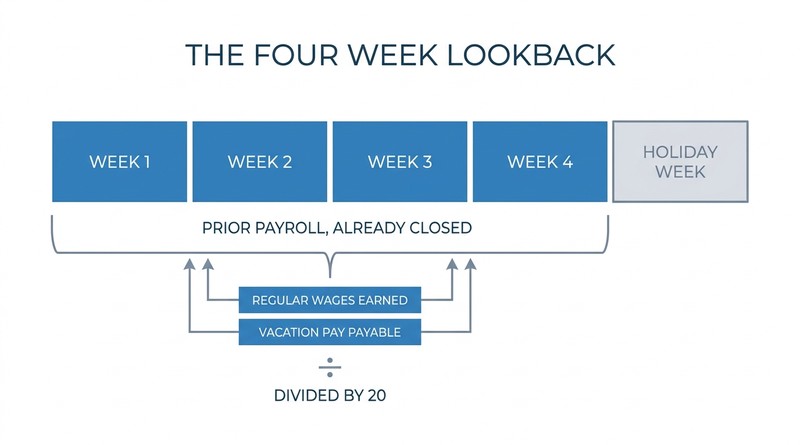
Ontario’s public holiday pay rule runs the other direction. Under the Employment Standards Act, public holiday pay is the regular wages earned plus the vacation pay payable in the four work weeks before the work week containing the holiday, divided by twenty. The number comes from payroll that has already been processed and closed, not from the current timecard. For a specialty grocery retailer in Ontario with a few stores, payroll two periods in arrears and vacation pay on every cheque, that structural difference makes nine holidays a year the most manual part of the payroll calendar.
The Calculation That Would Not Sit in a Timecard
Grocery is a scheduling environment with almost no clean patterns. Part-time cashiers pick up hours across two locations, deli and bakery staff move between departments, students work heavy weeks in summer and light weeks in November, and vacation pay is paid as a percentage of all earnings on every cheque.
Every one of those variables feeds the four-week lookback. Two employees who worked identical hours in the week of a holiday can be owed different public holiday pay because their prior four weeks differed, and the vacation pay attached to those weeks differed with them.
So the retailer’s payroll team does what many Ontario employers do and calculates it manually. Before each holiday cutoff, someone pulls prior-period wage and vacation pay detail, rebuilds the divide-by-twenty math in a spreadsheet for every eligible employee, and keys the resulting amounts back in as adjustments. The business plans to grow, and every new location and new hire adds to that work.
The Cost of a Correct Answer Produced the Wrong Way
The output can be right. That is not the concern. The concern is everything around it.
A calculation reconstructed by hand every cycle has no memory. When the person who owns the spreadsheet is away, the process either waits or runs with someone less familiar with the inputs. New hires are the recurring trouble: an employee hired within the last two pay periods does not have four full work weeks of history, and catching those cases depends on someone noticing a short hire date among several hundred rows.
There is also no defensible record. Ontario employers are expected to show how public holiday pay was determined for a given employee on a given holiday, and a spreadsheet overwritten nine times a year is not that record.
This is the pattern that shows up across payroll rules that depend on historical data rather than current hours, and it is the same underlying weakness behind retroactive pay adjustment errors and the broader class of payroll penalty exposure that comes from calculations living outside the system of record.
Putting the Rule Inside the Payroll Cycle
UKG Ready holds everything the calculation needs: wage history, vacation pay records, employee groups, hire dates, and the pay codes the result has to land on. What the retailer needs is for the Ontario formula to run against that history automatically, on schedule, without a person assembling the inputs.
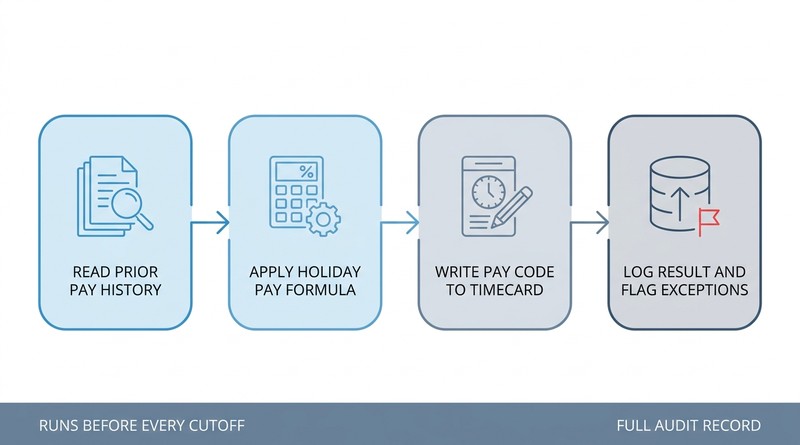
CloudApper provides exactly that layer. Ahead of each payroll cutoff, it reads prior-period wage and vacation pay data directly from the UKG Ready APIs, applies the four-week lookback and divide-by-twenty calculation for every eligible employee, and writes the resulting amount back into UKG Ready as a pay code on the current timecard. Payroll processes normally. Nobody exports anything.
The part a payroll team should value most is not the calculation. It is the record. A management dashboard logs every calculation that ran, the inputs it used, and the amount it produced, and flags exceptions rather than burying them. New hires without four full work weeks of history surface as a named list before cutoff instead of being found afterward.
What It Opens Up Beyond the Nine Holidays
The immediate case is time: a payroll function of this size is not staffed to rebuild the same spreadsheet nine times a year.
The larger effect is on what the organization can take on as it grows. A retailer that can encode one jurisdiction’s payroll rule and run it reliably can encode the next one. Provincial employment standards differ on holiday entitlement, premium pay, and substitute day agreements, and the operators who expand across provincial lines without adding payroll headcount are the ones whose rules live in software. The same reasoning covers the holiday premium pay calculations that sit alongside public holiday pay, and vacation and accrual accuracy, which feeds the lookback window itself.
For store employees, the stakes are quieter and more direct. Part-time grocery staff are the group most likely to have public holiday pay calculated incorrectly, because their prior four weeks vary the most and their pay is the least forgiving of an error. An automated rule gives them an amount produced the same way every holiday, from records that can be shown to them if they ask.
UKG Ready remains the system of record for time, wages, and payroll. What changes is where the province-specific business rule lives. CloudApper AI Platform for UKG and CloudApper iPaaS for UKG run it against the platform’s own data and hand the result back as a pay code, so the approach requires no change to how payroll is processed. Organizations approaching this the same way usually start by asking how to extend their UKG environment without creating upgrade risk, which is the right question.
The CloudApper AI Platform for UKG exists for rules like this one: specific to a jurisdiction, an industry, or a collective agreement, too particular to belong in any platform’s core, and too consequential to leave in a spreadsheet. CloudApper is the process layer that holds the work on top of UKG. The organizations that move fastest are not the ones with the largest payroll teams. They are the ones that do not rebuild the same calculation nine times a year.
If your organization runs Canadian or multi-jurisdictional payroll on UKG and a compliance calculation still depends on exported history and a spreadsheet, talk with the CloudApper team about encoding that rule directly into your existing UKG environment.



October 16, 2026
Public Holiday Substitution Rules Around the World: Why UKG Pro WFM Still Needs Manual Checks
New Zealand calls it Mondayisation, the UK calls it a substitute bank holiday, Canada calls it holiday pay in lieu, and the US calls it an observed holiday. Four names, four rules, and the same manual-check problem for global UKG Pro WFM deployments.


October 16, 2026
UKG Pro Position Management at a Food Producer: Who Sets the Defaults When 75 Employees Change Jobs Every Week
A large food producer moving to UKG Pro handles about 75 internal transfers a week. CloudApper automates the position defaults behind each move, including comp codes, cost centers, standard hours and union codes, through the UKG Pro API, with HR owning and updating the rules without opening a project.

October 15, 2026
Health and Welfare Pay for Military Base Stores: Making Every H&W Hour Traceable in UKG
A national specialty retailer with stores on US military installations needs health and welfare pay it can defend. CloudApper applies the 40-hour weekly cap, multi-store proration and employer cost recovery against UKG time data, posting H&W pay codes to each timecard with a trail back to the hours.

September 30, 2026
Your Best Candidates Already Worked for You: Rehire Campaigns and Geographic Filtering in UKG Pro for Home Care
Large home care organizations hire at high volume across many territories, and former employees often re-enter the same pipeline as strangers. CloudApper AI Recruiter extends UKG Pro Recruiting with zip-code filtering, rehire outreach campaigns and blind ranking, so coordinators see the strongest local candidates first.