A PE-backed HVAC and plumbing group acquiring five to ten businesses a year should not rebuild technician pay logic at every deal. The reason is not cycle time. It is that whatever calculates technician commissions eventually gets read by somebody doing diligence on you, and CloudApper builds that logic once on top of UKG.



Table of Contents
Roll-ups make technician commissions audit-ready by building pay logic once and applying it to every company they acquire. A private-equity-backed HVAC and plumbing group buying five to ten businesses a year builds a lot of things twice, and pay logic should not be one of them. The usual argument is speed of integration. The stronger one is diligence: whatever you build to calculate technician pay will eventually be read by someone evaluating your business.
Technician Pay Logic Is a Diligence Artifact
Across well over a dozen entities, this group’s technician compensation blends hourly rates, multi-tier commissions, revenue threshold kickers, overtime blending and drive-time pay. A spreadsheet can produce those numbers. What it cannot easily produce is a defensible account of how it produced them, per technician, per period, eighteen months after the fact.

That distinction matters at exit. A quality-of-earnings review tests labor cost, and labor cost in a trades business is mostly these calculations. When the arithmetic lives in a compensation engine that reads job and revenue data from the field service platform, applies the pay plan, and posts pay codes to UKG Pro WFM timecards, the answer to “show me how this technician was paid in March” is a lookup rather than an archaeology project.
“From a liability standpoint, we need to just be digitally tracking approvals.”
Finance and Analytics Lead, private-equity-backed HVAC and plumbing group
CloudApper’s approach is to build that engine once, along with the three-way connection between UKG, the field service platform and the financial system that lets payroll and finance data reconcile without a manual pass. The same discipline shows up wherever pay depends on a blended rule: location-based physician incentives and piecework calculations that stay auditable both live or die on whether the arithmetic can be reproduced later.
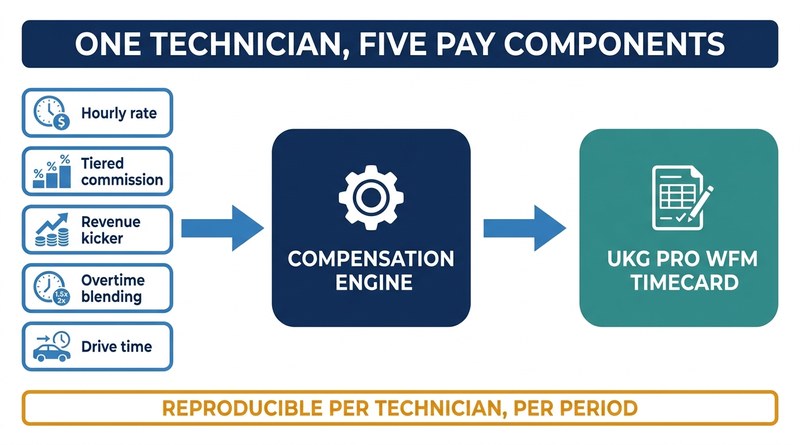
Hourly rate, tiered commission, revenue kickers, overtime blending and drive time resolve into pay codes that can be reproduced per technician, per period.
The Portal Removes One Variable, Not All of Them
An acquisition launch portal standardizes the technical side of onboarding a newly acquired company, and it would be dishonest to claim more than that. Each acquired leadership team still sets its own cut-over date, for reasons that are usually about people rather than systems. What the portal removes is the technical variable, so the conversation is about readiness rather than about whether anyone has built the pay rules yet.
“We don’t have like a standard five pay plans or whatever… that gets dispersed down. Each brand kind of has their freedom to configure it, however, and they’ll get paid on various things.”
Finance and Analytics Lead, private-equity-backed HVAC and plumbing group
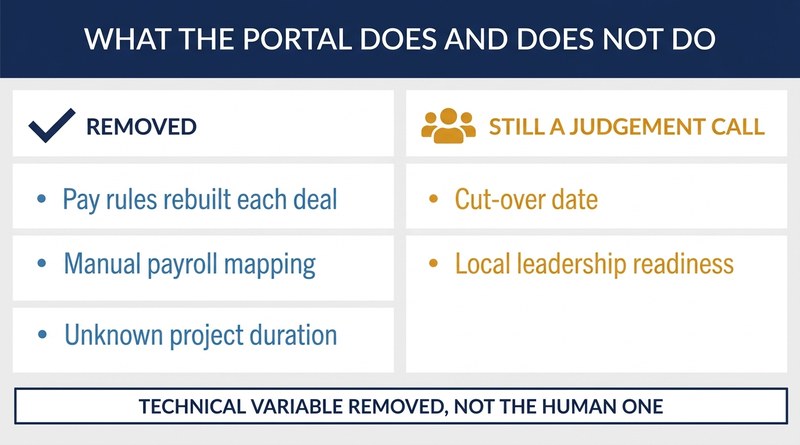
The portal takes the technical variable out of each acquisition. The cut-over date still belongs to the acquired leadership team.
Who Is Actually Measuring This
The person keeping score is often not in the building. In a sponsor-backed roll-up, the operating partner often tracks time-to-synergy in the investment model, and payroll consolidation is a line in that plan with a date attached. Anything that makes the duration predictable is worth more to that reader than anything that makes it briefly faster. Deciding who owns which data before the feed goes live is the same category of preparation.
If you are acquiring several businesses a year and rebuilding technician pay logic each time, CloudApper’s integration work is designed to make that a repeatable step. Talk to the CloudApper team about what it would take in your environment.



October 16, 2026
Public Holiday Substitution Rules Around the World: Why UKG Pro WFM Still Needs Manual Checks
New Zealand calls it Mondayisation, the UK calls it a substitute bank holiday, Canada calls it holiday pay in lieu, and the US calls it an observed holiday. Four names, four rules, and the same manual-check problem for global UKG Pro WFM deployments.


October 16, 2026
UKG Pro Position Management at a Food Producer: Who Sets the Defaults When 75 Employees Change Jobs Every Week
A large food producer moving to UKG Pro handles about 75 internal transfers a week. CloudApper automates the position defaults behind each move, including comp codes, cost centers, standard hours and union codes, through the UKG Pro API, with HR owning and updating the rules without opening a project.

October 15, 2026
Health and Welfare Pay for Military Base Stores: Making Every H&W Hour Traceable in UKG
A national specialty retailer with stores on US military installations needs health and welfare pay it can defend. CloudApper applies the 40-hour weekly cap, multi-store proration and employer cost recovery against UKG time data, posting H&W pay codes to each timecard with a trail back to the hours.

September 30, 2026
Your Best Candidates Already Worked for You: Rehire Campaigns and Geographic Filtering in UKG Pro for Home Care
Large home care organizations hire at high volume across many territories, and former employees often re-enter the same pipeline as strangers. CloudApper AI Recruiter extends UKG Pro Recruiting with zip-code filtering, rehire outreach campaigns and blind ranking, so coordinators see the strongest local candidates first.