A Canadian paper and packaging manufacturer's agreement does not set an overtime threshold. It sets a delta: hours added beyond an employee's scheduled baseline are overtime that day. Automating that raises a question most integration write-ups skip, which is who can still check the math once the logic leaves the agreement.



Table of Contents
The overtime rule governing pay at a unionized plant is rarely the one in the statute. It is the one someone negotiated, and negotiated clauses are shaped by what the parties argued about, not by what fits a configuration screen. A large Canadian paper and packaging manufacturer with several thousand employees offers a clear example. Its agreement does not set an overtime threshold. It sets a delta.
A Delta, Not a Threshold
Statutory overtime in Canada is a threshold rule, and thresholds differ by jurisdiction: Ontario triggers at 44 hours in a week with no daily trigger in its standard rule, British Columbia at eight in a day and 40 in a week, and federally regulated employers work from the Canada Labour Code. Payroll teams know that.

The bargained rule is a different animal. Hours added to a schedule beyond that employee’s regular daily baseline are overtime on that day, measured not against a fixed eight but against what the person was scheduled to work. The same nine-hour day is overtime for one employee and ordinary time for another. It compares two states of a schedule, per employee per day, before the week has finished forming.
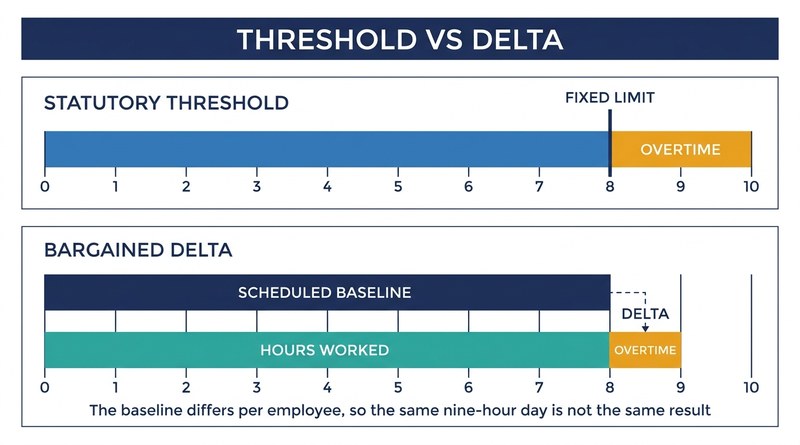
A statutory threshold measures hours against a fixed limit. The bargained rule measures them against that employee’s own scheduled baseline.
Where the Logic Lives Changes Who Can Check It
CloudApper’s approach is a calculation engine alongside UKG Pro WFM: it reads schedule and timecard data, applies the delta comparison and the service-milestone rules from CloudApper Step Progression for UKG, and writes the resulting pay code edits back onto the UKG timecard.
The consequence worth thinking about is not the automation but that pay logic then sits somewhere a union representative cannot read by opening the agreement. The answer is to treat the engine as transcription rather than interpretation: it replicates the clause’s language and adds no employer judgment about intent. Where the clause is ambiguous it stays ambiguous and a person decides, rather than the engine settling it.
A sound design lets the people who police the agreement review the output before it becomes a pay code, and keeps the edit visible on the timecard like any other. Automation does not make a company compliant with its agreement; that is a bargaining question. What the engine removes is the arithmetic as a source of error.
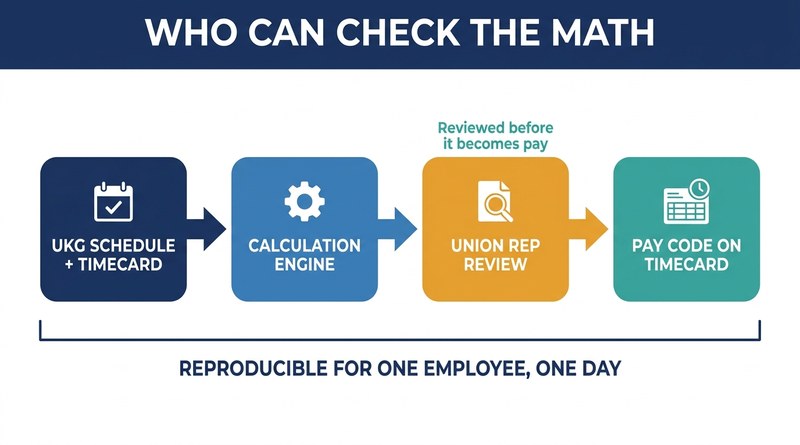
Where the logic lives determines who can check it: the engine’s output is reviewed before it becomes a pay code on the UKG timecard.
The Grievance Test
The test that matters is reproducibility for one employee on one day, because that is the unit a grievance arrives in. Nobody files on a quarter.
For UKG customers whose pay rules come from a bargaining table, bargained clauses are often deltas or conditions on a state rather than thresholds against a clock, and the design question is where that logic lives and who can inspect it. That holds for daily overtime on prevailing wage work, Ontario statutory holiday pay computed from pay history, and step progression rules that differ by department. CloudApper handles the computation; the clause stays the authority, with provincial labour law sitting underneath the bargained terms, not instead of them.
One Question Teams Ask
How do collective agreement overtime rules differ from provincial statutory overtime rules in Canada?
Statutory overtime is set by each province or territory, with the Canada Labour Code applying to federally regulated employers, and works on thresholds such as hours in a day or week. A collective agreement can provide a greater entitlement, and where it does the bargained term governs for covered employees. Those clauses are frequently structured as conditions on a schedule rather than fixed thresholds, which is why they often need calculation logic built for them.
If your pay rules were written at a bargaining table and someone still computes them by hand each period, talk to the CloudApper team about running that logic against your UKG timecards.



October 16, 2026
Public Holiday Substitution Rules Around the World: Why UKG Pro WFM Still Needs Manual Checks
New Zealand calls it Mondayisation, the UK calls it a substitute bank holiday, Canada calls it holiday pay in lieu, and the US calls it an observed holiday. Four names, four rules, and the same manual-check problem for global UKG Pro WFM deployments.


October 16, 2026
UKG Pro Position Management at a Food Producer: Who Sets the Defaults When 75 Employees Change Jobs Every Week
A large food producer moving to UKG Pro handles about 75 internal transfers a week. CloudApper automates the position defaults behind each move, including comp codes, cost centers, standard hours and union codes, through the UKG Pro API, with HR owning and updating the rules without opening a project.

October 15, 2026
Health and Welfare Pay for Military Base Stores: Making Every H&W Hour Traceable in UKG
A national specialty retailer with stores on US military installations needs health and welfare pay it can defend. CloudApper applies the 40-hour weekly cap, multi-store proration and employer cost recovery against UKG time data, posting H&W pay codes to each timecard with a trail back to the hours.

September 30, 2026
Your Best Candidates Already Worked for You: Rehire Campaigns and Geographic Filtering in UKG Pro for Home Care
Large home care organizations hire at high volume across many territories, and former employees often re-enter the same pipeline as strangers. CloudApper AI Recruiter extends UKG Pro Recruiting with zip-code filtering, rehire outreach campaigns and blind ranking, so coordinators see the strongest local candidates first.