A defense services contractor runs a 65-field, two-way UKG Costpoint integration on CloudApper iPaaS. The real lesson is governance: HRIS, finance and IT each own their part of the mapping rules, so labor cost data stays audit-ready as contracts change, without touching UKG Pro configuration.


Table of Contents
A government contractor’s labor cost lives in two places. UKG Pro holds the people: who was hired, which labor category they sit in, what they are paid and where they report. Deltek Costpoint holds the contracts: which project an hour was charged to, what that hour costs once fringe and overhead are applied, and what the government is billed. When an auditor runs a floor check, the real question is whether those two records tell the same story.
For a defense services contractor with 818 employees plus subcontractors, keeping that story consistent had turned into a recurring reconciliation job. CloudApper now runs a 65-field, two-way UKG Costpoint integration that keeps the HR system of record and the project accounting system in agreement. The more useful lesson from the deployment is not that the data moves. It is how the contractor decided who owns the rules that move it.
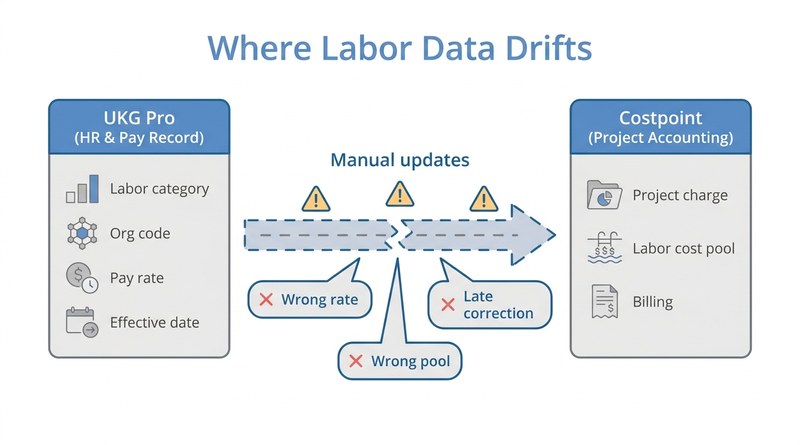
Why Labor Data Drifts Between UKG Pro and Costpoint
FAR 31.201-2 makes the contractor responsible for keeping records adequate to show that claimed costs were incurred, are allocable to the contract and follow the applicable cost principles. For a services contractor, labor is the largest of those costs, so every employee attribute that touches labor charging matters: home organization, labor category, pay rate, exempt status, timesheet approver and effective dates.

Each of those attributes changes in UKG Pro first. A promotion changes a labor category. A transfer changes an organization code. A rate change carries an effective date that has to land in the right Costpoint period. When the update reaches Costpoint late, or by hand, labor gets costed at the wrong rate or charged to the wrong pool, and the correction surfaces weeks later as a journal entry someone has to explain. As the Controller at the defense services contractor put it, “The audit question is never whether we fixed it. It is why the two systems disagreed in the first place, and who noticed.”
Sixty-Five Fields, One Set of Rules
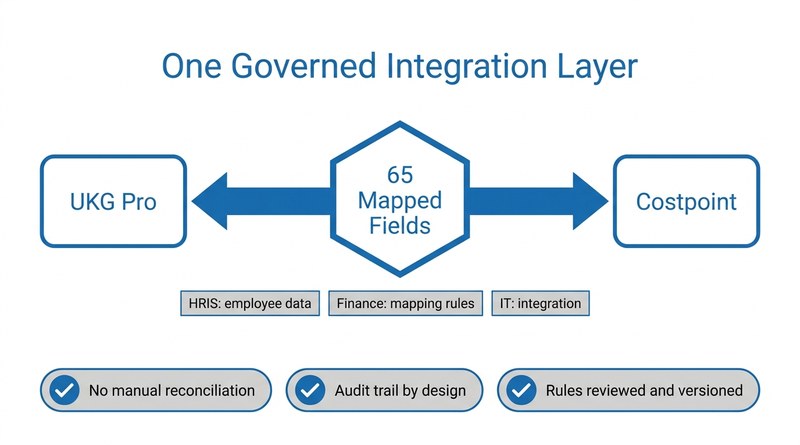
CloudApper built the sync on CloudApper iPaaS for UKG. UKG Pro remains the system of record for employee and pay data, Costpoint remains the system of record for project and contract data, and 65 mapped fields move between them in both directions. The integration carries the business logic government contract reporting depends on: labor category translation, organization and account mapping, effective-dated changes and subcontractor records.
The design choice that mattered most was putting that logic in one governed layer instead of spreading it across export scripts, spreadsheet lookups and individual memory. Every mapping rule has a named owner. HRIS owns the employee attributes, finance owns how those attributes translate into Costpoint labor categories and organizations, and IT owns the integration itself. When a new contract introduces a labor category, the rule is updated once, reviewed and versioned, and nothing in UKG configuration changes. Teams that have worked through feeding client-owned time data into UKG Pro WFM will recognize the pattern: the hard part is agreeing on whose definition wins.
“We stopped asking IT to rewrite an export every time a contract changed. Finance updates the mapping, IT reviews it, and UKG stays exactly as it is.”
HRIS Manager, defense services contractor
The integration does not make the contractor compliant on its own. Contract rules change, edge cases still need a person, and the contractor still answers for every mapping decision. What CloudApper changed is that the responsibility is now visible and reviewable, the same ownership question that comes up when UKG feeds an ERP approval hierarchy.
“An auditor can follow one employee from the UKG record to the Costpoint labor posting without anyone opening a spreadsheet.”
IT Director, defense services contractor
What Changed for Finance and IT
Manual reconciliation between UKG Pro and Costpoint is gone. Labor cost reporting now starts from the same employee data payroll uses, so finance spends close week reviewing exceptions instead of rebuilding records. For audit preparation, the trail from an employee record to a labor posting is documented by the integration rather than reconstructed afterward. That is the same kind of evidence organizations need when somebody has to sign a grant-funded labor allocation.
“Floor checks used to mean a week of pulling records from both systems. Now the records already agree before the auditor arrives.”
Government Compliance Manager, defense services contractor
The Takeaway for Government Contractors on UKG
Contractors often treat an HR-to-ERP interface as an IT project with a go-live date. In a DCAA environment it behaves more like a control, because it decides which numbers reach an invoice. The useful questions for an HRIS Director, Controller or CIO are who owns each mapped field, how a rule change gets reviewed, and how quickly a change in UKG Pro shows up in Costpoint. Contractors handling certified payroll on prevailing wage work see the same pattern: the compliance risk sits in the handoff between systems.
CloudApper builds that handoff as a governed layer on top of UKG, through the CloudApper AI Platform for UKG, so UKG Pro stays the record and the contract books follow it.
If your UKG Pro and Costpoint data still meet in a spreadsheet before every close or audit, talk to CloudApper about connecting them with a two-way integration your HRIS, finance and IT teams can all own.



October 12, 2026
ATS to UKG Ready Integration: How a Light Industrial Staffing Firm Made Every New Placement Payroll-Ready on Day One
A light industrial staffing firm placing 20 to 40 new workers a week was retyping every hire from its ATS into UKG Ready. CloudApper built a daily sync that creates UKG Ready records at assignment and carries updates and terminations across, so every placement is payroll-ready on day one.

October 9, 2026
UKG Pro and Mexico Payroll Integration: How a PEO Keeps Cross-Border Employee Data in Sync
US employers with Mexico operations often run UKG Pro as the system of record and a local platform for Mexican payroll. A professional employer organization replaced manual dual entry between the two with a CloudApper two-way sync for hires, terminations, pay changes and org updates, cutting cross-border payroll errors.

October 7, 2026
Client-Site Employees and UKG Pro WFM: How an Automotive Engineering Firm Keeps Embedded Engineers Paid Right
Engineers working inside a client's facility log time in the client's system, so their paycheck is the employer touchpoint that matters most. An automotive engineering services firm used CloudApper to move those hours into UKG Pro WFM automatically, ending manual re-entry and the pay errors that strained trust with embedded engineers.

September 4, 2026
Inside the Payroll Cut-Off: Landing Telematics Driver Hours in UKG Ready Timecards
A regional trucking company's vehicles already recorded driver hours and mileage accurately. The design question was not whether that data could reach UKG Ready, but whether it would land before the morning payroll review rather than during it, and who on the fleet side now owns data quality that payroll depends on.