Configure UKG Ready or Pro WFM for Canadian provincial labor law — overtime thresholds vary from 40 to 48 hours weekly, break documentation requirements differ by province, and Quebec terminals must operate in French. This guide identifies what UKG handles natively and where the hardware layer introduces compliance gaps.



Table of Contents
- Why Provincial Law Complexity Is Uniquely Challenging for UKG Administrators
- Provincial Overtime Thresholds: The Configuration Matrix
- Break Requirements: Simpler Than Overtime, but Still Province-Specific
- What UKG Does Well for Canadian Compliance
- Where the Gaps Show Up
- What to Configure in UKG Before Expanding into Canadian Provinces
- How CloudApper AI TimeClock Handles Provincial Variation
- Frequently Asked Questions
- Closing
When a US-headquartered company rolls UKG Ready or UKG Pro WFM into its Canadian locations, the assumption is usually that the hard work is already done. The software is configured. The integrations are live. Payroll is running. What more could Canada need beyond a timezone adjustment and a French language pack?
The answer is: a fundamentally different labor law framework that operates at the provincial level, where ten provinces set their own overtime thresholds, break schedules, statutory holiday entitlements, and pay calculations — sometimes radically differently from each other, and almost always differently from the FLSA rules your UKG environment was originally built around.
CloudApper AI TimeClock for UKG runs on any Android tablet or iPad, syncs directly with UKG Ready and Pro WFM, and surfaces location-specific compliance workflows at the terminal — meaning an employee in Ontario sees Ontario rules, and an employee in British Columbia sees BC rules, without requiring separate hardware or parallel systems for each province.
Why Provincial Law Complexity Is Uniquely Challenging for UKG Administrators
Canada has no single national employment standard that governs private-sector workers across all provinces. The Canada Labour Code applies only to federally regulated industries — banking, interprovincial transport, broadcasting, and telecommunications. For the majority of Canadian employers — retail, manufacturing, healthcare, hospitality, construction — each province is its own jurisdiction.
That creates a configuration problem for UKG administrators that has no equivalent in US multi-state deployments. In the United States, the FLSA sets a federal floor and states layer on top. In Canada, there is no provincial floor — each province is the entire regulatory framework for the workers it governs.
The practical consequence for multi-jurisdiction hour tracking in UKG Pro WFM is that every pay rule — overtime threshold, break trigger, statutory holiday calculation — must be configured independently for each province where you have employees, and those configurations cannot share assumptions.
Provincial Overtime Thresholds: The Configuration Matrix
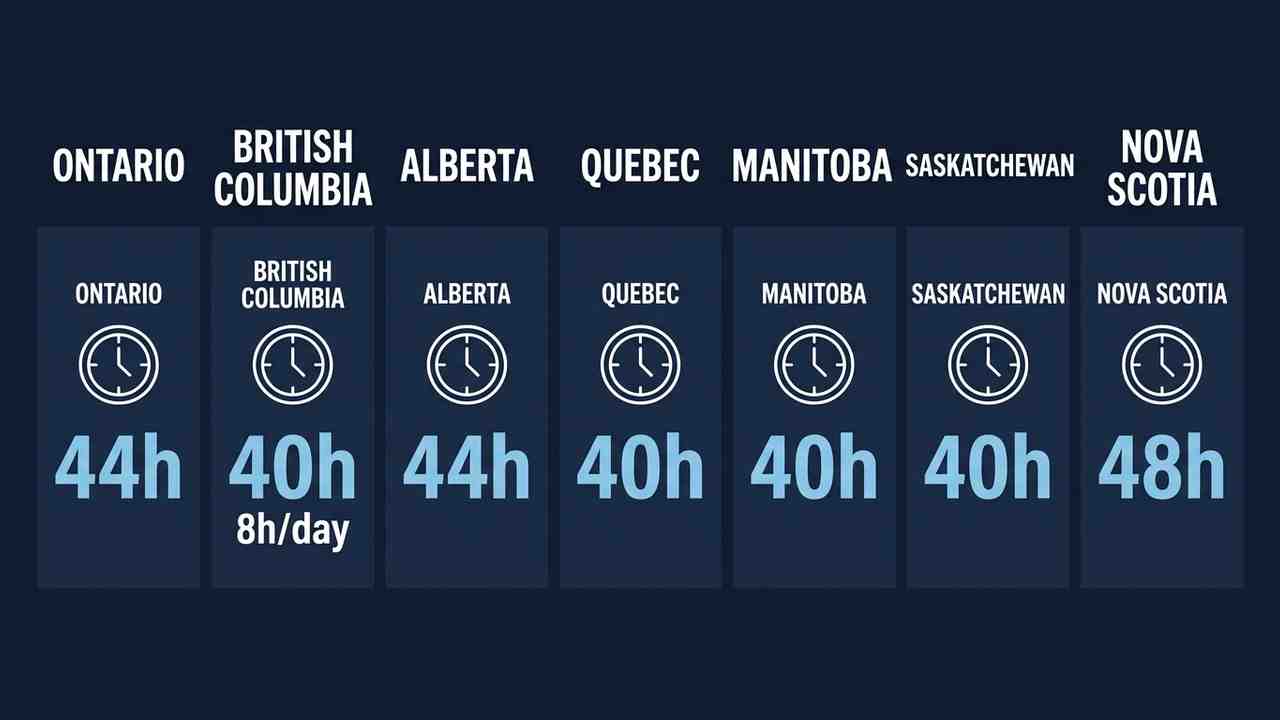
Overtime in the United States triggers at 40 hours per week under the FLSA. In Canada, that number is different in almost every province, and several provinces add daily overtime thresholds on top of weekly ones.
Ontario: Overtime begins at 44 hours per week at 1.5× regular pay. No daily overtime trigger. Employees can enter into written overtime averaging agreements.

British Columbia: The most layered structure in Canada. Daily overtime triggers at 8 hours (1.5×) and again at 12 hours (2×). Weekly overtime triggers at 40 hours. Both calculations run simultaneously — the employee receives whichever produces more overtime pay.
Alberta: Daily overtime at 8 hours, weekly overtime at 44 hours. Alberta uses a “greater of” rule — employers calculate both thresholds and pay the one that generates more overtime hours, not both combined.
Quebec: Weekly threshold at 40 hours, no daily trigger. 1.5× regular wage. Quebec employees can take time off in lieu of overtime pay under certain conditions.
Manitoba and Saskatchewan: Both set weekly overtime at 40 hours with daily triggers at 8 hours and a 1.5× rate. Overtime banking arrangements are permitted with written agreement.
Nova Scotia and PEI: Weekly thresholds at 48 hours — the highest in Canada — calculated against minimum wage rather than the employee’s regular wage. This distinction matters significantly for employees earning above minimum.
New Brunswick: Weekly threshold at 44 hours, calculated at 1.5× minimum wage rather than regular wage.
For a UKG administrator maintaining overtime control in UKG, each of these represents a distinct pay rule configuration. A single Canadian national pay group does not exist — and any assumption that Ontario rules cover Alberta employees, or that BC rules cover Quebec employees, will produce payroll errors in both directions.
Break Requirements: Simpler Than Overtime, but Still Province-Specific
Canadian provincial break requirements are more uniform than overtime thresholds, but uniform does not mean identical. Most provinces trigger a 30-minute unpaid meal break after five consecutive hours of work. The exceptions matter.
British Columbia requires the 30-minute break after five consecutive hours, but if the employee is required to remain available during the break — at the workstation, near the phone, on-call — the break is counted as paid work time. This distinction is the same trigger that generates break-related wage claims in US states like California: a break that is not truly uninterrupted is not a legally compliant break.
Newfoundland and Labrador requires a one-hour unbroken rest period after five consecutive hours — double the minimum in every other province. Organizations operating in Newfoundland with the same 30-minute break prompt used elsewhere are under-complying, and the employee has no record of what actually occurred.
Alberta allows the 30-minute break to be split into two 15-minute periods by agreement — but requires written documentation of that arrangement. Without a contemporaneous record at the terminal confirming the employee received the required break, a split-break arrangement has no paper trail.
The pattern across these variations is the same one that drives California meal break enforcement in UKG: the legal requirement is not just that a break occurred, it is that the employee received it, that it was uninterrupted, and that a record of that acknowledgment exists. A punch-out and punch-in generates a data point. An employee attestation at the terminal generates a compliance record. These are different things.
What UKG Does Well for Canadian Compliance
UKG Ready and UKG Pro WFM support multi-jurisdiction pay rule configuration. A UKG administrator can configure separate overtime policies by province, assign those policies to location-based employee groups, and run provincial-specific overtime calculations through the pay rules engine. The platform’s labor law tools are built to accommodate layered thresholds — the daily-plus-weekly structure that British Columbia requires, for example, is something UKG can model.
UKG’s reporting engine handles overtime reporting across jurisdictions once the pay rules are configured correctly. For payroll teams running consolidated reports across Canadian and US locations, the platform can segment by province and produce the records a Ministry of Labour audit would request.
Where UKG’s native Canadian compliance support is limited is at the point of capture — what happens between the employee and the time record, before the data ever reaches the pay rules engine.
Where the Gaps Show Up
Break attestation at the terminal. Native UKG hardware — Intouch DX, 9000, 9100, 4500 — does not, in standard configuration, prompt employees for a break acknowledgment at clock-out. In provinces where break compliance depends on a contemporaneous employee record (British Columbia’s paid-availability rule, Newfoundland’s one-hour requirement, Alberta’s split-break documentation), the absence of a terminal-level attestation means the compliance record does not exist. Managers inferring break compliance from a punch gap cannot produce what a Ministry of Labour investigator will ask for in a contested break dispute.
Provincial-specific workflows on shared hardware. Organizations that deploy a single UKG terminal model across multiple provinces cannot configure location-specific break prompts or overtime acknowledgments on proprietary UKG hardware without substantial configuration overhead. An employee at an Ontario facility and an employee at a BC facility may be clocking in on identical terminals with identical workflows — even though BC’s daily overtime structure and break-time rules impose meaningfully different capture requirements.
Statutory holiday pay calculation documentation. Every Canadian province has its own statutory holiday list and pay calculation methodology. Ontario, BC, Alberta, and Quebec each calculate statutory holiday pay differently — average daily earnings formulas, qualifying day requirements, and opt-out provisions vary. When a Ministry of Labour audit flags a statutory holiday underpayment, the documentation trail runs from the pay rule configuration back to the time record. Audit readiness for wage and hour investigations applies equally in Canadian employment standards contexts: the records need to exist before the inquiry opens.
Bilingual terminal requirements in Quebec. Quebec’s Charter of the French Language requires that workplace tools available to employees operate in French. For organizations deploying time clock terminals in Quebec, an English-only interface is not compliant. UKG’s proprietary hardware supports French interfaces at the configuration level, but organizations deploying mixed tablet-based hardware need to confirm that clock-in workflows, attestation prompts, and self-service functions surface correctly in French for Quebec employees.
What to Configure in UKG Before Expanding into Canadian Provinces
Build a provincial pay rule map before configuration begins. Every province where you have employees needs its own pay group in UKG with the correct overtime thresholds, daily triggers (where applicable), and statutory holiday pay methodology. Do not copy US pay rules into Canadian locations and adjust the overtime threshold. Build each provincial configuration from the applicable employment standards act.
Audit your break event capture method. If your current UKG configuration infers break compliance from punch gaps rather than capturing a discrete break event, identify which Canadian provinces you operate in and which require break attestation documentation. BC, Ontario, and Newfoundland are the highest-risk jurisdictions. Confirm whether your terminal hardware supports break acknowledgment prompts before you need those records in a dispute.
Document your statutory holiday calculation logic. Pull the pay rule documentation for each province and confirm that the statutory holiday pay methodology matches the Employment Standards Act in that province. Pay miscalculation errors surface in audits as the gap between what the pay rule produces and what the legislation requires — that gap needs to be your documentation to provide, not the auditor’s to find.
Confirm French-language terminal compliance for Quebec. If you operate in Quebec, test clock-in, break acknowledgment, and self-service workflows in French before those terminals go live. A French-language compliance gap is an Employment Standards complaint waiting to happen, not an abstract risk.
How CloudApper AI TimeClock Handles Provincial Variation
CloudApper AI TimeClock for UKG runs on standard Android tablets or iPads and syncs directly with UKG Ready and Pro WFM. For Canadian organizations managing provincial complexity, several capabilities address the hardware-layer gaps that proprietary UKG terminals do not close.
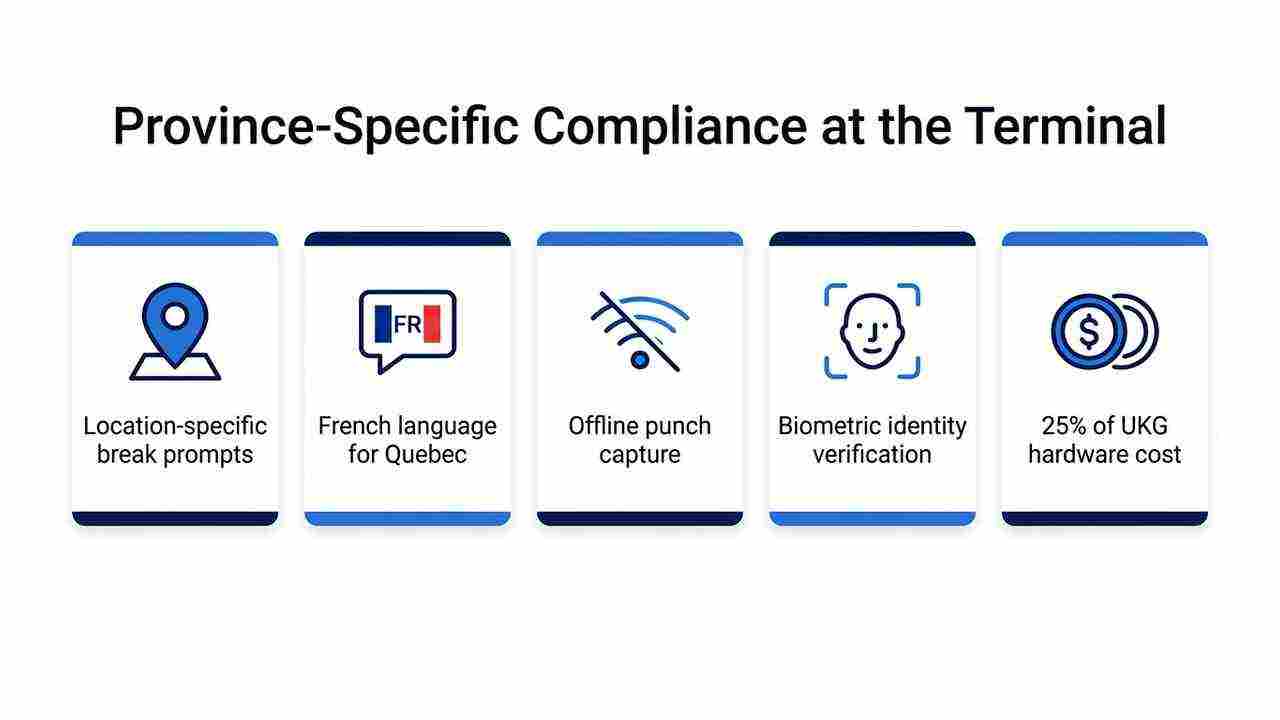
Location-specific attestation prompts. Break acknowledgment workflows, overtime acknowledgments, and compliance prompts are configured per location. An employee clocking out at a BC facility sees a break attestation prompt calibrated to BC’s paid-availability rule. An employee in Newfoundland sees a prompt confirming receipt of the full one-hour rest period. An employee in Alberta clocking out under a split-break arrangement sees the documentation that makes that arrangement legally defensible. The configuration follows provincial law, not a single national template.
Bilingual interface support. CloudApper AI TimeClock supports multi-language terminal configurations, allowing Quebec locations to operate in French — clock-in prompts, self-service menus, attestation language, and HR policy queries through the 24/7 AI assistant. Organizations that added Canadian locations incrementally and never resolved the Quebec language compliance gap can close it through terminal configuration rather than a hardware replacement project.
Offline capture with automatic sync. Canadian operations frequently include remote and rural locations — resource extraction sites, logistics hubs, construction sites in areas with unreliable connectivity. Offline time capture with automatic sync ensures that punch data and attestation records are preserved at the terminal and written to UKG when connectivity is restored. A Ministry of Labour records request covering a 24-month period should never produce a gap because a terminal went offline during a northern winter storm.
Biometric identity at every punch. Facial recognition verification is included in standard CloudApper AI TimeClock licensing at no additional cost. For Canadian operations with high shift overlap or shared terminal stations, biometric verification addresses the same identity risk that compliance-grade time clock configuration requires in any jurisdiction where the punch record needs to prove who worked, not just that someone clocked in.
Hardware cost at 25% of proprietary UKG devices. Canadian expansion — opening additional provincial locations, converting legacy punch clocks at manufacturing facilities, or standardizing on a single hardware platform across US and Canadian sites — typically triggers a hardware procurement review. CloudApper AI TimeClock runs on any standard Android tablet or iPad at 25% of the cost of UKG’s proprietary Intouch devices, without sacrificing biometric verification, attestation compliance, or offline capability.
Frequently Asked Questions
Q: Does UKG Ready support Canadian provincial overtime rules natively?
Yes. UKG Ready and UKG Pro WFM support multi-jurisdiction pay rule configuration, allowing administrators to build province-specific overtime policies with distinct daily and weekly thresholds. British Columbia’s dual-trigger structure (1.5× after 8 hours, 2× after 12 hours, weekly at 40 hours) and Alberta’s “greater of” daily/weekly rule can both be modeled in UKG’s pay rules engine. The configuration work is substantial for organizations with employees in multiple provinces, but the platform supports it.
Q: Which Canadian province has the most complex overtime rules for UKG configuration?
British Columbia is typically the most complex, because it applies both daily and weekly overtime triggers simultaneously, with two different multipliers (1.5× and 2×) depending on how many daily hours were worked. Configuring BC pay rules in UKG requires careful attention to the interaction between daily and weekly calculations to ensure the employee receives the legally correct amount — not a blended average, but the higher of the two applicable calculations.
Q: Are meal break rules the same across all Canadian provinces?
No, though most provinces share a common baseline: a 30-minute unpaid meal break after five consecutive hours of work. The key exceptions are Newfoundland and Labrador (one-hour break), British Columbia (break is paid if the employee must remain available), and Alberta (split-break permitted by written agreement). Organizations with employees in multiple provinces should configure terminal-level break capture per location rather than using a single national break workflow.
Q: Does the Canada Labour Code apply to UKG organizations in manufacturing, retail, or healthcare?
Generally no. The Canada Labour Code governs federally regulated industries — banking, telecommunications, interprovincial transport, broadcasting — which represent a minority of Canadian employers. Most manufacturing, retail, healthcare, hospitality, and construction employers are governed by provincial employment standards legislation. UKG configurations for these organizations should be built against the Employment Standards Act or equivalent in each province, not the Canada Labour Code.
Q: What records does a provincial Ministry of Labour investigation typically request?
Provincially regulated workplace investigations mirror the structure of US DOL wage and hour audits: clock-in and clock-out records for each employee under review, total daily and weekly hours, overtime calculations, pay stubs, and break period records where applicable. Investigations in BC, Ontario, and Quebec are most likely to request break documentation as a specific line item. Organizations that cannot produce contemporaneous break records — as distinct from punch gaps — are in a weaker position in contested break disputes.
Q: Do Quebec time clock terminals need to operate in French?
Yes. Quebec’s Charter of the French Language requires that workplace tools available to employees function in French. A time clock terminal operating exclusively in English in a Quebec workplace is non-compliant. This applies to clock-in interfaces, break prompts, self-service menus, and any employee-facing HR content the terminal surfaces. CloudApper AI TimeClock supports multi-language configuration per location, allowing Quebec terminals to operate in French while other provincial locations use English.
Q: Can one CloudApper AI TimeClock device handle both Canadian and US employee groups?
CloudApper AI TimeClock is configured at the location level — each tablet or iPad at a given site can be set to surface the compliance workflows, break prompts, and language settings appropriate for that location’s workforce. A single deployment can span US and Canadian sites with location-specific configurations applied per terminal. The UKG sync handles payroll routing to the correct pay group for each employee, meaning the hardware standardization does not require a corresponding simplification of the pay rule structure.
Closing
Canadian operations introduce a labor compliance layer that is genuinely distinct from US multi-state deployments — not a minor configuration adjustment, but a set of independent provincial frameworks that each require their own pay rule logic, break documentation standards, and statutory holiday calculations. UKG’s pay rules engine supports that complexity at the software level. The hardware layer is where organizations most often leave gaps.
If your Canadian locations are running proprietary UKG hardware without province-specific attestation prompts, or are capturing break compliance through punch gaps rather than terminal acknowledgments, or are managing Quebec operations on English-only terminals, those are solvable configuration problems — not permanent hardware constraints.
Explore how CloudApper AI TimeClock handles multi-province Canadian compliance at https://ukg.cloudapper.ai/affordable-ukg-kronos-time-clock/


October 9, 2026
Biometric Time Clocks in Canada: Quebec Law 25, PIPEDA, and Provincial Rules for UKG Sites
Biometric time clock rules in Canada change at provincial borders. Learn what Quebec Law 25 and its 60-day CAI notice require, when PIPEDA applies, how Alberta and BC PIPA treat employee information, and a five-step plan for consent and audit at UKG sites using Intouch devices or CloudApper AI TimeClock.

October 8, 2026
Locking a Tablet Down as a Dedicated UKG Time Clock: Kiosk Mode with Jamf, Intune, and Android Enterprise
IT's first objection to a tablet time clock is that someone will misuse it. Learn how to lock an iPad or Android tablet into a dedicated UKG time clock with Jamf, Intune, or Android Enterprise, a five-step day-one checklist, and what IT should manage after go-live alongside Intouch DX devices.

October 7, 2026
Moving Sites Off Paper Timesheets into UKG Without Buying Terminals
Some UKG sites still run on a clipboard because mobile punching and dedicated terminals never fit. Learn how to match each site to the right UKG capture method, why paper creates FLSA recordkeeping risk under 29 CFR 516, and a five-step cutover plan that includes a shared tablet kiosk option.
October 6, 2026
Does Your UKG Time Clock Vendor Need a BAA? HIPAA, Biometrics, and Healthcare IT Review
Healthcare procurement often attaches a BAA to every vendor by reflex, but for time clocks that can point at the wrong law. Learn why employee punches usually are not PHI, when patient data or biometric laws change the analysis, and the five-step review healthcare IT should run before deploying a UKG time clock.