A large resort pays housekeepers by the room across 108 room types and turns up to 800 rooms on peak weekend days. CloudApper adds a piece-rate engine on top of UKG Pro WFM that pays the higher of piece or hourly earnings each day, protecting the minimum wage floor and keeping overtime on the right basis.



Table of Contents
- The Math Behind the Room
- Extending UKG Pro WFM to Do the Work
- Self-Managed Rate Tables That Hold Up Under Audit
- What Payroll Gets Back
Piece-rate housekeeping pay in UKG has to protect the minimum wage floor across every room type, and at one large mountain resort that means 108 of them. The resort pays housekeeping per room: one rate for a standard unit, another for a luxury unit, and others for partially occupied rooms. On peak weekends the team turns up to 800 rooms in a day. Under the FLSA, if a housekeeper’s piece-rate earnings for the workweek fall below minimum wage for the hours worked, the resort must make up the difference. Running that check across 108 rate combinations every payroll cycle calls for a dedicated calculation layer, which CloudApper builds on top of UKG Pro WFM, because any miss is wage-and-hour exposure built into payroll.
The Math Behind the Room
Piece-rate pay works as long as the rate per room stays above what the worker would have earned by the hour. When it doesn’t, because the day was slow, a particular room type pays less or a shift ran short, the employer owes a makeup payment. It’s a federal requirement, and in a property with 108 room types spread across multiple ownership tiers, tracking it by hand every cycle is the kind of work that only seems manageable until payroll actually runs it.

The resort’s CTO described the rate structure plainly: “So there’s 108 different ways you can own timeshare with this… we have five different OAs. Within those OAs, they sometimes have a costly unit, a luxury unit. So there’s so many different room types.”
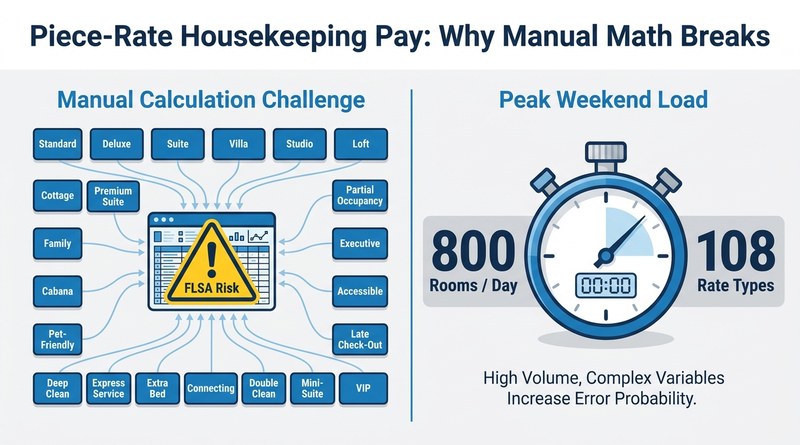
The legacy system managing this calculation had been built years earlier and had no scalable path forward. Adding new room types meant calling the vendor. Rate changes required support tickets. And the compliance calculation itself, the one that determined whether a worker was being paid correctly under the FLSA, was locked inside an application the resort could no longer maintain.
Extending UKG Pro WFM to Do the Work
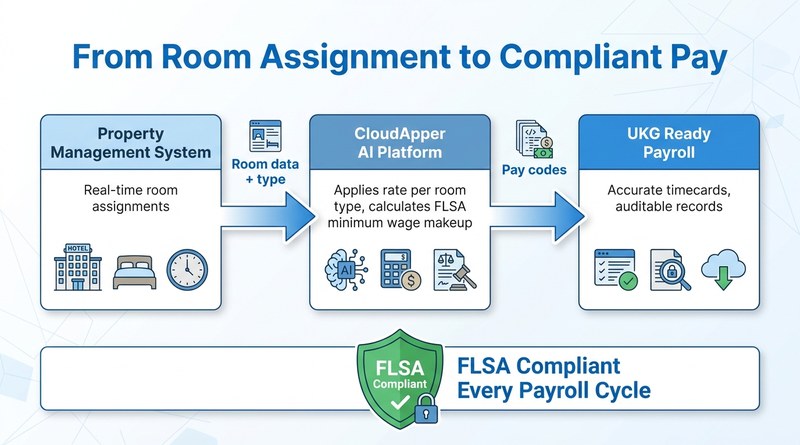
CloudApper designs the piece-rate pay engine to run on top of UKG Pro WFM. It takes room assignments and completed cleans from the housekeeping system, by employee, date, unit, room type and clean type, and applies the correct rate for each of the 108 room types. A nightly run compares each housekeeper’s piece earnings with hours worked at their own hourly rate, pays the higher of the two, figures overtime on whichever method won that day, keeps weekend bonuses out of the comparison, and writes the result to the UKG Pro WFM timecard.
The point is that the compliance decision happens at the calculation layer, not the review layer. Payroll does not receive a timecard to evaluate; it receives a timecard with the correct amounts already applied.
“The reason that we take the higher of the two is because we want to ensure that minimum wage rates are hit.”
HR Administrator, large mountain resort
The CTO explained why the employee-first rule matters: “We always want to give whatever works out best for the employee. If they’re cranking out units that’s worth more than their hourly rate, then that’s their incentive to crank out units that fast.”
For hospitality payroll leaders comparing this to tip pool calculation challenges in UKG Ready, the pattern is familiar: a per-employee earnings calculation that depends on real-time operational data (who worked, for how long, in which role) cannot be solved by native configuration alone. Both require a calculation layer that reads from operational systems and writes accurate pay codes back to UKG.
Self-Managed Rate Tables That Hold Up Under Audit
One requirement shapes the CloudApper design more than any other: self-service. The resort needs to update room rates, add new room types and adjust associations without engaging a vendor for every change. That is a legitimate business requirement. A resort property’s rate structure isn’t static, and rate management can’t become a support-ticket queue.
The CTO was direct about this expectation. When housekeeping calls to say “we’re having a hard time getting cleaners, we’re jumping up piecework by ten dollars across the board,” the CTO wants to make the change “on the appropriate day, and your system just picks it up. And I don’t have to go call you and have you modify things.”
What makes this safe from a compliance and audit standpoint is that the self-managed rate tables operate within a governed, change-logged framework that extends UKG Pro’s payroll integrity rather than working around it. The CloudApper AI Platform for UKG treats UKG Pro and UKG Pro WFM as the systems of record throughout: every pay code that CloudApper generates lands in UKG as an auditable entry, not a manual override.
What Payroll Gets Back
The operational payoff should show up in two places. The first is labor cost visibility. Piece-rate operations generate a lot of data (rooms cleaned, rates applied, time spent, exceptions flagged) and the resort wants easier access to it.
As the CTO described: “We keep striving for better real-time reporting, especially on labor, because… labor can be the one of the most expensive metrics for any business… the more we can get that into the managers’ hands, then maybe there’s the ability to, oh, we only got 10 units left and we can cut five cleaners and try to save some money.”
The second is FLSA confidence. Hospitality operations with piece-rate workers face a compliance audit exposure that’s easy to underestimate until a payroll exception surfaces it. Automating the minimum wage makeup calculation, with a defensible audit trail behind every timecard, converts that exposure from an ongoing risk into a closed loop. Payroll leaders who have managed piecework compliance in manufacturing environments will recognize the same dynamic: the math isn’t hard, but the scale and the frequency make manual processes unsustainable.
The Broader Point for Hospitality on UKG Pro WFM
Resort and hotel properties that pay housekeeping staff on a piece-rate basis are common. The compliance requirement (minimum wage makeup pay when piece-rate falls short) applies regardless of how many room types are in the rate table. What varies is how the calculation gets done. At 108 room types and 800 rooms on a peak weekend, the manual version doesn’t scale. What scales is a calculation engine that connects the property management system to UKG Pro WFM and handles the math automatically.
For UKG Pro and UKG Pro WFM hospitality customers operating similar piece-rate models, this requirement is worth studying closely. The same pattern of extending UKG Ready with a purpose-built calculation layer applies wherever the pay rule outpaces the platform’s native configuration, and piece-rate minimum wage compliance in hospitality is exactly that kind of requirement.
To explore how CloudApper can extend UKG Pro WFM for piece-rate pay compliance at your property, contact the CloudApper team.



October 16, 2026
Public Holiday Substitution Rules Around the World: Why UKG Pro WFM Still Needs Manual Checks
New Zealand calls it Mondayisation, the UK calls it a substitute bank holiday, Canada calls it holiday pay in lieu, and the US calls it an observed holiday. Four names, four rules, and the same manual-check problem for global UKG Pro WFM deployments.


October 16, 2026
UKG Pro Position Management at a Food Producer: Who Sets the Defaults When 75 Employees Change Jobs Every Week
A large food producer moving to UKG Pro handles about 75 internal transfers a week. CloudApper automates the position defaults behind each move, including comp codes, cost centers, standard hours and union codes, through the UKG Pro API, with HR owning and updating the rules without opening a project.

October 15, 2026
Health and Welfare Pay for Military Base Stores: Making Every H&W Hour Traceable in UKG
A national specialty retailer with stores on US military installations needs health and welfare pay it can defend. CloudApper applies the 40-hour weekly cap, multi-store proration and employer cost recovery against UKG time data, posting H&W pay codes to each timecard with a trail back to the hours.

September 30, 2026
Your Best Candidates Already Worked for You: Rehire Campaigns and Geographic Filtering in UKG Pro for Home Care
Large home care organizations hire at high volume across many territories, and former employees often re-enter the same pipeline as strangers. CloudApper AI Recruiter extends UKG Pro Recruiting with zip-code filtering, rehire outreach campaigns and blind ranking, so coordinators see the strongest local candidates first.