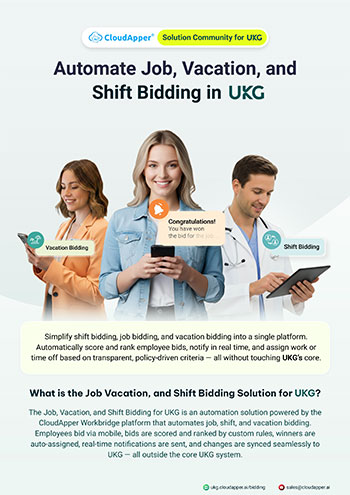

Multi-site employers donโ€™t have one bidding process. They have one per location, because union contracts, seniority definitions, and vacation policies legitimately differ from site to site, and each site ends up improvising with spreadsheets, sign-up sheets, and email threads to manage it. The result is a set of manual bidding practices that nobody can apply consistently or prove they followed. CloudApper extends UKG Pro to simplify shift, vacation, and job bidding, letting each department or location run its own configured bidding rules and qualification criteria, applied automatically and synced back to UKG. Hereโ€™s why the rules differ, where the manual approach breaks, and how the automated version works.

TL;DR

  • Bidding rules legitimately differ by site, since union contracts and vacation policies arenโ€™t the same everywhere.
  • Manual processes, not rule variation, are what break consistency and create grievance risk.
  • Spreadsheets and sign-up sheets leave no audit trail when a union rep or corporate asks how an award was decided.
  • CloudApper extends UKG Pro so each siteโ€™s bidding rules in UKG run as configured, automated logic, synced back to UKG Pro.
  • Consistency means proving each site followed its own rules, not forcing every site onto identical ones.

Why Bidding Rules Legitimately Differ Across Sites

The variation itself is not the problem. Sites run different bidding rules for structural reasons, and usually contractual ones.

Turn-HR-gaps-into-working-solutions-in-days-not-months

Different Union Contracts, Different Seniority Logic

A manufacturer with five plants might operate under five collective bargaining agreements, each defining bidding its own way. One contract awards by strict seniority. Another uses rotating priority to spread desirable shifts around. A third applies seniority only when qualifications are equal. Even the word seniority means different things in different buildings: plant seniority at one site, company tenure at another, hours worked at a third. None of them is doing it wrong. Theyโ€™re doing what their contract says.

Different Vacation and Shift Policies by Location

Vacation bidding varies just as much. One site runs an annual seniority-ordered bid round with a cap of two people off per week. Another runs quarterly windows. A third applies past-usage rules, so whoever got Christmas off last year goes to the back of the line this year. Shift bidding splits the same way: awards by seniority at some locations, rotation to equalize overtime at others, skills-based ranking for specialized work elsewhere.

Automate-Job-Vacation-and-Shift-Bidding-in-UKG-Datasheet

Free Datasheet

CloudApper Job, Vacation, and Shift Bidding Solution for UKG Datasheet

Different Qualification Requirements per Site

Who can even bid differs by location. State licenses, site-specific equipment training, and role certifications all gate eligibility, and a rule that makes sense at a facility running heavy machinery has no equivalent at a distribution center two states away. Multi-site shift bidding has to respect these boundaries, or unqualified awards create safety and compliance problems on top of scheduling ones.

The Real Problem: Every Site Improvises Its Own Manual Process

Hereโ€™s the situation most multi-site HR leaders live with. UKG Pro holds the schedules, the accrual balances, and the seniority data. The bidding decision logic, though, lives somewhere else: in a spreadsheet at Site A, a printed sign-up sheet at Site B, a schedulerโ€™s memory at Site C. Corporate has no way to know whether any given award followed policy, and in a union environment, every inconsistency is grievance material. A mis-ordered seniority award can end in arbitration and back pay.

CloudApper-WorkBridge-The-AI-Layer-That-Makes-Any-HCM-Fit

The manual approach also breaks at scale. An annual vacation bid at a 500-person site means cross-referencing seniority lists, balances, and slot caps by hand, in order, over weeks. One skipped name restarts the round and burns employee trust. When a union rep asks how an award was decided, the answer is a spreadsheet version nobody can verify. And when employees canโ€™t see the logic behind awards, they assume favoritism. The fix starts with a definition. Consistency doesnโ€™t mean every site runs the same rules. It means every site runs its own rules the same way every time, and can prove it. Thatโ€™s what CloudApper builds on top of UKG Pro.

Infographic showing how CloudApper automates different job, shift, and vacation bidding rules across multiple UKG Pro sites while maintaining consistent eligibility, ranking, approvals, and audit trails.
CloudApper helps each site run its own bidding rules consistently while syncing approved outcomes back to UKG Pro.

How CloudApper Extends UKG Pro to Automate Bidding Rules Across Every Site

CloudApper works alongside your UKG Pro system, using the employee data already there and pushing results back when bids close. Hereโ€™s the workflow.

Step 1: Each Siteโ€™s Rules Become Configured Logic, Not Tribal Knowledge

Every locationโ€™s bidding rules get configured in the platform: strict seniority order, rotating priority, first-come within tier, slot caps, blackout periods, past-usage penalties, and the qualification requirements that gate eligibility. Each department or location keeps its own rulebook, with no custom code inside UKG. When a contract provision changes at one plant, the rule updates in hours and touches nothing at the other four.

Add-missing-HR-features-with-web-and-mobile-apps-fast

Step 2: Only Eligible Employees See the Bid

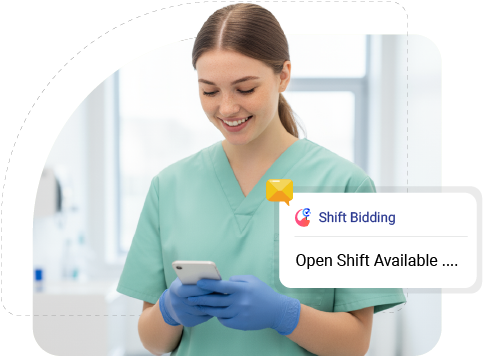
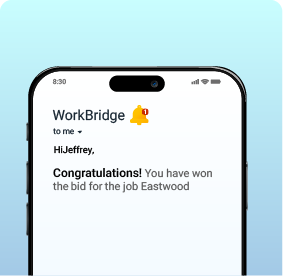
When a manager posts an open job, shift, or vacation slot, the system checks training, certifications, tenure, and job role before anyone gets invited to bid. Ineligible bids never enter the process, which means no awkward retractions later. Eligible employees get notified instantly by SMS, email, or their team chat tool the moment the bidding window opens.

Step 3: Employees Bid From Their Phones in Seconds

No sign-up sheet taped to a break room wall, no reply-all chains. Employees can bid from any device and check whether their bid is pending, ranked, approved, or declined. That visibility matters, because favoritism suspicion feeds on silence, and a seniority-based bidding process employees can watch working is one they stop complaining about.

Step 4: The System Scores and Ranks Every Bid by That Siteโ€™s Rules

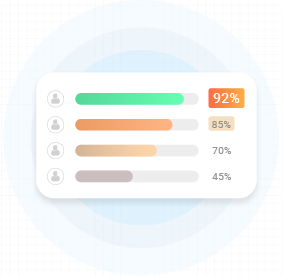
As bids come in, the platform scores and ranks them using that locationโ€™s configured criteria, whether thatโ€™s seniority, tenure, past vacation usage, skills, or performance data. The same rules apply to every bid in every cycle, and conflicts like overlapping shifts or double assignments get caught automatically before an award goes out. Union bidding rules run exactly as written, because thatโ€™s exactly how they were set up.

Step 5: Managers Review, and Results Sync Back to UKG Pro

Managers can review the ranked results and approve, adjust, or override before anything finalizes, with every action timestamped in a tamper-evident audit record. Then the platform syncs bidding results to UKG automatically: awarded assignments, approved time-off entries, and pay codes flow into UKG Pro, so scheduling, payroll, and accruals stay aligned without anyone retyping outcomes.

Benefits of Automating Multi-Site Bidding Rules

Hereโ€™s what changes when every locationโ€™s rulebook runs as configured logic:

CloudApper-WorkBridge-The-AI-Layer-That-Makes-Any-HCM-Fit

  • Every site follows its own rules exactly, every cycle, with no drift between what the policy says and what the spreadsheet did.
  • Bid seasons shrink from weeks to days, because scoring, ranking, and conflict checks happen automatically instead of by hand.
  • Every award comes with proof, a timestamped audit trail ready for union reps, corporate reviews, or compliance.
  • Rule changes deploy in hours, per site, without retraining schedulers or touching other locations.
  • Employees trust the outcomes, because they can see their bid status and know the same logic applies to everyone.
  • Corporate gets one consolidated view of bidding activity across every location, instead of five versions of the truth.

Frequently Asked Questions

Can UKG Support Different Bidding Rules For Different Locations?ย 

Yes. CloudApper extends UKG Pro so each department or location runs its own bidding criteria, policies, seniority rules, and qualification requirements. The platform applies each siteโ€™s rules automatically based on employee groupings and syncs final assignments back into UKG.

Does Automated Bidding Work With Union And Seniority Rules?

ย Yes. You can configure seniority-driven and union-compliant rules such as strict seniority order, first-come within tier, and rotating priority, matched to each siteโ€™s collective bargaining agreement, without modifying anything inside UKG.

Can Managers Override Bidding Results?

ย Yes. Managers can review ranked results and approve, adjust, or override assignments before they finalize. Every change is timestamped and documented in the audit record, so transparency holds even when a human steps in.

How Do Bidding Results Get Back Into UKG Pro?

ย Automatically. Once an award finalizes, CloudApper pushes the assignment, approved time-off entry, and related pay codes directly into UKG Pro, keeping scheduling, payroll, and accrual data aligned without double entry.

One Platform, Every Siteโ€™s Rules

Running different bidding rules in UKG Pro across multiple sites was never the problem. The contracts and policies behind those rules are real, and they arenโ€™t going to converge. The problem was that each site enforced its rules by hand, with no consistent way to prove any of it. UKG Pro holds your schedules, seniority data, and accruals. CloudApper extends it so the bidding logic on top runs on rules configured once and applied the same way every time, with a record to prove it. If your bid seasons still run on spreadsheets and sign-up sheets, contact us today to see how CloudApper automates job, vacation, and shift bidding in UKG and watch your most complicated siteโ€™s rules run themselves.