A 1,500-employee food manufacturer runs absence reporting through department voicemail lines that fill up, and verifies no-call/no-shows by hand. Here is why that breaks down on production lines and how CloudApper AI Platform for UKG connects bilingual SMS call-outs and NCNS detection to UKG Pro WFM.


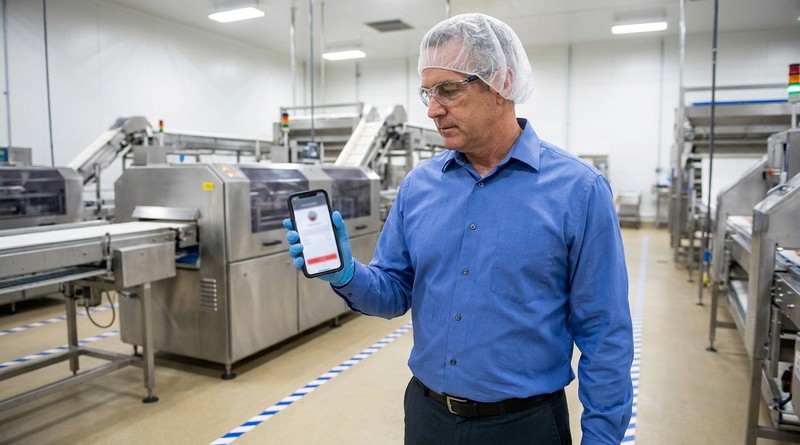
Table of Contents
UKG absence management automation matters most at a plant where call-offs still go to a voicemail box. A food manufacturer with roughly 1,500 employees, most of them hourly and on rotating shifts, runs UKG Pro WFM for time and pay while absence reporting and no-call/no-show detection happen by hand. Employees call a department voicemail extension at least an hour before their shift, supervisors are expected to check and clear the box every day, and HR verifies each suspected no-call/no-show before adding the NCNS pay code in UKG Pro WFM.
The process is fragile at exactly the moments it needs to work. Voicemail boxes fill up when they are not cleared, and employees who cannot leave a message end up texting their supervisor and HR with screenshots of call logs. No-call/no-show cases depend on supervisors reporting them and HR verifying each one, and attendance disciplinary emails are waiting in HR’s inbox every morning.
CloudApper AI Platform for UKG addresses this with a multilingual SMS absence and NCNS workflow connected directly to UKG Pro WFM. Supervisors see an absence the moment an employee texts in, and the NCNS pay code is applied automatically for employees who neither punch nor report.
When the Voicemail Fills Up, Supervisors Work Blind
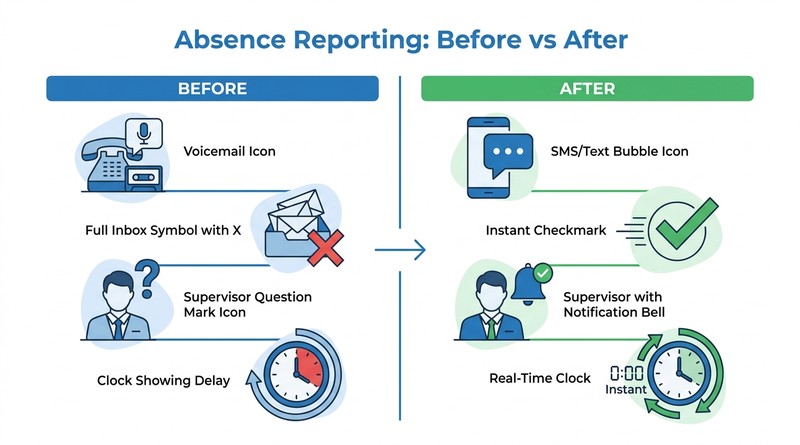
The operational cost of a voicemail-based absence system is easy to underestimate because it is spread across many small failures rather than one visible one. A voicemail box that fills up at 4 a.m. on a Monday means the next three employees who call in get no confirmation and no record. A supervisor who checks messages at 6 a.m. has a 30-minute window to adjust staffing before the shift starts, if the messages were even audible. An HR team that logs absences from voicemail transcriptions is introducing a data entry step into a process that doesn’t need one.
The no-call-no-show problem compounds this. An employee who simply doesn’t show up is indistinguishable, in the moment, from an employee whose call-in message got lost. The supervisor doesn’t know which situation they’re dealing with until the shift is underway. The formal NCNS designation, with its pay code implications and HR documentation requirements, can’t happen until after HR compares punch data against absence records the following morning. In the meantime, the employee’s status in UKG Pro WFM reflects nothing meaningful about what happened.

For a food manufacturing environment, where production lines depend on minimum crew levels and last-minute staffing gaps have real output consequences, this lag in absence visibility is not an administrative inconvenience. As discussed in the context of how frontline workers interact with UKG systems, the distance between what HR systems record and what supervisors can act on in real time is where workforce management breaks down most visibly for hourly employees.
How CloudApper Approaches the SMS-to-UKG Absence Pipeline
The approach is built around a single action: the employee sends a text message. No app to download, no portal to log into, no call that might go unanswered. The employee texts their absence to a designated number in English or Spanish, and the response is immediate: a confirmation that the absence was received and recorded.
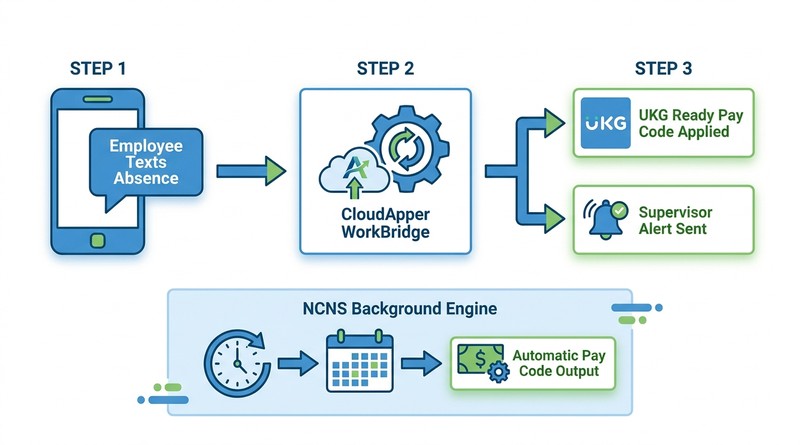
What happens on the back end is where CloudApper AI Platform for UKG does its work. CloudApper receives the incoming text, identifies the employee based on their registered mobile number, cross-references their UKG Pro WFM profile to confirm their department, shift assignment, and supervisory hierarchy, and pushes an Absence pay code directly to their UKG Pro WFM timecard in real time. Simultaneously, the shift supervisor receives an automated alert. By the time the employee finishes texting, the supervisor has a notification on their phone showing who is out and for which shift.
The multilingual capability is a deliberate design choice, not an afterthought. The plant workforce includes both English and Spanish speakers. A system that requires English-only interaction creates a two-tier absence process: one that works easily for some employees and creates unnecessary friction for others. CloudApper handles the incoming message in either language, processes it identically, and confirms the receipt in the same language the employee used. The pay code that enters UKG Pro WFM is the same regardless.
What this gives supervisors is something a voicemail line cannot provide: a real-time view of who is absent, before the shift begins. There is no message queue to check, no phone tag with HR, and no delay between when an employee reports out and when that information appears where supervisors need to see it. As analyzed in the context of filling last-minute shift call-outs in UKG Pro WFM, the speed of absence notification directly determines whether staffing adjustments are possible before a shift is already short.
“They will also text me like, hey, I want to make sure that you guys know I tried to call, but the voicemail is full.”
Plant HR Representative, Food Manufacturer
Automated NCNS Detection and What Visibility Can Change
The no-call-no-show problem requires a different mechanism. An employee who doesn’t text in and doesn’t punch in generates no data at all until the shift has already started. Detecting that situation in real time, rather than the morning after, requires continuous cross-referencing of punch data against scheduled shifts during the shift window.
CloudApper runs a background detection engine that does exactly this. As each shift’s clock-in window closes, CloudApper compares the employee’s scheduled start time against their UKG punch record. Employees who have no punch and no recorded absence are flagged automatically. CloudApper applies the NCNS pay code to their UKG Pro WFM timecard and routes an alert to HR and the shift supervisor, not the following morning, but during the same shift. The supervisor knows the situation before the day is over. HR reviews a consolidated exception report instead of verifying each case by hand.
The pay code accuracy this is designed to produce has downstream consequences for payroll processing. When NCNS codes are applied manually, the lag between the event and the record creates correction cycles: adjustments made after payroll review, sometimes retroactively. When detection is automated, the code is in the system before payroll runs, at the correct rate, against the correct shift record.
For plant leadership, the design also adds something new: executive-level reporting. CloudApper delivers daily reports on absences by plant, repeat offenders and tardiness, measured as scheduled start versus actual punch with a configurable grace window, without requiring HR to build them manually. Today a late arrival only adds half a point and never shows up as its own event, so for operations leadership managing production capacity across plants, that data turns absence from an HR administrative problem into an operations visibility input.
The voicemail system this organization relies on is not a failure of effort. It is a failure of architecture: the channel cannot scale, the data does not reach supervisors in time, and the NCNS process depends on human detection of a problem that is inherently automatable. CloudApper AI Platform for UKG adds the layer that turns absence reporting from a manual, lag-prone process into a real-time, bilingual, UKG-integrated workflow, without replacing any part of the workforce management infrastructure the organization has already built.
If your organization manages frontline absence reporting through phone calls, voicemail, or manual NCNS detection, CloudApper can help you build a real-time SMS-to-UKG absence pipeline that works for your entire workforce. Contact the CloudApper team to discuss your specific environment.


October 16, 2026
Public Holiday Substitution Rules Around the World: Why UKG Pro WFM Still Needs Manual Checks
New Zealand calls it Mondayisation, the UK calls it a substitute bank holiday, Canada calls it holiday pay in lieu, and the US calls it an observed holiday. Four names, four rules, and the same manual-check problem for global UKG Pro WFM deployments.

October 16, 2026
UKG Pro Position Management at a Food Producer: Who Sets the Defaults When 75 Employees Change Jobs Every Week
A large food producer moving to UKG Pro handles about 75 internal transfers a week. CloudApper automates the position defaults behind each move, including comp codes, cost centers, standard hours and union codes, through the UKG Pro API, with HR owning and updating the rules without opening a project.
October 15, 2026
Health and Welfare Pay for Military Base Stores: Making Every H&W Hour Traceable in UKG
A national specialty retailer with stores on US military installations needs health and welfare pay it can defend. CloudApper applies the 40-hour weekly cap, multi-store proration and employer cost recovery against UKG time data, posting H&W pay codes to each timecard with a trail back to the hours.
September 30, 2026
Your Best Candidates Already Worked for You: Rehire Campaigns and Geographic Filtering in UKG Pro for Home Care
Large home care organizations hire at high volume across many territories, and former employees often re-enter the same pipeline as strangers. CloudApper AI Recruiter extends UKG Pro Recruiting with zip-code filtering, rehire outreach campaigns and blind ranking, so coordinators see the strongest local candidates first.