Australia's NT Government needed SMS-based shift fill for Fire and Emergency Services with four-layer eligibility filtering and overtime priority ordering — a capability UKG Pro WFM's engineering team confirmed it could not deliver. Here is how CloudApper AI Platform for UKG built it.




Table of Contents
For a public safety agency, an unfilled shift is not an administrative inconvenience. It is a staffing gap. When a fire station cannot reach minimum coverage before a shift begins, a supervisor is making decisions under time pressure with incomplete information: who is eligible, who last worked overtime, who holds the right certifications, and whether any of them can be reached in the next fifteen minutes.

An Australian government public safety authority — operating Fire and Emergency Services as well as Police across a geographically dispersed region — needed UKG Pro WFM to handle all of that automatically. Filter the eligible pool. Sort by fairness rules. Broadcast via SMS. Let different agencies configure their own allocation logic. The combination of requirements went beyond UKG Pro WFM’s standard configuration, so CloudApper AI Platform for UKG was brought in as a UKG innovation partner to build the extension.
The shift fill problem in public safety has four layers
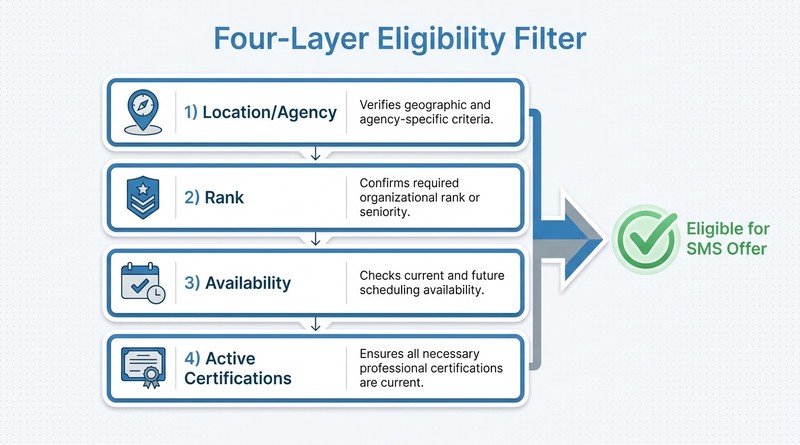
Filling a shift in a retail store is not the same as filling one for Fire and Emergency Services. The worker has to be eligible in four simultaneous ways: right location or agency, correct rank for the open position, confirmed availability, and active certifications for the role. Miss one, and the worker cannot take the shift regardless of willingness. The system had to evaluate all four before any notification went out — not sequentially but as a single gate.
Then there was the fairness requirement. Overtime in public safety is contested. Workers who have not received overtime recently expect the next available shift to come to them before colleagues who have worked it more recently. Notification order had to be sorted dynamically by each eligible worker’s most recent overtime record. A random or alphabetical list would not survive scrutiny. Poorly managed overtime distribution is not a minor HR complaint — it generates grievances that accumulate fast in unionized workforces, a dynamic that transparent allocation systems address directly.
UKG Pro WFM’s native open shift notification is a solid base for workforce communications. This authority needed an additional layer that could handle eligibility filtering, priority ordering, and SMS delivery at the precision their collective agreements required. CloudApper AI Platform for UKG built that layer directly on top of UKG Pro WFM’s existing infrastructure.
How the SMS pipeline works
The solution sits between UKG Pro WFM and Twilio’s SMS platform. When a shift gap opens, the supervisor enters it. CloudApper AI Platform for UKG checks eligibility against the UKG workforce data — location, rank, availability, certifications — and excludes anyone who does not clear all four. No message goes out until that check runs.
The remaining pool is sorted by overtime priority. Whoever has gone longest without an overtime shift is first. The SMS goes out with a response timer. No reply before the timer expires, and it moves to the next person. This continues until the shift fills or the pool is exhausted — at which point the supervisor gets an escalation alert.
What that replaces is a supervisor working through a paper list, calling people who may not pick up, with no record of what happened. The automated version is faster and documentable — which matters a great deal when someone asks, after the fact, why they were not offered the shift. With SMS as the channel, workers respond through something they already use. No app, no portal login. Notification speed is what determines whether a gap gets filled or becomes an operational problem — something anyone managing last-minute shift call-outs in UKG Pro WFM knows well.
“Before this, filling a shift at short notice meant working through a list on paper, calling people who might not pick up, with no record of who was offered the shift and in what order. Now the system does that automatically, and there’s an audit trail for every step. That changes the conversation entirely when someone raises a question about overtime.”
— Workforce Planning Manager, Australian Government Public Safety Authority
Fire gets Manager Discretion. Police gets First-Come-First-Served.
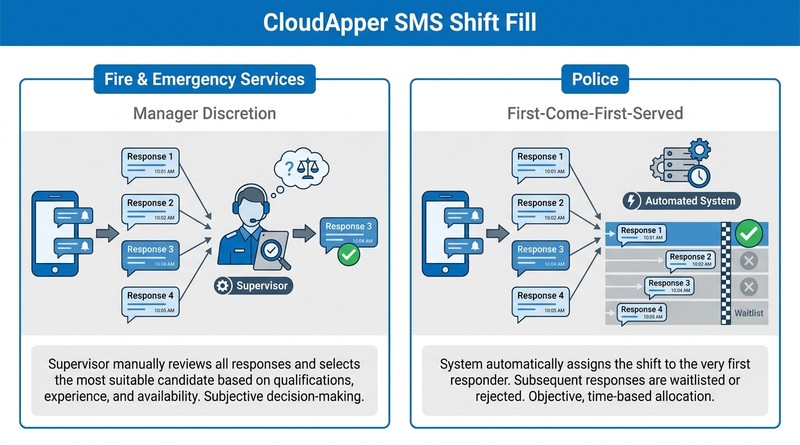
Fire and Emergency Services and Police are both entities within this authority on UKG Pro WFM, but they want different things at the allocation stage.
For Fire: once the SMS broadcast surfaces willing, eligible respondents, the supervisor makes the final call. Crew dynamics, deployment context, incident type — there are things the eligibility filter does not know. The system presents the candidates in priority order. The supervisor decides.
For Police: first eligible worker to respond gets the shift. No supervisor involvement, automatic confirmation. Speed and consistency matter more than case-by-case discretion, and a fully automated process is harder to dispute.
Same CloudApper AI Platform for UKG platform. Same eligibility filtering, overtime sorting, and SMS delivery. Only the final assignment step differs. This authority can extend the same infrastructure to additional agencies — different collective agreement rules, different shift fill preferences — without rebuilding. The platform CloudApper delivered for Fire and Police was designed to scale from the start.
The audit trail is the real outcome
Shifts fill faster. That is the visible result.
The more significant one is the record. Every step is logged: who was in the eligible pool, in what order, who received an offer, when they received it, how they responded, who got the shift. In a collective bargaining environment, that log is what you produce when someone files a grievance about overtime. The answer is no longer a supervisor’s recollection. It is a timestamped sequence of events.
That tends to change how disputes are handled — and over time, how often they come up.
CloudApper AI Platform for UKG extended UKG Pro WFM with the eligibility logic, priority ordering, SMS delivery, and configurable allocation modes these agencies needed — keeping UKG Pro WFM as the system of record throughout. The shift fill process is faster, fairer, and auditable. That is what it was supposed to be.
If your government or public safety organization runs UKG Pro WFM and needs a configurable, SMS-based shift fill process with eligibility filtering and overtime priority ordering, CloudApper can design the right solution. Contact the CloudApper team to start the conversation.



December 6, 2024
Simplify Holiday Employee Scheduling Using CloudApper’s UKG/Kronos TimeClock
Streamline holiday scheduling with CloudApper AI. Simplify shift management, automate approvals, and reduce last-minute stress. Empower employees with schedule control, ensure attendance, and integrate seamlessly with UKG. Handle the holiday rush confidently while boosting efficiency and employee satisfaction.
May 2, 2024
How UKG Users Can Ensure Optimal Shift Coverage With CloudApper AI
Unfilled shifts disrupt operations and cost businesses. UKG users can ensure optimal coverage with CloudApper AI's Shift Optimization solution for shift trading, bidding, and confirmations.

February 19, 2024
How UKG Users Can Minimize The Effects of No-Call No-Show Events
Worried about employee no-call no-show events? Use CloudApper AI's Shift Optimization for UKG and reduce the effects now!

January 18, 2024
Make Group Scheduling Easier on UKG with Two Simple Steps
UKG boasts powerful group scheduling features, but there are ways to simplify scheduling with a few clicks. Enhance UKG's workforce management capabilities by simplifying scheduling with 2 steps.