A trucking carrier's vehicles already record driver hours and mileage accurately. The design question is not whether that data can reach UKG Ready, but whether it lands before the morning payroll review rather than during it, and who on the fleet side owns the data quality payroll will depend on.


Table of Contents
Telematics driver payroll in UKG Ready works best when accurate hours and mileage from the fleet platform land on timecards before the payroll cut-off. A regional trucking carrier that pays drivers by the mile and by the hour already has that data in its fleet telematics platform. The work is getting it into UKG Ready in time, so the morning review is a check rather than a data-entry shift. CloudApper addresses this with a daily sync from the fleet telematics platform into UKG Ready, and the design has to respect one constraint that has little to do with technology.
The Constraint Is the Clock
Fleets run a review before hours lock. Somebody looks at the driving day, questions what looks wrong, and fixes it before payroll closes. That window is short, sits at a fixed time, and everything upstream has to arrive before it opens rather than during it.
So the question for a daily feed from the telematics platform into UKG Ready is never whether the data can move. It is whether it will land early enough to be reviewed on the existing schedule, already matched to the fields that review works from. A feed that is correct but late saves nobody anything. One that is on time but in a shape the reviewer must interpret creates a second queue beside the one it was meant to shrink.
CloudApper UKG Sync pulls hours driven and mileage from the telematics platform daily and populates the UKG Ready timecards ahead of that window, mapped to the fields already in use. The variance review still runs, because payroll teams do not stop checking. The aim is that what it surfaces are real questions about a driving day rather than transcription slips.
“Download the data for us, we could review it for accuracy, and then say it’s good, and then it goes into UKG automatically, right? That’s kind of my simple belief on that one.”
IT Lead, regional trucking and logistics company
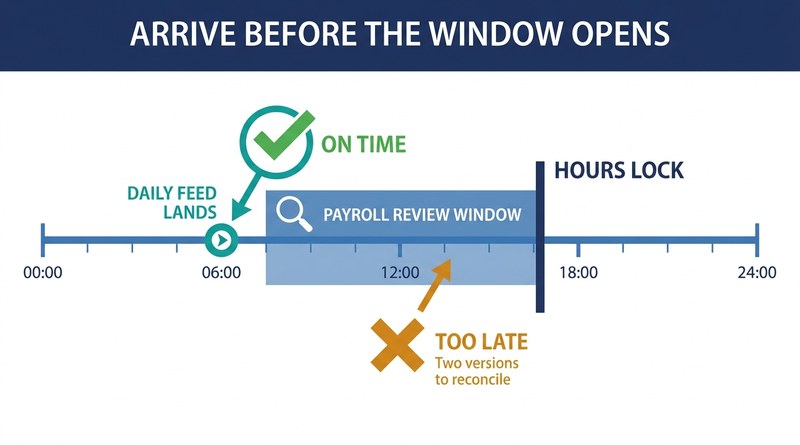
The constraint is timing: a feed that is correct but late leaves the payroll team reconciling two versions instead of one.
Two Owners, One Driving Day
Here is the part these projects miss. The telematics platform belongs to the fleet side, and whoever administers it is measured on hours-of-service compliance and safety, not payroll accuracy. Those records and payroll records are separate obligations drawn from the same driving day, and until a feed like this exists, nothing the fleet manager does has payroll consequences downstream.

That changes the moment payroll depends on the same data. A stale vehicle assignment, a driver profile not updated, a device swapped without a note: each becomes a pay question rather than only a compliance one. That data-quality responsibility has to be named rather than assumed, and the two paths kept separate, so FMCSA hours-of-service reporting stays its own deliverable rather than a by-product of the pay run.
“We capture the miles driven, because we pay our guys by the mile, and the hours driven, because we pay our guys by the hour. You pay them two ways.”
IT Lead, regional trucking and logistics company
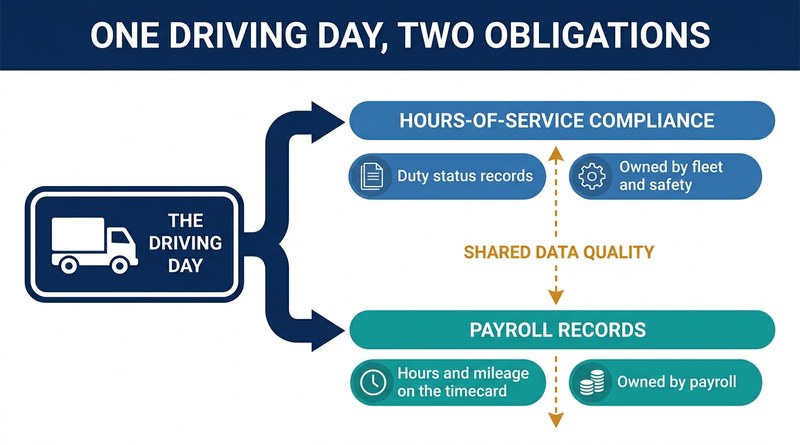
One driving day carries two separate obligations with two different owners, which is why data quality on the fleet side has to be named rather than assumed.
What It Buys
When drivers are paid from what the vehicle recorded rather than what someone read off a screen and typed again, a category of correction goes away. The sync also has to place overnight runs that start in the evening and end the next morning on the correct day, and update timecards daily for the drivers who borrow against their work in progress. And where annual driver turnover at large truckload carriers still runs in the high eighties, getting a paycheck right the first time is not only an accounting matter.
The pattern holds for any pay component captured by a system the payroll team does not own, whether that is travel time between job sites, mileage reimbursement, or the hours a client’s own system records. As with producing a change-only payroll file for a downstream platform, the design work is the timing and the ownership, not the pipe.
One Question Fleets Ask
How can telematics and ELD data populate UKG Ready driver timecards without manual re-entry?
Pull hours driven and mileage from the telematics platform daily, map them to the timecard fields the payroll review already uses, and land the feed before the review window rather than inside it. Keep hours-of-service reporting on its own path, and name who owns data quality on the fleet side, since payroll now depends on it.
If your vehicles capture driver hours and mileage accurately and someone then retypes them into UKG, talk to the CloudApper team about landing that data in your timecards ahead of the payroll review.


October 14, 2026
UKG Costpoint Integration for Defense Contractors: Who Owns the 65 Fields Between Payroll and the Audit
A defense services contractor needs its HRIS to update more than 65 Costpoint fields through an API. CloudApper iPaaS handles the UKG Costpoint integration, and the real lesson is governance: HRIS, finance and IT each own their part of the mapping rules, so labor cost data stays audit-ready as contracts change.
October 12, 2026
ATS to UKG Ready Integration: Making Every Light Industrial Staffing Placement Payroll-Ready on Day One
A light industrial staffing firm placing 20 to 40 new workers a week re-enters every hire from its ATS into payroll by hand. CloudApper's sync creates UKG Ready records at assignment and carries updates and terminations across, so every placement can be payroll-ready on day one.

October 9, 2026
UKG Pro and Mexico Payroll Integration: Keeping Cross-Border Employee Data in Sync
US employers with Mexico operations often run UKG Pro as the system of record and a local platform for Mexican payroll. CloudApper connects the two with an automated sync that sends hires, terminations and pay changes to the Mexico platform and brings payroll results back into UKG Pro.
October 7, 2026
Client-Site Employees and UKG Pro WFM: Keeping Embedded Automotive Engineers Paid Right
Engineers working inside a client’s facility log time in the client’s system, so their paycheck is the employer touchpoint that matters most. For an automotive engineering services firm, CloudApper moves those hours into UKG Pro WFM automatically, removing the manual re-entry where pay errors start.