A unionized candy manufacturer runs a three-track attendance discipline policy with hundreds of point combinations. Here is why that is hard to enforce consistently, and how CloudApper AI Platform for UKG calculates the tracks, windows and tickets on top of UKG Pro WFM.


Table of Contents
- What a three-track attendance system actually demands
- What UKG Pro WFM captures and what the labor agreement adds
- How the discipline engine works inside UKG Pro WFM
- What consistent enforcement means in a unionized manufacturing environment
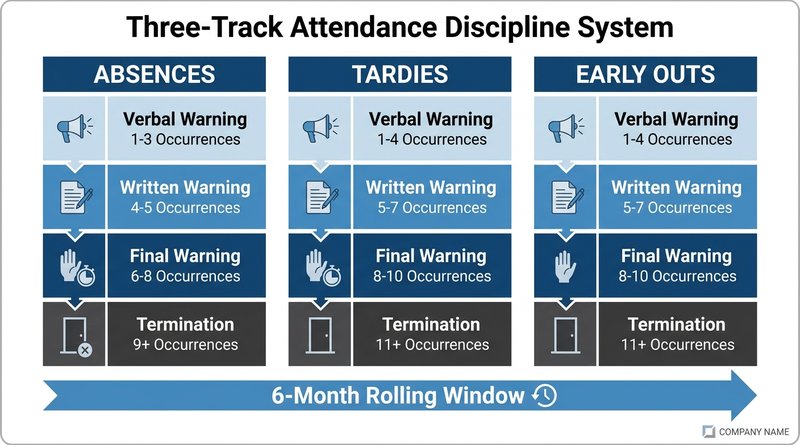
A large candy manufacturer running UKG Pro WFM has a three-track attendance discipline policy that calls for a custom points engine, and CloudApper’s approach builds that engine on top of WFM. Most attendance policies look simple on paper: miss more than a set number of days in a rolling period and receive a written warning, then a final warning, then termination. This facility’s policy is not simple even on paper. It runs separate point accumulators for absences, tardies and early outs, each with its own thresholds, each evaluated on a rolling six-month window that expires old incidents as new ones accumulate. The combinations run into the hundreds, and HR has to act every time an employee crosses a threshold on any track, with a ticket that holds up under the labor agreement.
CloudApper AI Platform for UKG addresses this with an attendance discipline engine on top of UKG Pro WFM that tracks all three accumulators, evaluates the rolling windows on every daily run and creates discipline tickets automatically.
What a three-track attendance system actually demands
The distinction between Absences, Tardies, and Early Outs matters operationally, not just administratively. A worker who leaves early three times in a month creates a different staffing problem than a worker who misses full shifts. A worker who is chronically late creates a different problem than one who occasionally misses a day. Treating all three the same under a single point tracker loses the operational signal. Tracking them separately preserves it.
But separate tracking creates a separate calculation burden. Three tracks means three running point totals, three sets of thresholds, and three rolling six-month windows that each expire incidents on different timelines depending on when they occurred. A written warning triggered by the Absence track doesn’t reset the Tardy track. An Early Out accumulation can push a worker to a discipline level independently of anything else on their record.

The number of possible combinations across all three tracks and all active thresholds at any given time runs into the hundreds. On a manufacturing floor with a large hourly workforce, that means HR is managing hundreds of individual running calculations simultaneously, checking whether an incident that happened 180 days ago has expired, determining whether last week’s tardy pushed a specific employee over a specific threshold, deciding whether a discipline action is now due and what level it should be.
In practice, that work falls through the cracks. Not because HR isn’t diligent, but because the volume of manual tracking makes consistency impossible at scale. Someone crosses a threshold and HR doesn’t catch it in time. A rolling window expires, points should drop off, and they don’t, because no one ran the calculation that week. The policy exists. The enforcement doesn’t match it.
“All the time we get people that come a week later they’ve got doctor’s notes, they’ve got FMLA, they’ve got court things, they’ve got a million different reasons why we have to go back to the system… It’s critical that it works properly so that we’re not giving out disciplines to people that don’t deserve them.”
Employment Relations Manager, Large Candy Manufacturing Facility
What UKG Pro WFM captures and what the labor agreement adds
UKG Pro WFM captures time and attendance events with precision. Punch data, missed punches, tardy flags, schedule adherence: all of it flows into the platform in real time. That’s the foundation the facility needed. The data was there.
What the labor agreement adds on top of those events is multi-track point accumulation logic, rolling expiration windows for each track, and progressive discipline actions when thresholds are crossed. Configured one combination at a time, those rules would produce an unmanageable number of attendance policies, so the logic belongs in a layer that builds on WFM.
This is a custom business rule set with a level of specificity few attendance policies reach. As discussed in the context of customizing UKG without breaking it on the next update, the answer isn’t modifying UKG’s core system. It’s building the specific logic in a layer that reads from UKG and writes back to it, preserving the integrity of the platform while adding the enforcement capability the organization actually needs.
CloudApper AI Platform for UKG was designed exactly for this: a logic engine that runs alongside UKG Pro WFM, reads time and attendance events, applies custom business rules, and pushes actions and notifications back into the workflow.
How the discipline engine works inside UKG Pro WFM
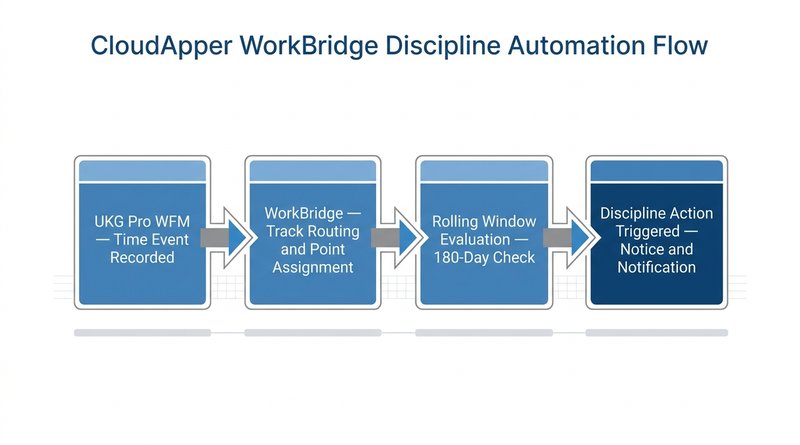
The CloudApper AI Platform for UKG attendance discipline engine reads UKG Pro WFM exceptions and timecard comments every day. When a time event is recorded (an absence, a tardy flag, an early punch-out), the engine receives it and routes it to the correct track.
Each track maintains its own running point total. The rolling window is evaluated on every run: as incidents age past 180 days, their points are automatically removed from the active total. No manual calculation. No periodic cleanup. The window maintains itself.
When a point total on any track crosses a configured threshold, the engine triggers the corresponding discipline action automatically. For a unionized plant, that means creating a ticket at the correct discipline level, listing it in a tile inside UKG for the Employment Relations Manager, and nudging the employee’s current supervisor. A five-day window gives supervisors time to excuse or correct an exception before any ticket is created, so the action doesn’t wait for HR to notice the crossing.
The design goal is a discipline system that applies the policy as written. An employee who reaches a warning level on the Tardy track gets a ticket on the next run rather than when HR next reviews a report. An employee whose old absences fall outside the window sees the level step down automatically. When a doctor’s note or FMLA approval arrives later, the excused comment added in UKG triggers a recalculation of that track.
“Supervisors should only be working in the time card from a day-to-day perspective… they don’t get involved with anything CloudApper related unless a ticket is generated.”
HRIS and Timekeeping Systems Lead, Large Candy Manufacturing Facility
What consistent enforcement means in a unionized manufacturing environment
The most visible effect of automating this is on HR’s time. Calculating rolling windows across hundreds of employees on three separate tracks is repetitive, error-prone work. It doesn’t require judgment. It requires time. Automating it frees HR for the parts of attendance management that do require judgment: conversations with employees, understanding the context behind patterns, deciding how to handle edge cases that the policy doesn’t fully anticipate.
The less obvious issue is consistency. When discipline depends on a person reviewing a report and running a calculation, outcomes vary. A manager who checks reports weekly catches threshold crossings faster than one who checks monthly. A busy week means some employees don’t receive timely notices. Others do. The inconsistency isn’t intentional. It’s structural.
Automated enforcement is designed to remove that variation. Every employee on the floor is subject to the same daily threshold evaluation. Nobody crosses a line and doesn’t receive the corresponding action. Nobody gets a pass because the week was too busy for a full review. The policy applies uniformly. For a union workforce where inconsistent discipline application is a standard grievance basis, that uniformity is not a secondary benefit. It’s the outcome the policy was written to produce.
Absence management more broadly benefits from the same automation logic , a point that applies just as much to food manufacturers running UKG. The more of the tracking and notification process that runs automatically inside UKG, the more reliable the downstream HR response becomes. Manual steps are where consistency breaks down. Removing them is where it gets restored.
“Signatures are critical because we have to prove that we met. And it’s all because of the labor agreement. We have to prove that we met with the individual, we talked about the ticket, we administered the ticket, and it was signed off on.”
Employment Relations Manager, Large Candy Manufacturing Facility
Extending the model to other attendance policy requirements
A three-track attendance system with rolling windows is a specific configuration. But the underlying requirement, custom discipline logic layered on top of UKG Pro WFM, is common across manufacturing. Different facilities run different point structures, different window durations, different threshold levels, and different combinations of what counts toward each track. The specifics vary. The need for a rules layer that follows the policy exactly is consistent.
CloudApper’s HCM automation approach is built around this reality. The platform reads from UKG’s time and attendance data, applies whatever rule logic the customer’s policy requires, and pushes results back into UKG Pro WFM as actions, notifications, and records. The logic engine is configurable to the specific policy. The integration with UKG is standard. That means a facility with a two-track system, or a four-track system, or a hybrid structure that mixes point accumulation with calendar-based windows, can be served by the same approach without rebuilding the integration from scratch.
For a manufacturing facility like this one, the approach is to have CloudApper AI Platform for UKG extend UKG Pro WFM with a discipline layer that follows the labor agreement. Three tracks, hundreds of combinations and rolling windows are calculated automatically, with an audit record behind every ticket. HR still handles the judgment calls. The engine handles the math.
If your manufacturing or industrial facility runs UKG Pro WFM and manages attendance discipline policies built on custom labor agreement rules, CloudApper can build the enforcement engine your policy requires. Contact the CloudApper team to start the conversation.



October 16, 2026
Public Holiday Substitution Rules Around the World: Why UKG Pro WFM Still Needs Manual Checks
New Zealand calls it Mondayisation, the UK calls it a substitute bank holiday, Canada calls it holiday pay in lieu, and the US calls it an observed holiday. Four names, four rules, and the same manual-check problem for global UKG Pro WFM deployments.


October 16, 2026
UKG Pro Position Management at a Food Producer: Who Sets the Defaults When 75 Employees Change Jobs Every Week
A large food producer moving to UKG Pro handles about 75 internal transfers a week. CloudApper automates the position defaults behind each move, including comp codes, cost centers, standard hours and union codes, through the UKG Pro API, with HR owning and updating the rules without opening a project.

October 15, 2026
Health and Welfare Pay for Military Base Stores: Making Every H&W Hour Traceable in UKG
A national specialty retailer with stores on US military installations needs health and welfare pay it can defend. CloudApper applies the 40-hour weekly cap, multi-store proration and employer cost recovery against UKG time data, posting H&W pay codes to each timecard with a trail back to the hours.

September 30, 2026
Your Best Candidates Already Worked for You: Rehire Campaigns and Geographic Filtering in UKG Pro for Home Care
Large home care organizations hire at high volume across many territories, and former employees often re-enter the same pipeline as strangers. CloudApper AI Recruiter extends UKG Pro Recruiting with zip-code filtering, rehire outreach campaigns and blind ranking, so coordinators see the strongest local candidates first.