A restaurant group running UKG WFM with CloudApper hrPad builds schedules in a third-party platform. The hard part is not the connection but last-minute shift covers approved after the last sync. A sync cadence tuned to when changes cluster, plus a supervisor path on the floor, is what keeps punch rules from refusing the right person.



Table of Contents
Late schedule changes are the hardest test for a UKG time clock that enforces punch rules against a schedule kept in another system. A multi-location US restaurant group runs UKG WFM for time and payroll, with CloudApper hrPad on the floor, and builds its schedules in a specialist third-party platform. Operations chose that platform, and the job for HRIS and IT was to route the operative schedule to the clocks already on the wall without touching payroll.

Connecting the systems is the easy part. The design work is deciding what the clock should do when a manager approves a shift cover after the last sync, and who settles a refused punch in the middle of service.
Everything Turns on What Happens Between Syncs
Punch rules at these clocks are schedule-aware. A common one: no clock-in more than fifteen minutes before the scheduled start. That rule is only as good as the schedule the clock is reading.
Now consider a typical shift. Someone calls out at 3:40. A manager approves a cover at 3:52. The replacement arrives at 4:05 for a 4:15 start and puts a hand on the clock. If the terminal still holds the schedule as it stood at the last sync, that person is not on it, and a rule meant to prevent early clock-ins refuses somebody standing there ready to work.
That is the whole problem. Not the connection. The window between a change and a punch.
“It should be a week before, but sometimes there’s edits.”
Director of IT, multi-location restaurant group
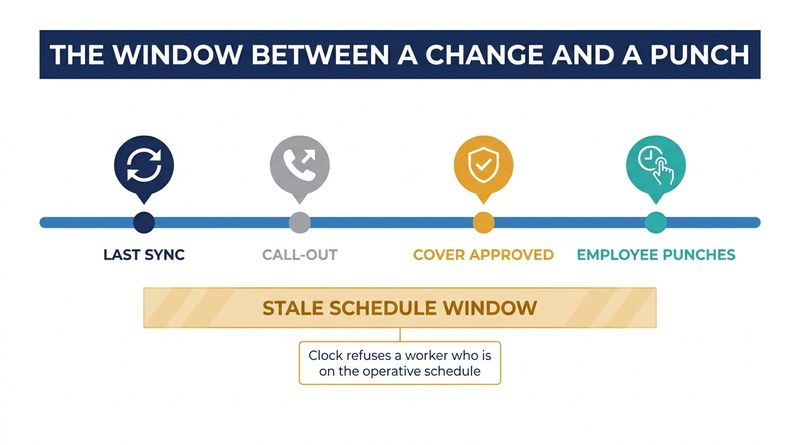
The design problem is not the connection. It is the window between a manager approving a cover and the replacement putting a hand on the clock.
Two Levers, and Neither Is the Connection Itself
The first is sync cadence. Schedule data flows from the scheduling platform into CloudApper hrPad on a configurable interval, and the useful work is tuning that interval against when changes actually cluster rather than picking a round number. If edits bunch in the hours before service, that is where the cadence matters most.
The second is what happens when the sync loses anyway, because sometimes it will. A rule that cannot be satisfied at the terminal needs a path that resolves on the floor. A supervisor confirming a legitimate punch in the moment costs less than a refused employee waiting on a ticket, and it leaves a record either way.
Punches keep flowing to UKG WFM for payroll throughout. Nothing about the pay calculation or the timecard changes, which is what makes this a scheduling project rather than a payroll project. The pattern is the same one behind multi-location scheduling flexibility and clock-level location enforcement: the enforcement point stays where it was, and the data feeding it gets sourced from wherever the business decided it should live.
“We’re not changing that at all in the integration. It’s working well now and we have no issues with it.”
Director of IT, multi-location restaurant group
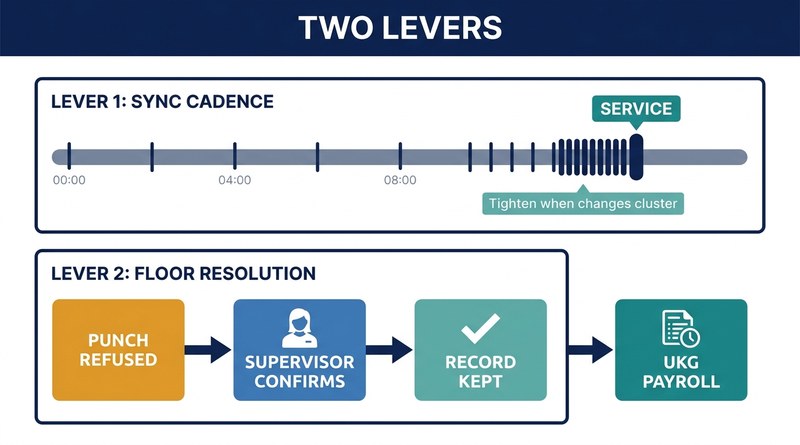
Two levers carry the design: a sync cadence tuned to when changes actually cluster, and a resolution path that settles a refused punch on the floor.
The Person Standing at the Clock
Designs like this get judged by a general manager during a Friday dinner rush, not in a review meeting. The test is whether a disputed punch can be settled without leaving the floor. Anything that sends a shift lead to a laptop mid-service loses, however correct it is architecturally.
For UKG customers assembling a best-of-breed stack, the lesson is this: enforcement logic survives a system move when someone maps the timing of real-world changes against the timing of the sync, and decides in advance who resolves what falls through. CloudApper’s connective work puts the schedule at the clock; those operating decisions are what keep last-minute schedule changes from becoming punch exceptions and payroll cleanup. The ownership decisions that come before any sync are a separate question, covered in how a restaurant group decided who owns the schedule, the punch and the pay when it added a third-party scheduler.
One Question Teams Ask
How can UKG time clocks keep enforcing schedule-based punch rules when schedules come from a third-party tool?
Feed the clock the operative schedule from that tool on a sync interval tuned to when changes actually happen, keep punches flowing to UKG for payroll, and define a supervisor path for punches that arrive before a change has synced. The enforcement point does not move; only the source of the schedule does.
If your scheduling has moved to a specialist platform and your UKG time clocks are still enforcing against yesterday’s roster, talk to the CloudApper team about sourcing the operative schedule at the clock.




October 19, 2026
Nurse Mandatory Overtime Limits in UKG: Documenting Voluntary Overtime at Clock-Out
New York, Pennsylvania and Washington restrict mandatory overtime for nurses, which makes documented consent the key record. Learn how UKG Pro WFM and UKG Ready separate voluntary and mandated overtime, and how CloudApper AI TimeClock captures consent on an affordable unit tablet.

October 16, 2026
Heat Illness Recovery Breaks in UKG for Construction and Logistics Crews
State heat rules in California, Washington and beyond require cool-down breaks that payroll must be able to prove. Learn how UKG Ready and UKG Pro WFM track recovery periods, and how CloudApper AI TimeClock captures them on an affordable jobsite tablet that works offline.
October 15, 2026
PUMP Act Lactation Breaks in UKG: Tracking Them Without Breaking Meal Rules
Lactation breaks protected by the PUMP Act often show up as meal break exceptions in UKG. Learn what federal law requires, how to configure UKG Ready and UKG Pro WFM pay codes, and how CloudApper AI TimeClock records these breaks privately on an affordable tablet clock.
October 14, 2026
Enforcing Minor Work Hour Limits at the UKG Time Clock
Child labor hour limits are usually built into UKG schedules, but violations happen at the punch. Learn the federal rules for 14 to 17 year olds, how UKG Pro WFM and UKG Ready handle minor rules, and how CloudApper AI TimeClock adds age-based checks on an affordable tablet clock.