When a restaurant group adds third-party scheduling software to UKG WFM, HRIS and payroll first have to decide which system owns the schedule, the punch and the pay. CloudApper connects the scheduler to existing hrPad kiosks, so punch rules keep working and UKG WFM stays the single payroll record.


Table of Contents
When a restaurant group adds a third-party scheduling platform to a UKG environment, the first decision for HRIS and payroll leaders is ownership: which system is the record for the schedule, which for the punch and which for the pay. Operations usually makes the scheduling choice, because a new concept opens, a regional team prefers a different workflow, or managers want a tool built around front-of-house and kitchen staffing. Payroll and HRIS inherit the consequences.

A multi-concept restaurant group running UKG WFM faced exactly this choice, and its IT team started with ownership before scoping any connection. CloudApper connects a new scheduler to the existing time clocks, so punch rules keep working, UKG WFM stays the single payroll record and operators get the scheduling tool they asked for.
Operations Picks the Scheduler, Payroll Keeps UKG
The group was already running CloudApper hrPad as its time clock on UKG WFM. Its kiosks enforced schedule-based punch rules in every restaurant, the same kind of real-time enforcement hospitality operators rely on to control labor cost and meet break rules. Then operations chose a dedicated restaurant scheduling platform for building and publishing shifts. UKG WFM would remain the payroll system of record.
As the Director of IT at the restaurant group put it, “We’re really just looking to call and say, hey, should this employee be punching in or not?”
The risk was concrete. Without the schedule, the clock can’t stop an employee from clocking in forty minutes early, which is exactly the problem early clock-in controls exist to prevent. Multiply that across every location and every shift, and the labor cost adds up fast.
One Owner for the Schedule, the Punch and the Pay
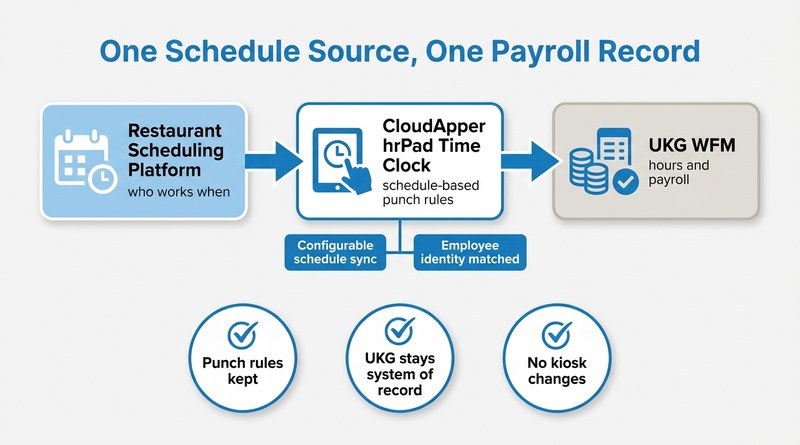
The design gives each record exactly one owner. The scheduling platform owns who works when. The hrPad kiosk owns the punch and the rules applied to it. UKG WFM owns hours and pay. CloudApper changes one thing to match: hrPad reads the operative schedule from the scheduling platform, every punch still flows into UKG WFM, and employee identities are matched across both systems so a shift built in the scheduler lines up with the right person in UKG. How often the schedule syncs, and what the clock does with a shift cover approved after the last sync, are operating decisions each group makes separately.
“I think the biggest thing will be, we just have to map correctly.”
Director of IT, multi-concept restaurant group
Because the integration sits on CloudApper iPaaS for UKG, the scheduling platform never writes to payroll directly. UKG stays authoritative for hours and pay, and the scheduler stays authoritative for who works when.
“We’re not changing that at all in the integration. It’s working well now and we have no issues with it.”
Director of IT, multi-concept restaurant group
What This Means for HRIS and IT Leaders
The goal is to give operators the scheduling tool they want, keep schedule-based punch enforcement running in every restaurant, and keep UKG WFM as the single payroll record. Because the change sits behind the existing hrPad kiosks, the punch itself looks the same to staff on the floor.
The broader lesson is about ownership. In multi-unit hospitality, tool choices will keep shifting as concepts are added and acquired. HRIS leaders who define which system owns each piece of data, the schedule, the punch and the pay, can say yes to operations without putting payroll at risk. The same approach applies wherever UKG connects to restaurant systems, from scheduling to POS-driven tip pooling.
“That’s really all that’s changing in the stack. That we’re still putting all those punches to UKG.”
Director of IT, multi-concept restaurant group
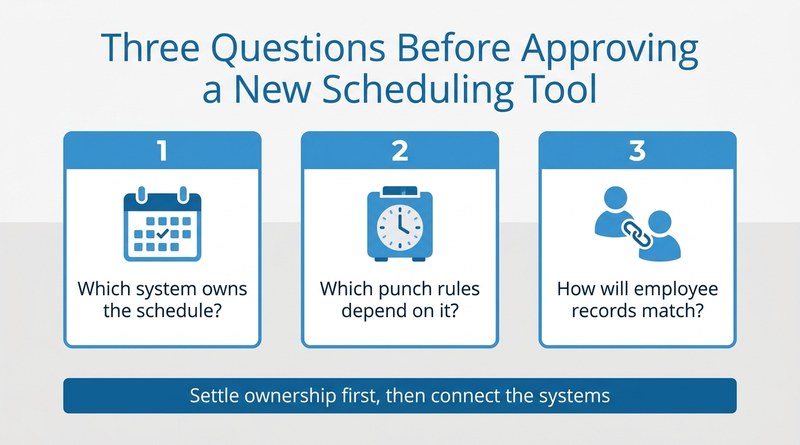
Before approving a scheduling change, ask three questions. Which system will be the source of truth for the schedule? Which punch rules depend on that schedule today? And how will employee records match across both platforms? CloudApper builds the answers into the integration, so the time clock keeps doing its job wherever the schedule lives.
If your operations team is moving scheduling to a new platform and you want punch enforcement and UKG payroll to stay intact, talk to CloudApper about connecting the two without disrupting your restaurants.



October 23, 2026
Barcode Labor Tracking on UKG Ready: Two Clocks, One Labor Record, and an ERP-Validated Hierarchy
Some plants keep attendance on the clocks at the door and capture job labor at the workstation. This piece looks at that two-clock model on UKG Ready: scan-only capture for gloved operators, work orders validated against the ERP, and how CloudApper adds that layer using the PCs and scanners already on the line.
October 13, 2026
Paperless HR for Rural Hospitals on UKG: Extending One Kiosk to Documents, E-Signatures and Benefits Data
A rural hospital using CloudApper hrPad as its UKG time clock still handled much of HR on paper. Its next step is extending the same kiosk to documents, e-signatures and transfers, with CloudApper iPaaS moving benefits data to providers, all within network rules that block external AI services.

October 7, 2026
Shared Tablet SSO in UKG: One Time Clock for Every Login Type
Hourly staff on basic UKG logins and managers on SSO can share one tablet time clock without login mix-ups. This guide explains each login type in plain English, compares three shared-tablet setups and shows how hrPad by CloudApper AI makes it work.
October 5, 2026
Why Is My Paycheck Wrong? Tracing UKG Payroll Errors to Six Upstream Causes
Most UKG payroll questions start upstream of payroll: in employee details, attendance, deductions, approvals, compliance or reconciliation. hrPad by CloudApper AI catches each one at the time clock.