A metropolitan convention center onboards hundreds of union workers on event days knowing little more than a name and a union card number. The dashboard CloudApper built tracks five stages in real time, but its purpose is reassignment mid-flow, and whether the union steward accepted the audit log mattered more than the interface.


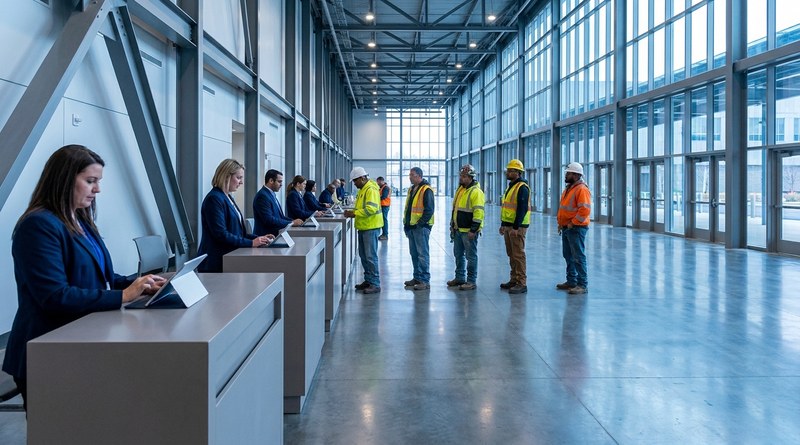
Table of Contents
Ninety minutes before doors, the roster changes. Forty workers who were on this morning’s list are not coming, thirty others arrive who were not expected, and the event opens at the advertised time regardless.
That is a normal event day at a large metropolitan convention center in the northeastern US, where hundreds of union workers are onboarded at once with almost nothing known in advance: a name, a union card number, sometimes a phone number. CloudApper built the onboarding dashboard the venue’s floor leads now run that morning on, with worker documents flowing into UKG Pro. Its real value is how quickly it moves people through check-in, badging, biometrics and paperwork.
Five Stations, One Curtain Time
Every worker clears five stages before starting: check-in, badging, biometric enrollment, paperwork, document collection. Multiple workstations run in parallel. Any operations leader can predict what follows: one station slows, a line forms behind it, the others idle.
The problem was never that the backup happened. It was that nobody could act on it while it was happening. As one badging supervisor at the venue put it, paper tracking told you “where somebody had been, never where the line was bending.” By the time a supervisor walked the floor and worked it out, the imbalance had cost the morning.
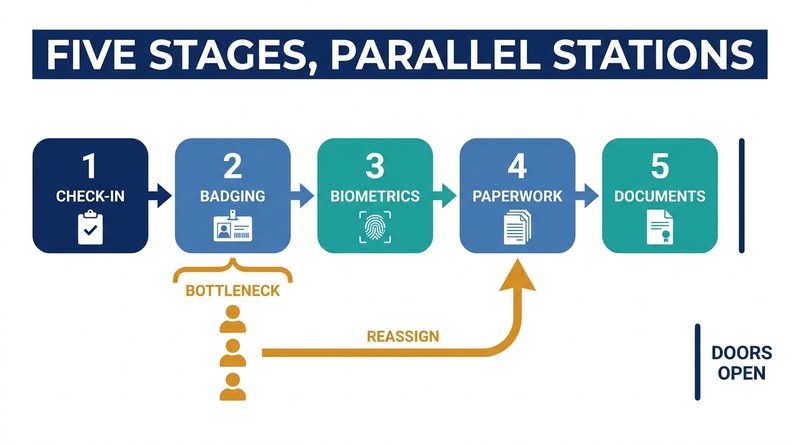
The tool exists to serve one action: pulling workers out of a backed-up station into an open one without losing the stages they already cleared.
Moving People, Not Just Watching Them
The dashboard CloudApper built on the CloudApper AI Platform for UKG tracks each worker’s position across all five stages in real time, and that visibility exists to serve one action: reassignment mid-flow.
When badging backs up, a station lead pulls waiting workers into an open paperwork station and the system carries their state with them, so nobody restarts a stage they already cleared. Returning workers skip what they have already completed, which is why packets print color-coded by new versus returning rather than identically. A roster change at the last minute reprints only the workers who changed, not the stack. Documents signed electronically on tablets land directly in the worker’s UKG Pro HRSD record, so the collection stage finishes when the signature does.
“I am not looking at the screen to know how we are doing. I am looking at it to decide who moves next.”
Floor Operations Lead, metropolitan convention center
One design decision mattered more than the mechanics. Reassignment authority sits with the station leads on the floor, not with HR, which sees aggregate completion only after the event closes. Nobody in an office watches individual union members move through stages in real time, and the venue said so before the first pilot, because a tool that reads as surveillance of union labor does not get used twice.
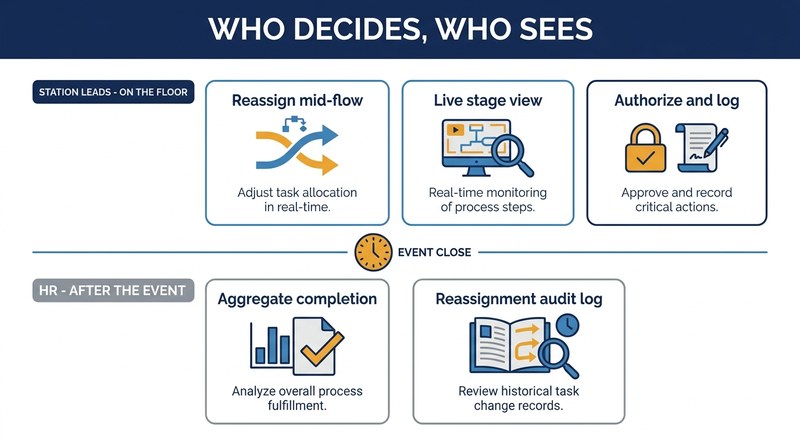
Reassignment authority stays with station leads on the floor; HR sees aggregate completion and the audit log after the event closes.
The Steward Decides Whether It Gets Used
Adoption did not turn on the software. It turned on whether the union steward accepted that moving a worker between stations respected the work rules and left a record. Each reassignment logs who authorized it and what stage the worker had reached, giving the steward something to check rather than something to trust. According to the venue’s HR Operations Director, that log settled the conversation faster than any demonstration of the interface.
“The first question was not about speed. It was whether the system could tell us afterward exactly what happened to any one member. Once it could, the speed argument made itself.”
HR Operations Director, metropolitan convention center
What Transfers to Other Venues
Any employer intaking large crews against a fixed start time faces this shape: unknown arrivals, parallel stations, and rules about who may be asked to do what. It holds for event labor, seasonal crews, and the contingent staff tracked separately from FTEs in a UKG environment, and it raises the same questions as issuing credentials to temporary workers at volume or onboarding thousands of new hires a year. Where union rules govern who moves, the record of the decision matters as much as the decision, as it does in seniority-based shift bidding. CloudApper’s job was to make reassignment auditable, which is what made it usable.
If your operation onboards large crews against a fixed start time and the tracking still lives on paper, talk to the CloudApper team about what real-time stage tracking would look like inside your UKG environment.



October 5, 2026
Employee Relations Case Management in UKG: How a Building Products Manufacturer Moved ER Cases Out of the Inbox
A multi-plant building products manufacturer tracked employee relations cases in email threads and spreadsheets. CloudApper brought ER case management inside UKG with structured intake, AI categorization, automatic escalation and audit trails, cutting resolution time and giving HR leadership real-time visibility into open cases and trends across every plant.
March 14, 2025
Simplify On-Call Scheduling with UKG HR Service Delivery Solution
CloudApper hrPad simplifies on-call scheduling for UKG users, reducing errors and enhancing workforce management with AI and automation.
February 11, 2025
Automate UKG Pro SMS Shift Fill To Avoid Last-Minute Absences
Streamline your shift management with CloudApper hrPad and UKG Pro SMS Shift Fill. Automate shift confirmations, reduce no-shows, and improve employee engagement—all while minimizing HR effort.
February 6, 2025
Automate Sick Leave Accruals with UKG/Kronos HR Service Delivery Solution
Simplify sick leave management with CloudApper hrPad for UKG/Kronos! Automate accruals, integrate seamlessly, and empower employees with real-time data. Reduce HR workload, ensure compliance, and improve accuracy.