A 7,000-employee national parking company runs HR and time in UKG Ready and payroll with a separate provider that expects change-only files. Here is why full-row feeds trigger warnings and manual fixes, and how CloudApper iPaaS for UKG sends payroll only the fields that changed.


Table of Contents
A UKG Ready payroll integration has to send the payroll provider only the fields that changed, and a national parking management company with about 7,000 employees is a clear example of why. It runs UKG Ready for time and HR data and a separate provider for payroll processing, and the connection between two established platforms turns out to be the hardest part of the setup.

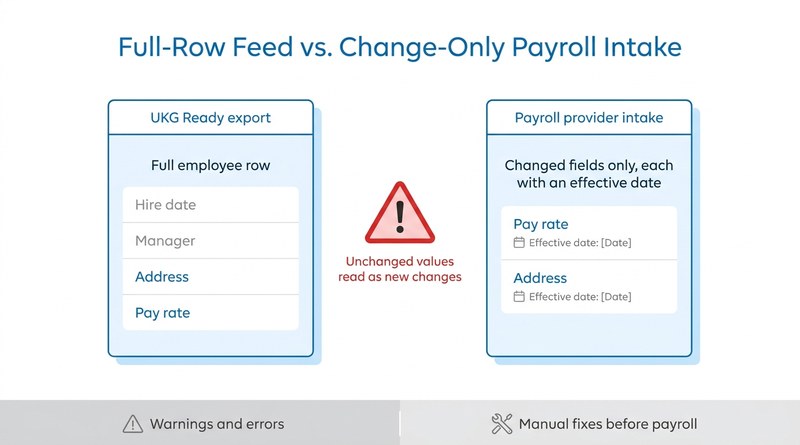
The current integration sends a complete employee row whenever anything in that row changes, while the payroll provider expects change-only files with an effective date on each changed field. Re-sending unchanged values such as hire date and manager makes the payroll system treat them as new changes, which produces warnings and errors that someone has to correct by hand before payroll can run.
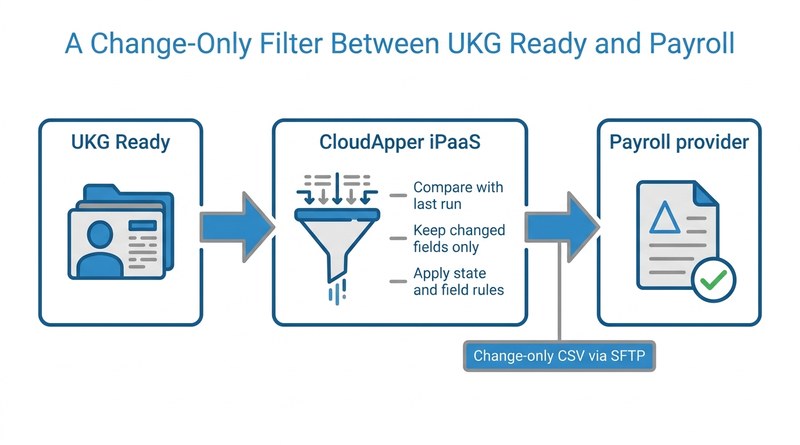
CloudApper addresses this with a filtering layer on the CloudApper iPaaS platform that sits between the two systems, compares each UKG Ready data set with the previous one and delivers a clean change-only CSV via SFTP, so only changed fields reach payroll.
Why Full-File Exports and a Change-Only Payroll System Don’t Mix
The mismatch is easy to describe and common in organizations that run UKG Ready alongside a separate payroll processor. A typical integration feed is designed to be comprehensive, sending the full employee row so the downstream system always has a complete picture. That design works well when the downstream system accepts full refreshes. A payroll system with effective-dated, change-only intake works differently.
That kind of file-based intake processes the records it receives as updates or additions rather than as a complete refresh. A full employee file sent on a regular payroll cycle looks like thousands of record changes, most of which are not changes at all. The result is overwrite behavior, record conflicts or validation warnings that have to be reviewed and corrected before payroll can run.
For the parking management organization in this story, the risk is concrete. The payroll system responds to the extra values with warnings and errors, especially on effective-dated fields like hire date and manager, and problem records have to be fixed by hand. Some failures come from undocumented rules, such as which work states can be sent for states without income tax, that only surface one file at a time. With employees spread across parking facilities, garages and hospitality service locations in multiple states, manual reconciliation is both slow and unreliable. As discussed in the context of payroll penalty exposure for UKG users, errors in the layer between HR and payroll rarely surface as clean, identifiable mistakes. They accumulate quietly until a reconciliation or an audit brings them out.
The people leadership team had run into the same full-file versus change-file problem on earlier integration projects, which is why they define the requirement so precisely.
How CloudApper Approaches the Delta Filter
The approach leaves UKG Ready’s export behavior alone and requires no change to the payroll system’s configuration. What CloudApper adds is a processing layer between the two that handles one specific workflow need: stateful comparison of sequential exports.
On each integration cycle, CloudApper reads the latest employee data from UKG Ready and compares every record against the prior export it stored. Identical records are filtered out. Records with relevant changes, such as new hires, terminations, pay rate updates, address changes and role changes, are extracted into a new file containing only those changes, and that delta file is delivered via SFTP in the format the payroll provider expects.
The comparison logic is configurable. The organization defines which fields count as a meaningful change, which keeps cosmetic or system-generated variations from creating unnecessary payroll records. That control matters in a 7,000-person workforce where the volume of records is high and the frequency of real changes varies by season, site and employee category.
A layer built to bridge the behavioral difference between two systems is what CloudApper iPaaS was built to handle: data leaving UKG that needs reshaping to fit what the receiving system expects, in places where a manual correction step has quietly become a permanent part of payroll.
The goal for the payroll team is a UKG Ready payroll integration that runs without manual intervention. Known edge cases, such as effective-dated fields and state-specific rules, live in one maintained rule layer instead of being rediscovered file after file, so the data reaching payroll is structurally correct from the point of transfer.
“I think what we’re really truly looking for is just a clean change file… [the payroll system] needs only the changes. So when we’re sending over full file feeds with all of the file fields, it’s confusing [the payroll system] and the intake and it’s causing not necessarily errors, but just warnings saying, hey, we already have this information.”
Senior Vice President of People, national parking management company
What This Means for Other UKG Ready Organizations With a Separate Payroll Provider
The full-file versus delta-file mismatch is not unique to this organization. It appears wherever full-row integration feeds meet effective-dated payroll intake, and it creates predictable problems in any environment where the downstream payroll processor expects incremental change files. Teams that manage it today with a pre-payroll review step are spending staff time on an architectural problem.
The answer is to connect the two platforms properly rather than replace either one. UKG Ready handles scheduling, timekeeping, leave and HR records with the depth a geographically distributed workforce needs, and the payroll provider handles processing at the scale an organization of several thousand employees requires. The issue is the seam between them, and that seam is where CloudApper’s role as a UKG integration partner is most direct.
For IT and HRIS leaders running this combination, a pre-payroll reconciliation step that exists only to catch integration errors is a sign of a structural problem. As described in the context of connecting UKG to downstream systems without coding overhead, the fix is a targeted layer that gets the right data from UKG Ready to payroll, in the right format, on every cycle, with no rebuild of either platform.
If your organization runs UKG Ready alongside a separate payroll provider and corrects integration errors by hand each cycle, CloudApper can assess your data flow and design a delta-filtering integration that removes the pre-payroll reconciliation step. Contact the CloudApper team to start the conversation.


October 14, 2026
UKG Costpoint Integration for Defense Contractors: Who Owns the 65 Fields Between Payroll and the Audit
A defense services contractor needs its HRIS to update more than 65 Costpoint fields through an API. CloudApper iPaaS handles the UKG Costpoint integration, and the real lesson is governance: HRIS, finance and IT each own their part of the mapping rules, so labor cost data stays audit-ready as contracts change.
October 12, 2026
ATS to UKG Ready Integration: Making Every Light Industrial Staffing Placement Payroll-Ready on Day One
A light industrial staffing firm placing 20 to 40 new workers a week re-enters every hire from its ATS into payroll by hand. CloudApper's sync creates UKG Ready records at assignment and carries updates and terminations across, so every placement can be payroll-ready on day one.

October 9, 2026
UKG Pro and Mexico Payroll Integration: Keeping Cross-Border Employee Data in Sync
US employers with Mexico operations often run UKG Pro as the system of record and a local platform for Mexican payroll. CloudApper connects the two with an automated sync that sends hires, terminations and pay changes to the Mexico platform and brings payroll results back into UKG Pro.
October 7, 2026
Client-Site Employees and UKG Pro WFM: Keeping Embedded Automotive Engineers Paid Right
Engineers working inside a client’s facility log time in the client’s system, so their paycheck is the employer touchpoint that matters most. For an automotive engineering services firm, CloudApper moves those hours into UKG Pro WFM automatically, removing the manual re-entry where pay errors start.