UKG Ready exports full employee files; ADP expects only changed records. For a national parking management company with 7,000 employees, that mismatch was causing payroll errors every cycle. CloudApper iPaaS built a delta-filtering layer that solved the problem without touching either platform.


Table of Contents
When a national parking management company with roughly 7,000 employees runs UKG Ready for time, scheduling, and HR data alongside ADP for payroll processing, the assumption is that the connection between them is a solved problem. Both platforms are established, widely adopted, and built with integration in mind. What the organization discovered is that “integration-ready” and “compatible by default” are not the same thing.

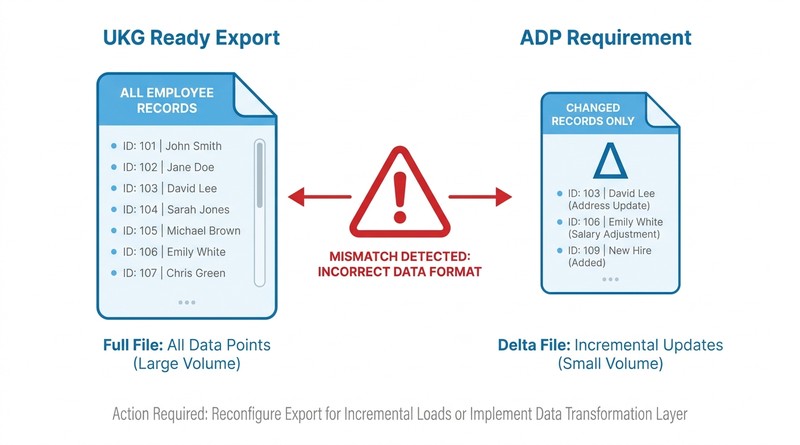
The specific problem: UKG Ready exports complete employee data files every time it sends data downstream. ADP, by design, expects and processes only delta files — change-only records containing what has changed since the last transfer. Send a full file to a system expecting only changes, and you get unpredictable results: record overwrites, duplicate entries, and data errors that surface in payroll after the fact. The gap between how UKG Ready exports and what ADP can safely process was creating real risk with every payroll cycle.
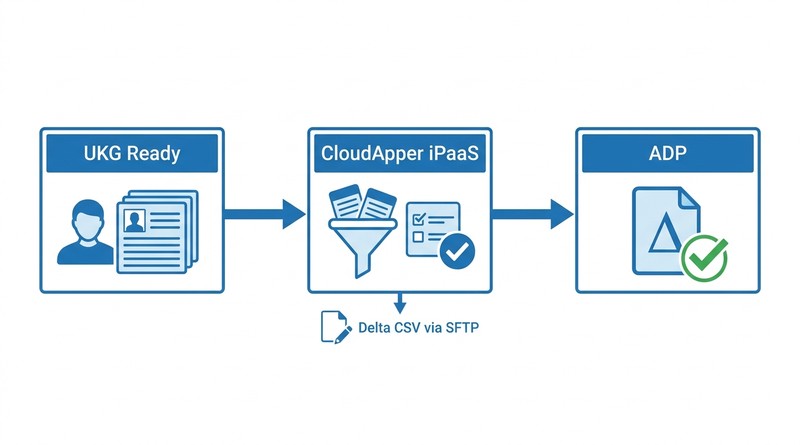
CloudApper resolved this through a targeted data scrubbing and filtering layer built on the CloudApper iPaaS platform — one that sits between the two systems, processes UKG Ready’s full-file exports, compares them against the prior transfer, and delivers a clean delta CSV to ADP via SFTP. The mechanism is invisible to payroll staff. The integration looks normal. But what actually moves between the two systems is only what changed — exactly what ADP requires.
Why Full-File Exports and a Change-Only Payroll System Don’t Mix
The technical mismatch is easy to describe but surprisingly common in organizations that run UKG Ready alongside a legacy payroll processor. UKG Ready’s export architecture is designed to be comprehensive — every export contains the full employee data set, not just what is new or updated. This is a reasonable design choice for environments where the downstream system can handle full refreshes. ADP’s integration architecture is not one of them.
ADP’s file-based payroll integration model operates on incremental changes. When it receives a file, it processes the records in that file as updates or additions — not as a complete refresh of everything it knows. A full employee file from UKG Ready, sent on a regular payroll cycle, looks to ADP like thousands of record changes, many of which are not changes at all. The result is overwrite behavior, record conflicts, or validation errors that ADP flags before processing — requiring manual review and correction before payroll can run.
For the parking management organization in this story, this was not a theoretical risk. The two systems were already connected, and the integration was already causing the kind of downstream errors that required payroll staff to intervene before each cycle closed. The volume of employees — distributed across parking facilities, garages, and hospitality service locations across multiple states — made manual reconciliation both time-consuming and structurally unreliable. As discussed in the context of payroll penalty exposure for UKG users, errors that occur in the integration layer between HR and payroll systems rarely surface as clean, identifiable mistakes — they accumulate, often silently, until a reconciliation process or an audit forces a reckoning.
UKG’s own Customer Success team confirmed that this type of export behavior was native to the platform and recommended CloudApper as their integration partner of choice for this specific problem.
How CloudApper Built the Delta Filter
The solution does not modify UKG Ready’s export behavior. It does not require changes to ADP’s configuration. What CloudApper adds is a processing layer between the two systems that handles what neither platform does natively in this configuration: stateful comparison of sequential exports.
The mechanism works as follows. When UKG Ready generates its scheduled export, CloudApper receives the full employee data file. It compares every record in that file against the prior export it received and stored. Records that are identical — no meaningful field changes — are filtered out. Records that contain relevant changes (new hires, terminations, pay rate updates, address changes, role changes) are extracted and assembled into a new file containing only those changes. That delta file is then delivered to ADP via SFTP in the format ADP expects.
The comparison logic is configurable. The organization can define which fields constitute a meaningful change worth transmitting, which prevents cosmetic or system-generated data variations from generating unnecessary ADP records. This level of control matters in a workforce of 7,000 employees where the volume of employee records is high and the frequency of actual changes varies significantly by season, site, and employee category.
A layer like this — purpose-built to bridge the behavioral difference between two systems that were never designed to work together natively — is exactly what CloudApper iPaaS was built to handle: scenarios where the native export from UKG does not match what the receiving system expects, and where a manual correction step has quietly become a permanent part of the payroll process because no one built the right technical bridge.
The result for the payroll team is a UKG Ready–to–ADP integration that runs without manual intervention. Payroll cycles close without the pre-processing review step that had previously existed to catch and correct integration errors. The reconciliation burden that had consumed payroll staff time before each cycle no longer exists, because the data reaching ADP is structurally correct from the point of transfer.
“We had a pre-payroll review step that existed for one reason: to catch the errors that came in from UKG before they hit ADP. Once CloudApper was in place, that step disappeared. Not because we stopped checking — because there was nothing to catch.”
— Payroll Director, National Parking Management Company
What This Means for Other UKG Ready Organizations Running ADP Payroll
The full-file vs. delta-file mismatch between UKG Ready and ADP is not unique to this organization. It is a structural characteristic of how UKG Ready exports data, and it creates predictable problems in any environment where ADP is the downstream payroll processor and expects incremental change files. Organizations that are currently managing this gap manually — with a pre-payroll review step or a reconciliation process designed to catch integration errors — are spending staff time on a problem that is architectural, not operational.
The answer is not to choose between UKG Ready and ADP. Both platforms serve their respective functions well. UKG Ready handles workforce management — scheduling, timekeeping, leave, and HR records — with the depth and configurability that a geographically distributed workforce requires. ADP handles payroll processing with the scale and compliance infrastructure that an organization of several thousand employees needs. The issue is the seam between them, and the seam is where CloudApper’s role as a UKG integration partner is most direct.
For IT and HRIS leaders at organizations running this combination: if there is a pre-payroll reconciliation step that exists to catch errors from the UKG–ADP connection, that step is a symptom of a structural integration problem, not a normal part of payroll operations. As described in the context of connecting UKG to downstream systems without coding overhead, the problem has a clean architectural solution — and it does not require changes to either platform. The parking management organization in this story did not rebuild its HR or payroll infrastructure. It added a targeted layer that got the right data from UKG Ready to ADP, in the right format, on every cycle — which is the baseline that integration should provide and often does not without the right layer in place.
If your organization runs UKG Ready alongside ADP payroll and manages integration errors manually each cycle, CloudApper can assess your data flow and design a delta-filtering integration that eliminates the pre-payroll reconciliation step entirely. Contact the CloudApper team to start the conversation.


September 4, 2026
Inside the Payroll Cut-Off: Landing Telematics Driver Hours in UKG Ready Timecards
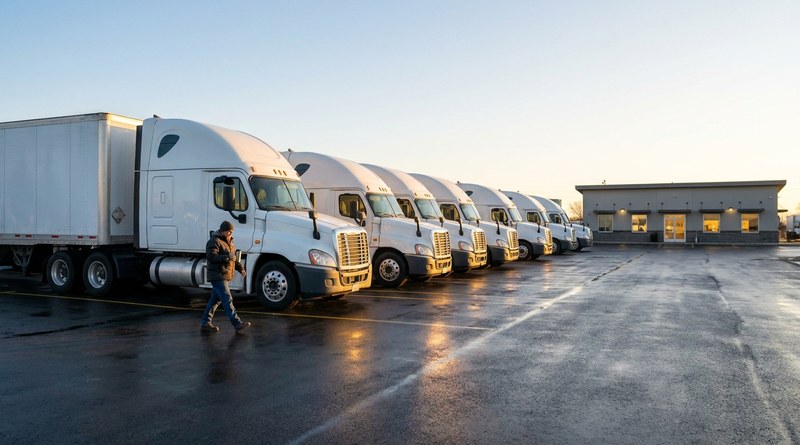
A regional trucking company's vehicles already recorded driver hours and mileage accurately. The design question was not whether that data could reach UKG Ready, but whether it would land before the morning payroll review rather than during it, and who on the fleet side now owns data quality that payroll depends on.

August 27, 2026
Who Owns the Approval Matrix Once UKG Feeds It? A Global Manufacturer’s Answer for SAP S/4HANA
A global oilfield products manufacturer made UKG Ready the originating source for manager chain, position and cost center in SAP S/4HANA Cloud. The integration took two weeks; agreeing what the feed was allowed to change took longer. Here is how the ownership question was settled, what the Controller required before signing off, and why scoping the claim narrowly is what made it auditable.
August 26, 2026
Two Definitions of the Same Hour: Feeding Client-Owned Time Data Into UKG Pro WFM
Engineers at an automotive engineering services firm log project hours in their client's own time system while payroll runs in UKG Pro WFM. This case study covers how CloudApper iPaaS ingests the client's daily export, keeps payroll rules and contract billing rules separate, holds exceptions for human review, and settles who owns the mapping when the client changes its format.

August 21, 2026
From 62 Reports to One File: What Global Payroll Directors Should Expect From Multi-Country Reporting on UKG Ready
Global payroll rarely breaks on calculation. It breaks on the handoff, where pay data has to reach every country in the layout that country requires. A global oilfield services company replaced 62 per-cycle reports with a single automated multi-tab export from UKG Ready into SAP using CloudApper.