Global payroll rarely breaks on calculation. It breaks on the handoff, where pay data has to reach every country in the layout that country requires. For a global oilfield services company on UKG Ready, that means an estimated 62 per-cycle reports, and CloudApper's approach is one automated multi-tab export into SAP.



Table of Contents
- Why Global Reporting Multiplies Instead of Adding
- The Cost Is Not the Hours
- Consolidating the Handoff Instead of the Data
- What Global Payroll Directors Should Actually Require
Global payroll reporting on UKG Ready lives or dies at the handoff: getting pay data out of the HR system and into the shape each country’s payroll process demands, on deadline, without an error that surfaces only when someone is paid wrong in a currency finance rarely reviews. Gross-to-net and statutory rates are largely settled work for most global payroll teams.
A single-country organization exports one file. An organization in twenty-plus countries has to meet each country’s payroll template, with its own required columns, currency, employee identifier convention and rules about what belongs in the file, and that work lands on a small team every cycle. CloudApper consolidates that reporting on top of UKG Ready so the team works from one file instead of dozens.
Why Global Reporting Multiplies Instead of Adding
Standard reporting is built around a defined output. You specify columns, filters, and a population, and you get a file. That model works when the destination is stable.
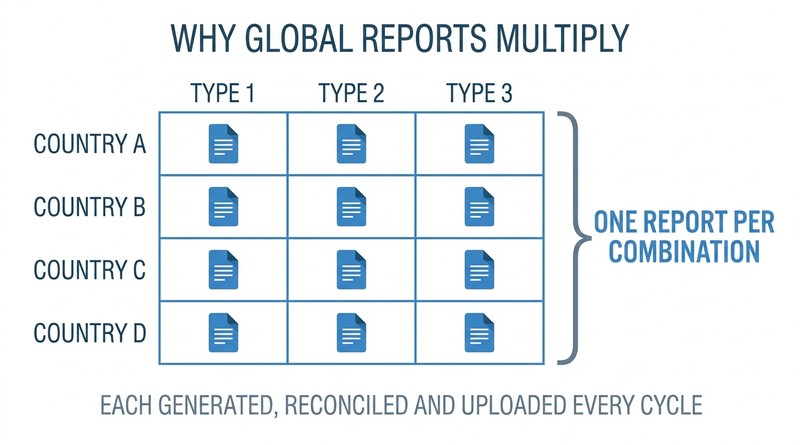
Global payroll breaks the assumption because the destination is plural. Local pay rates need local currency. Country providers and shared service centers each accept a particular layout. A field that is mandatory in one jurisdiction is meaningless in another. The natural response is one report per combination, and once the matrix has two dimensions the count climbs fast.
A global oilfield services company operating across more than twenty countries faces exactly that wall while implementing UKG Ready alongside SAP for global payroll. Its implementation partner estimated that getting pay data into SAP in the form each country requires would take about 62 separate reports, one per country and inventory type combination, each generated, reviewed, reconciled, and reshaped every payroll cycle.
The company’s Regional HR Manager was already running a manual version of that handoff, working from “what I currently get out of SAP to be able to input our variable data into the different systems,” and adding a second check on top: “I also pull fixed & additional data reports to cross check against software output.”
That describes most global payroll operations work. Not complex, just numerous, and numerous in a way that guarantees the occasional missed file or stale export. The reports are fine. The multiplication is the problem.
The Cost Is Not the Hours
Sixty-two reports per cycle is real labor, and reclaiming it matters. But the more consequential costs are the ones that do not appear on a timesheet.
The first is timing risk. A manual multi-file process has to complete before a hard cutoff, in sequence, usually by one or two people who understand the whole chain. Anything that delays the middle of that chain compresses everything after it. Global payroll teams manage this with buffer time, which means the data being sent is older than it needs to be.

The second is that nobody can see the whole picture. When pay data leaves the system as 62 fragments, there is no consolidated view of global labor cost until someone assembles one, and assembling one is another manual exercise. Finance ends up asking questions that HR can only answer by rebuilding the file set.
The third is fragility on change. Adding a country, changing a provider layout, or restructuring a business unit means revisiting the matrix. A process that takes effort to run takes more to modify, so it tends not to get modified. It accumulates workarounds instead.
Consolidating the Handoff Instead of the Data
The important design decision is to leave the system of record alone. UKG Ready already holds nearly every element the export needs: employee records, pay rates, hours, cost allocation, and country assignment, with a handful of locally sourced fields such as net pay added after export. The problem is not where the data lives. It is that the transformation between the platform’s structure and each destination’s required layout has no home, so it would live in 62 manual steps.
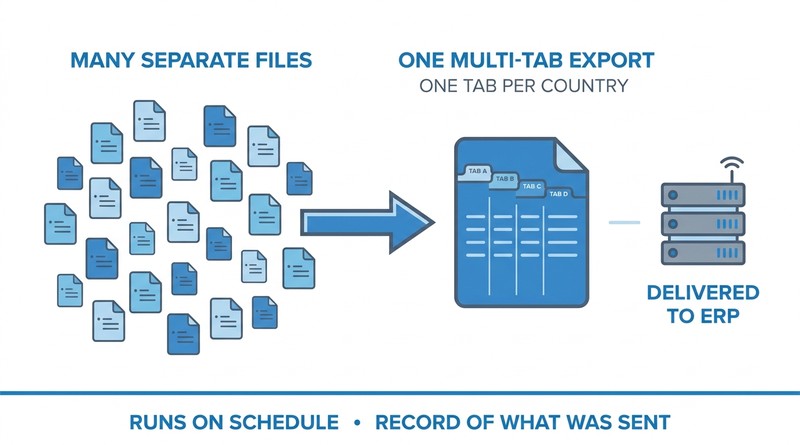
CloudApper provides that layer. CloudApper iPaaS for UKG pulls all pay-related data from UKG Ready through the platform’s APIs, applies each country’s formatting rules, and assembles a single multi-tab file with one tab per country, each already matching that country’s payroll template. The file is delivered by SFTP so payroll can load one file into SAP for all countries. The design replaces the 62-report exercise with one automated export.
What changes operationally is worth being precise about. The design does not reduce the number of country-specific formats the company supports. Every one of those rules still exists and still runs. They move from being executed by a person following a checklist to being executed on a schedule, which is the difference between a process that degrades under pressure and one that does not.
The starting point for that configuration is the company’s own material. As the Regional HR Manager wrote when sending the country templates over,
“I’ve copied all our excel formats as a starting point and stated whether it’s our own excel or from a software or 3rd party.”
This is the same structural pattern behind multilingual reporting where report clones become a single pipeline, and behind the various SAP labor costing integrations that organizations build when finance needs HR data in a form finance systems accept. The underlying question is always the same: does the transformation between two systems live in software, or in a person’s routine?
What Global Payroll Directors Should Actually Require
If you run payroll across multiple countries on UKG Ready, or you are scoping a global implementation now, the export layer deserves the same scrutiny as the calculation layer. A few requirements are worth stating explicitly before anyone builds a report.
Require that country formatting rules are configuration rather than separate report objects. If adding a country means cloning and editing a report, the matrix will grow and someone will maintain it forever.
Require one artifact per cycle, not one per combination. A single consolidated output can be verified as a unit. Sixty-two files can only be spot-checked, and spot-checking is how a stale file reaches a payroll provider.
Require the export to run on a schedule rather than on a person. Anything that depends on someone starting it will occasionally not start, and payroll deadlines do not move.
Require a record of what was sent. When a country provider queries an amount, the useful answer references the exact file and values transmitted, not a reconstruction.
These are integration requirements, best settled during implementation rather than after the first difficult cycle. Organizations that build on the platform’s API surface rather than on reporting exports end up with fewer moving parts, and the same reasoning applies to data flowing the other direction, which is why bidirectional employee data synchronization is usually scoped alongside the payroll export.
What Consolidation Makes Possible
For the oilfield services company, the aim is to turn a multi-hour manual process into a push-button or scheduled operation, so the payroll team is not spending each cycle assembling files. The larger objective is for UKG Ready to serve as the global HRIS for an organization whose reporting requirements span more than twenty jurisdictions, including crews paid day rates in local currency.
There is a strategic dimension for any organization growing by geography. Companies enter new countries through acquisition, new contracts, or new operational sites, and the payroll and HRIS integration work is often what determines how quickly a new entity is actually operating on corporate systems. An export layer that absorbs a new country as a configuration change absorbs growth. A report matrix negotiates with it.
For employees, the effect is the one that matters most and gets discussed least. A worker in a country representing a small share of headcount is the most likely to be affected by a late or incorrect file, because their country’s data is the least reviewed. Automating the handoff removes the correlation between how small your country’s population is and how likely your pay is to be wrong.
The CloudApper AI Platform for UKG exists for exactly this class of requirement: the transformations between a system of record and everything downstream of it, too specific to any organization’s country mix and provider set to belong in a platform’s core, and too consequential to run on a checklist. Connecting UKG to the rest of the enterprise stack is the work, and CloudApper is the process layer that holds it on top of UKG. The organizations that move fastest across borders are not the ones with the largest payroll operations teams. They are the ones that do not need 62 reports.
If your organization runs multi-country payroll on UKG and the export to your payroll providers or ERP still means generating and reconciling separate files per country, talk with the CloudApper team about consolidating that handoff into your existing UKG environment.


October 14, 2026
UKG Costpoint Integration for Defense Contractors: Who Owns the 65 Fields Between Payroll and the Audit
A defense services contractor needs its HRIS to update more than 65 Costpoint fields through an API. CloudApper iPaaS handles the UKG Costpoint integration, and the real lesson is governance: HRIS, finance and IT each own their part of the mapping rules, so labor cost data stays audit-ready as contracts change.

October 12, 2026
ATS to UKG Ready Integration: Making Every Light Industrial Staffing Placement Payroll-Ready on Day One
A light industrial staffing firm placing 20 to 40 new workers a week re-enters every hire from its ATS into payroll by hand. CloudApper's sync creates UKG Ready records at assignment and carries updates and terminations across, so every placement can be payroll-ready on day one.

October 9, 2026
UKG Pro and Mexico Payroll Integration: Keeping Cross-Border Employee Data in Sync
US employers with Mexico operations often run UKG Pro as the system of record and a local platform for Mexican payroll. CloudApper connects the two with an automated sync that sends hires, terminations and pay changes to the Mexico platform and brings payroll results back into UKG Pro.

October 7, 2026
Client-Site Employees and UKG Pro WFM: Keeping Embedded Automotive Engineers Paid Right
Engineers working inside a client’s facility log time in the client’s system, so their paycheck is the employer touchpoint that matters most. For an automotive engineering services firm, CloudApper moves those hours into UKG Pro WFM automatically, removing the manual re-entry where pay errors start.