When a convention center onboards union extras who arrive with only a name and a card number, placeholder employee records bridge a two hour propagation window. This piece looks at what those records cost at merge time and why the first record should carry the union card number.



Table of Contents
A major convention center in the northeastern US cannot know exactly who is coming to an event until the unions send their lists. When customer orders outrun the regular workforce, each union sends extras, and HR receives very little to work with. As the HR and HRIS team put it in their onboarding process document, “Note, the unions send different information, but normally it’s very limited (i.e. first name, last name, union card # and sometimes an unidentified type of phone #)”.

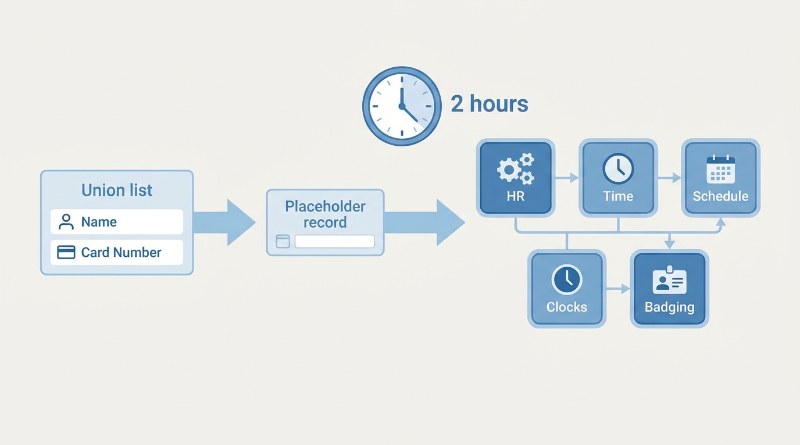
What happens next is a systems question. The venue runs UKG Pro for employee records, UKG Pro WFM for time and scheduling, UKG HR Service Delivery for documents, and UKG time clocks, plus a staffing system and a badging system. A worker must exist in every one before they can be scheduled, punch in and clear the turnstile. CloudApper has been part of that stack since late 2023, through a document capture app built on the CloudApper AI Platform for UKG.
Why a Placeholder Is a Reasonable Answer
A new hire takes about two hours to propagate across that chain. So the team pre-creates generic placeholder records equal to roughly 10 to 15 percent of the work call, letting unannounced replacements be scheduled and badged on the day.
“Why do we create Place Holder employees? Because it takes about 2 hours to propagate all the systems for a new hire…”
HR and HRIS team, major public convention center
Nothing here argues the chain should be faster. A placeholder answers that timing. The open question is what it costs afterward.
The Cost Arrives at Merge Time
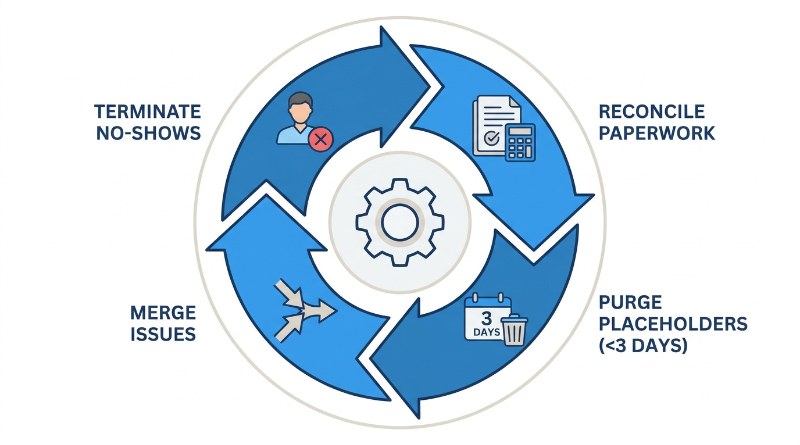
After each session, reactivated no-shows must be terminated, paperwork reconciled and shredded, and placeholders purged within three days. A terminated worker who returns without union notice cannot punch or be scheduled. That cleanup repeats after every event. Anyone who has planned biometric enrollment for a seasonal ramp will recognize the pattern.
Decide What the First Record Carries
If the propagation window is fixed, the variable left to design is what the record holds when it is created. The union card number is the one identifier every union list carries, and pay and seniority rules eventually depend on it, as in union and CBA rule configuration in UKG.
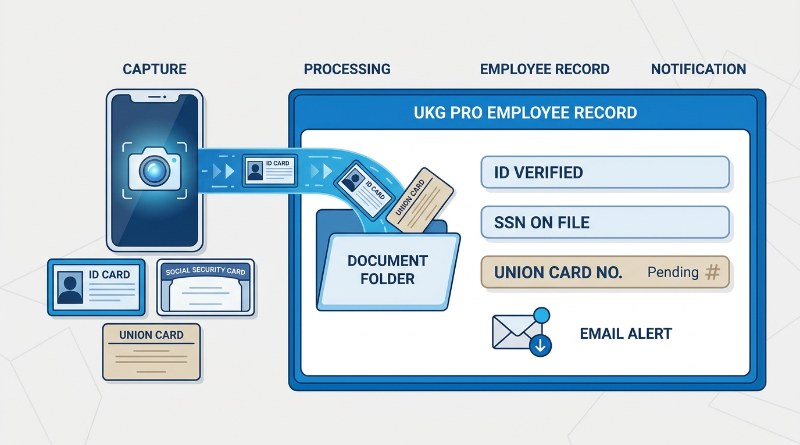
The CloudApper capture app is built around that idea. A custom field holds the union card number. HR staff photograph a worker’s ID, Social Security card, union card and other credentials on a phone or tablet, and the images are filed by document type to the worker’s UKG HR Service Delivery Document Manager record. The app opens as a tile inside UKG Pro with SSO, and HR gets an email when documents are scanned for someone not yet in the system. The UKG connection runs through CloudApper iPaaS for UKG.
“We currently use your services for uploading documents to employee records within UKG HRSD Document Manager.”
HRIS Administrator, major public convention center
That is the live part: credentials captured on mobile devices and filed directly to the worker’s record. It gives HR one place to hold the union card number and supporting documents from the first scan. It does not by itself change how many placeholders a venue creates.
What to Take Back to Your Team
Put three questions to your HRIS and IT leads before the next surge. Which identifier do your call-in lists carry? Where is the first record created, and what does it hold? What must be cleaned up when the event ends? How stations are sequenced around those answers is covered in our look at event-day union onboarding. CloudApper builds on UKG Pro rather than changing it.
If surge or union call-in labor puts pressure on how your UKG records get created, the CloudApper team can walk through how document capture would fit your environment. Start the conversation with CloudApper.



November 5, 2026
Wage Theft Notice Automation in UKG Ready: Two Transit Compliance Programs, One Small HR Team
A small transit agency often runs a state wage notice program and a federal drug and alcohol testing program with the same few people. See how CloudApper extends UKG Ready so each program starts from an HR event, produces the right document, and files it in the employee record.
November 2, 2026
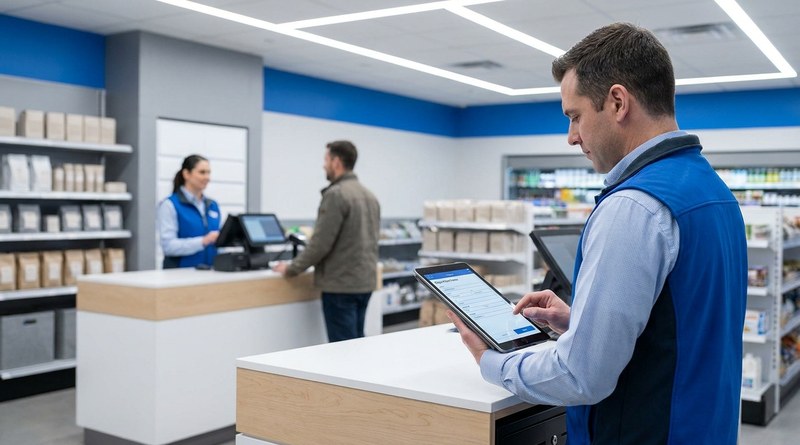
Employee Counseling Form in UKG Pro: How a Convenience Retailer Documents Age-Restricted Sales Violations the Same Way in Every Store
A national fuel and convenience retailer documents age-restricted sales violations and other store-level counseling the same way at every location. CloudApper launches a structured counseling form from the UKG Pro Jobs menu, with second-level manager review, employee remarks and an auditable record that replaces paper forms.

October 5, 2026
Employee Relations Case Management in UKG: How a Building Products Manufacturer Moved ER Cases Out of the Inbox
A multi-plant building products manufacturer tracked employee relations cases in email threads. CloudApper brought ER case management inside UKG with structured intake, AI risk triage, SLA-driven escalation and audit trails, giving HR one consistent process and leadership anonymized trend visibility across the organization.
August 31, 2026
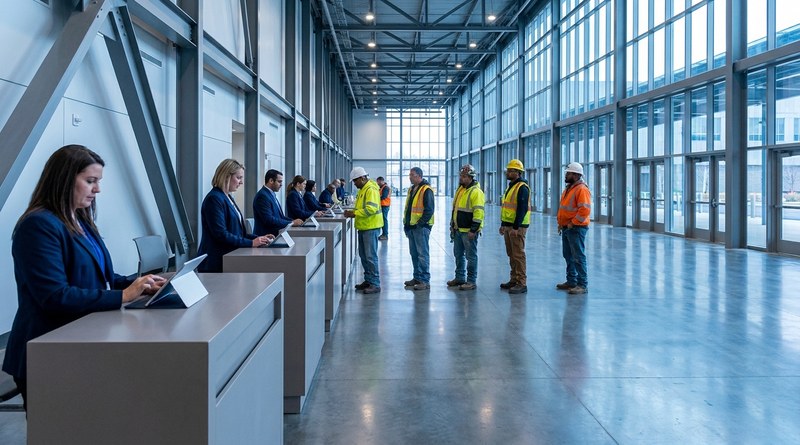
Five Stations, One Curtain Time: Event-Day Union Onboarding on UKG Pro
A metropolitan convention center onboards hundreds of union workers on event days knowing little more than a name and a union card number. CloudApper already files their documents into UKG. The next step is live stage tracking across five stations, and its purpose is reassignment mid-flow, with a record the union steward can check.