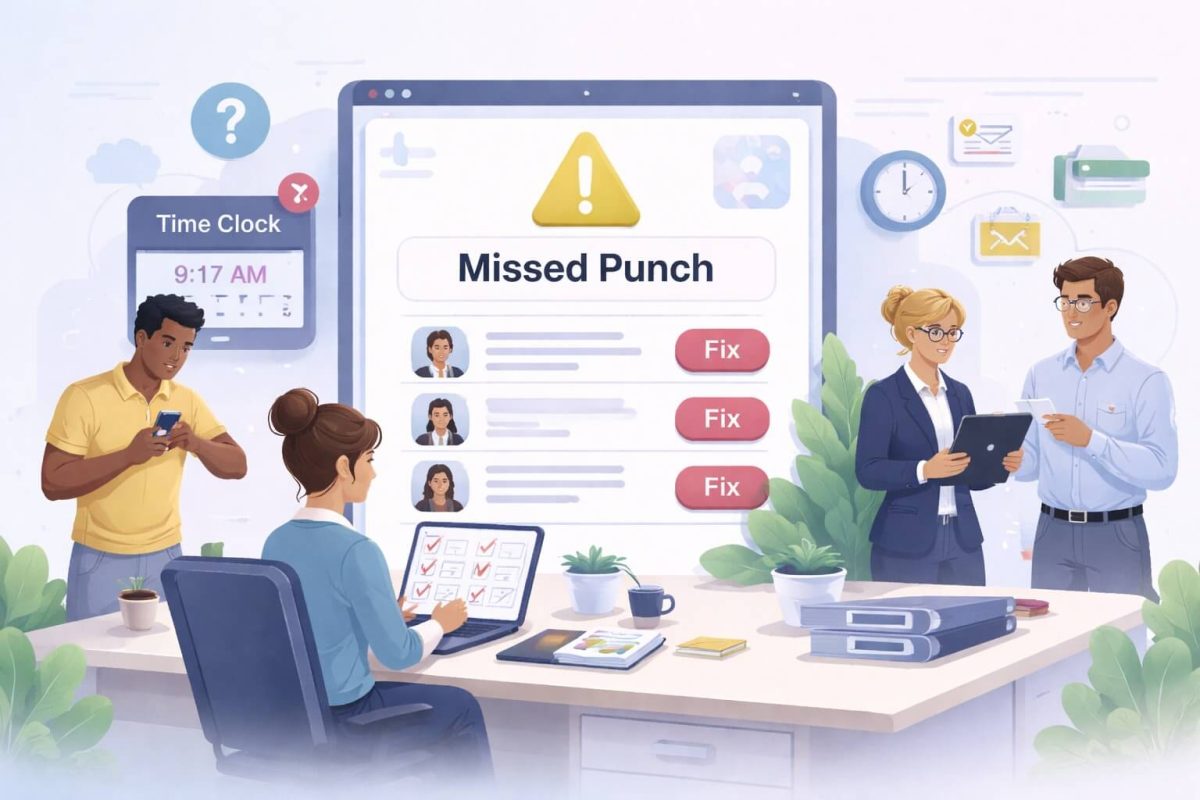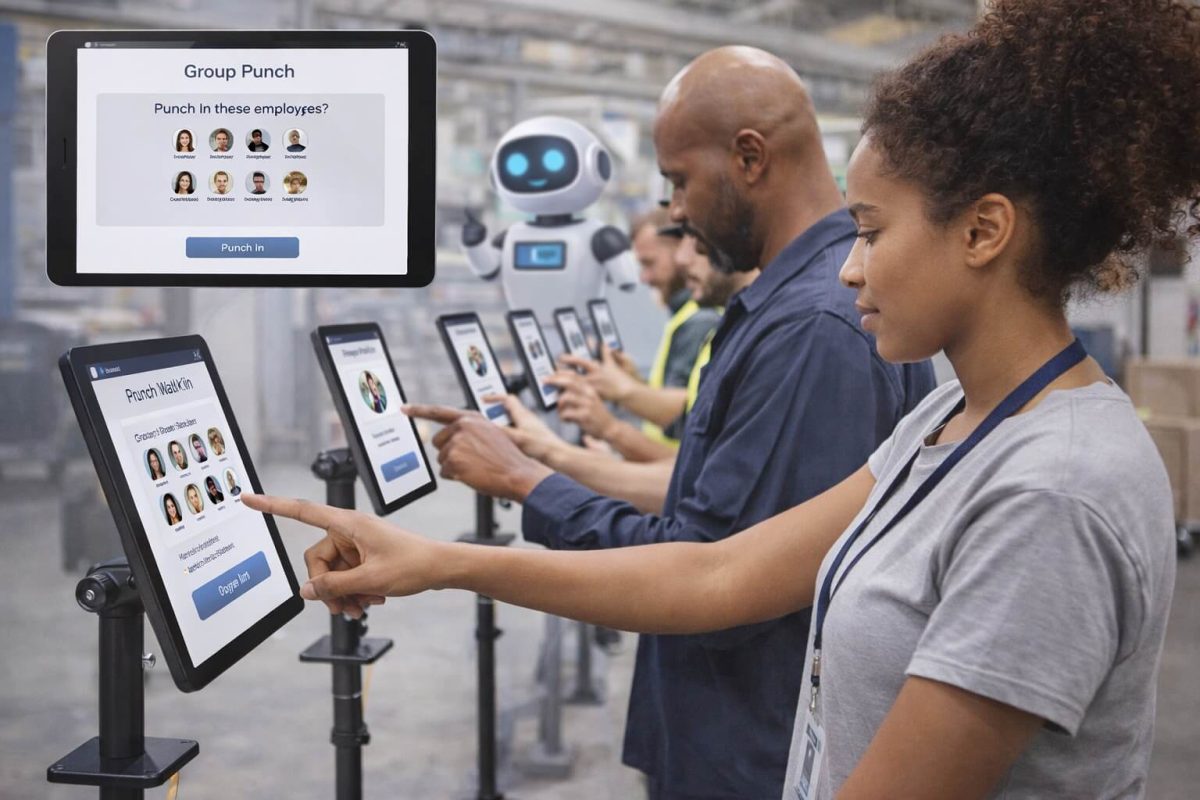

Manual missed punch corrections in UKG create hidden productivity killers: hours of admin time, delayed payroll, inconsistent approvals, compliance gaps, and employee frustration. CloudApper AI TimeClock automates the entire process with self-service mobile requests, GPS verification, instant notifications, and audit-ready documentation—eliminating manual work and disputes.



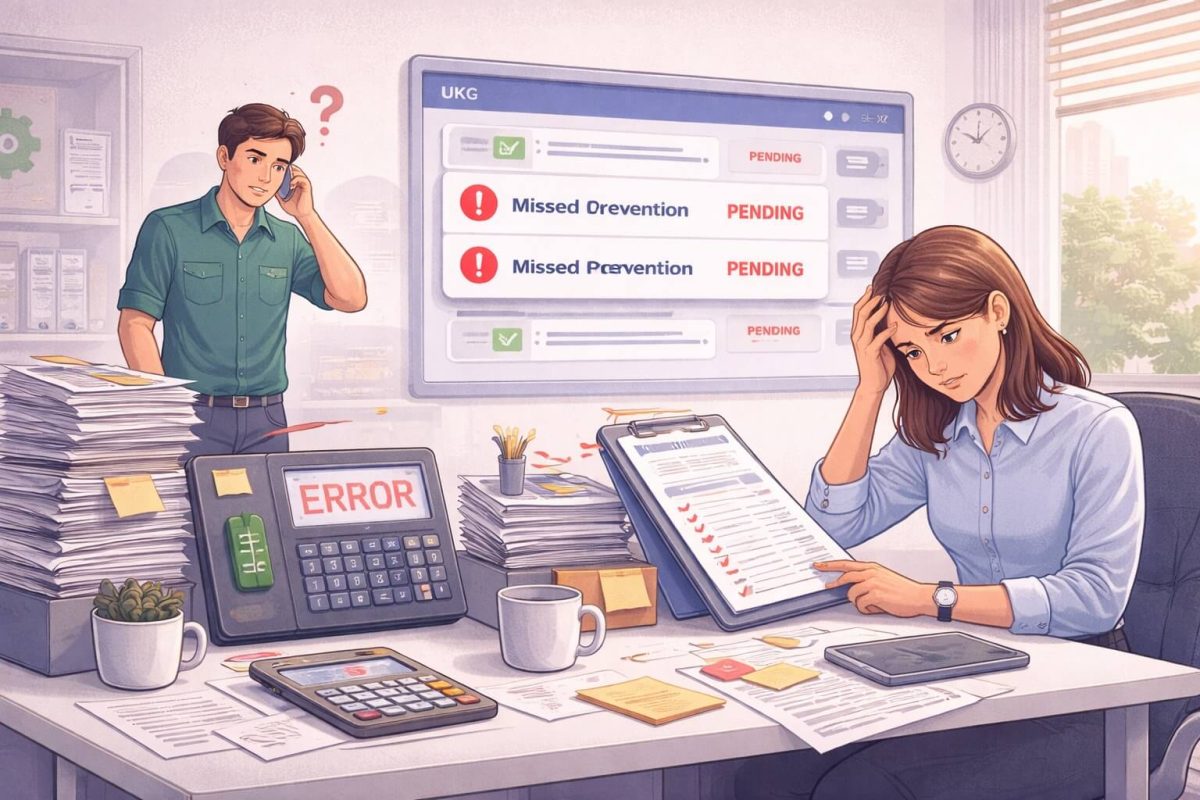
Table of Contents
Every payroll cycle, HR professionals and system administrators face the same productivity drain: manually processing missed punch corrections in UKG. What begins as a simple time tracking gap quickly spirals into hours of administrative work—investigating incidents, verifying hours, obtaining approvals, and manually entering corrections before payroll deadlines. For organizations in healthcare, retail, and manufacturing, where workforce sizes are substantial and shift-based scheduling is complex, manual missed punch corrections represent a significant hidden cost that undermines operational efficiency and diverts HR resources from strategic initiatives.
TL;DR
Manual missed punch corrections in UKG waste significant time and hurt productivity through repetitive admin work, manager bottlenecks, payroll delays, error-prone entries, compliance exposure, and employee dissatisfaction. CloudApper AI TimeClock solves this by enabling mobile self-service missed punch requests, automated manager notifications/approvals, GPS/time verification, real-time audit trails, and seamless UKG integration—cutting correction time by 80–90%, reducing disputes, ensuring accuracy, and freeing HR for strategic work in retail, healthcare, manufacturing, and logistics.
The True Cost of Manual Missed Punch Corrections
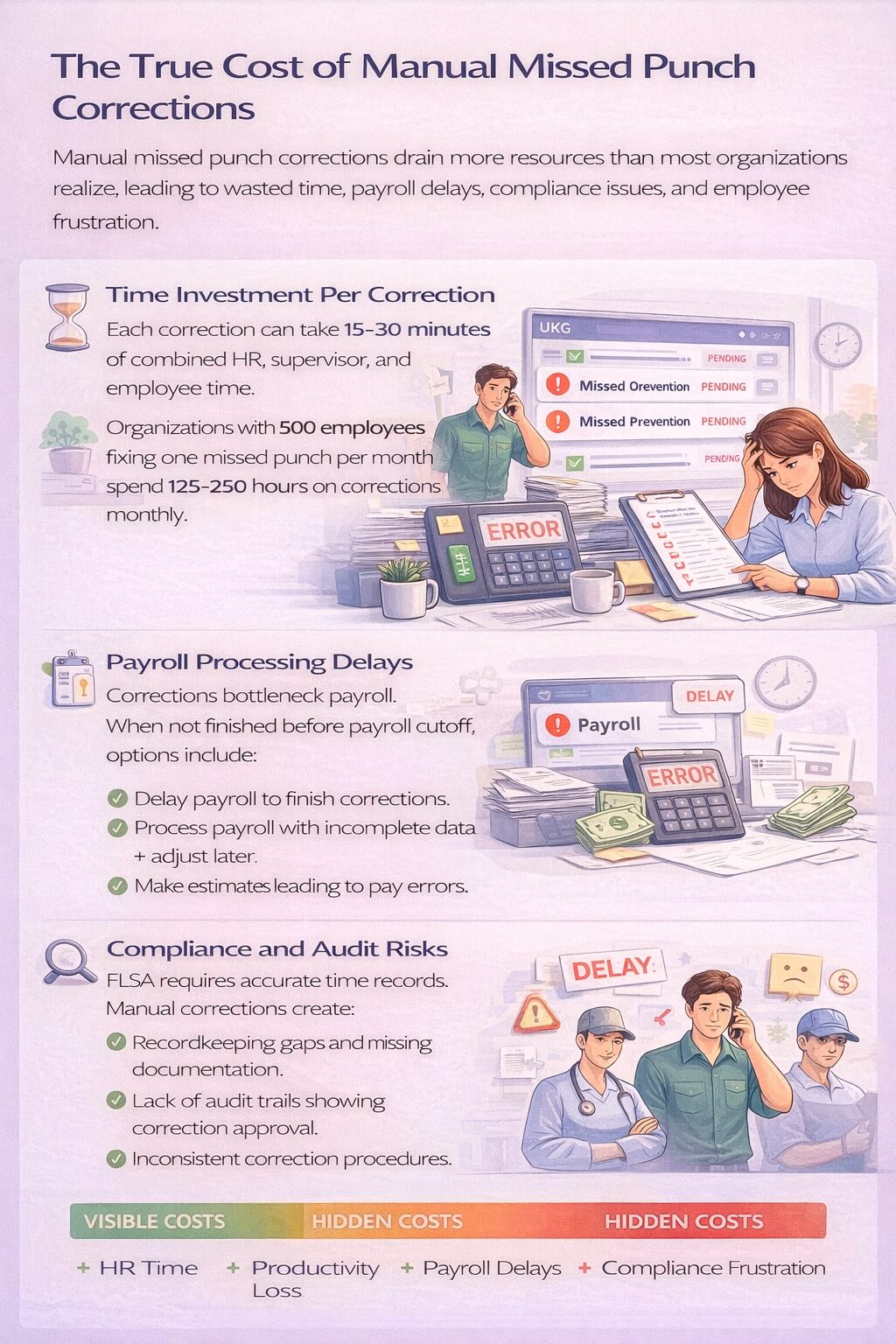
Manual missed punch corrections consume far more resources than most organizations realize. The visible costs include direct HR staff time spent processing corrections, but the hidden costs—productivity losses, payroll delays, compliance risks, and employee frustration—create a substantial drain on organizational effectiveness.

Time Investment Per Correction
A single missed punch correction in UKG requires multiple steps and involves several people. The employee must recognize the missed punch, notify their supervisor, and complete a correction request with details about actual work hours. The supervisor must verify the employee’s claim, often by checking schedules, reviewing work assignments, or consulting with other managers. HR staff must review the request, validate it against company policies, and manually enter the correction into UKG.
Industry research indicates that processing a single missed punch correction manually takes between 15 and 30 minutes of combined staff time when accounting for all parties involved. For an organization with 500 employees experiencing just one missed punch per employee per month, this translates to 125 to 250 hours of administrative time monthly—equivalent to one to two full-time employees dedicated solely to processing missed punch corrections.
Healthcare organizations with 24/7 operations and complex department structures often see even higher time investments per correction, as verifying actual hours worked may require confirming patient care activities, checking nursing notes, or coordinating with multiple department supervisors. Retail environments with high turnover and part-time workforces experience frequent missed punches from newer employees still learning punch procedures. Manufacturing facilities with shift differentials and multiple pay codes require additional verification to ensure corrections are applied to the appropriate labor categories.
Payroll Processing Delays
Manual missed punch corrections create bottlenecks in payroll processing workflows. When corrections aren’t completed before payroll cutoff, organizations face difficult choices: delay payroll processing to ensure accuracy, process payroll with incomplete data and issue manual adjustments later, or make best-guess estimates that may result in over or underpayment.
Each option creates problems. Delayed payroll processing frustrates employees who depend on timely compensation and can damage morale and retention, particularly in industries like healthcare and retail where frontline workers may already face challenging working conditions. Processing incomplete data and issuing corrections later increases administrative workload and creates confusion for employees trying to understand their paychecks. Making estimates introduces the risk of wage and hour violations if employees are underpaid, or overpayment recovery issues if employees are paid for unworked time.
Compliance and Audit Risks
The Fair Labor Standards Act (FLSA) requires employers to maintain accurate records of hours worked. Manual missed punch correction processes introduce multiple compliance vulnerabilities. Inconsistent correction procedures across departments or supervisors can create recordkeeping gaps. Verbal approvals without documentation leave organizations unable to demonstrate proper authorization during audits. Delays in processing corrections may result in wage and hour violations if employees work overtime that isn’t properly recorded and compensated.
During Department of Labor investigations or wage and hour lawsuits, organizations must produce detailed records documenting actual hours worked and the basis for any corrections made to time records. Manual processes often lack the comprehensive audit trails necessary to demonstrate compliance, particularly when corrections involve verbal communications, email exchanges, or paper forms that aren’t systematically retained.
Employee Experience and Morale
From the employee perspective, manual missed punch corrections create frustration and stress. Employees who forget to punch during busy shifts—healthcare nurses responding to patient emergencies, retail associates handling customer rushes, manufacturing workers meeting production deadlines—already feel stressed about the missed punch. Complicated correction processes that require tracking down supervisors, completing forms, and following up to ensure corrections are processed add additional burden.
When corrections aren’t processed before paychecks are issued, employees experience financial stress and may lose trust in the organization’s payroll accuracy. Frontline workers living paycheck to paycheck cannot afford delays or errors in compensation. The perception that the organization doesn’t prioritize accurate and timely payment damages employee engagement and can contribute to retention challenges.
Why Manual Processes Persist Despite the Costs
Given the substantial costs, why do organizations continue relying on manual missed punch corrections? Several factors contribute to this persistence.
Perceived Lack of Alternatives: Many organizations view manual correction processes as an unavoidable aspect of workforce management. System administrators may not be aware that technology solutions exist to automate and streamline missed punch corrections while maintaining the approval workflows and audit trails necessary for compliance.

Implementation Concerns: HR leaders may hesitate to implement new systems due to concerns about implementation complexity, integration challenges with UKG, or change management requirements. The status quo, despite its inefficiencies, feels safer than risking disruption to payroll processes.
Budget Constraints: Organizations may perceive automation solutions as expensive capital investments, failing to calculate the ROI that comes from reduced administrative time, improved accuracy, and enhanced compliance. When the hidden costs of manual processes aren’t quantified, the business case for automation remains unclear.
Fragmented Responsibility: In many organizations, responsibility for time tracking is distributed across HR, payroll, IT, and operations teams. This fragmentation makes it difficult to build consensus around process improvements or secure budget for solutions that benefit multiple departments.
CloudApper AI TimeClock: Automating Missed Punch Corrections
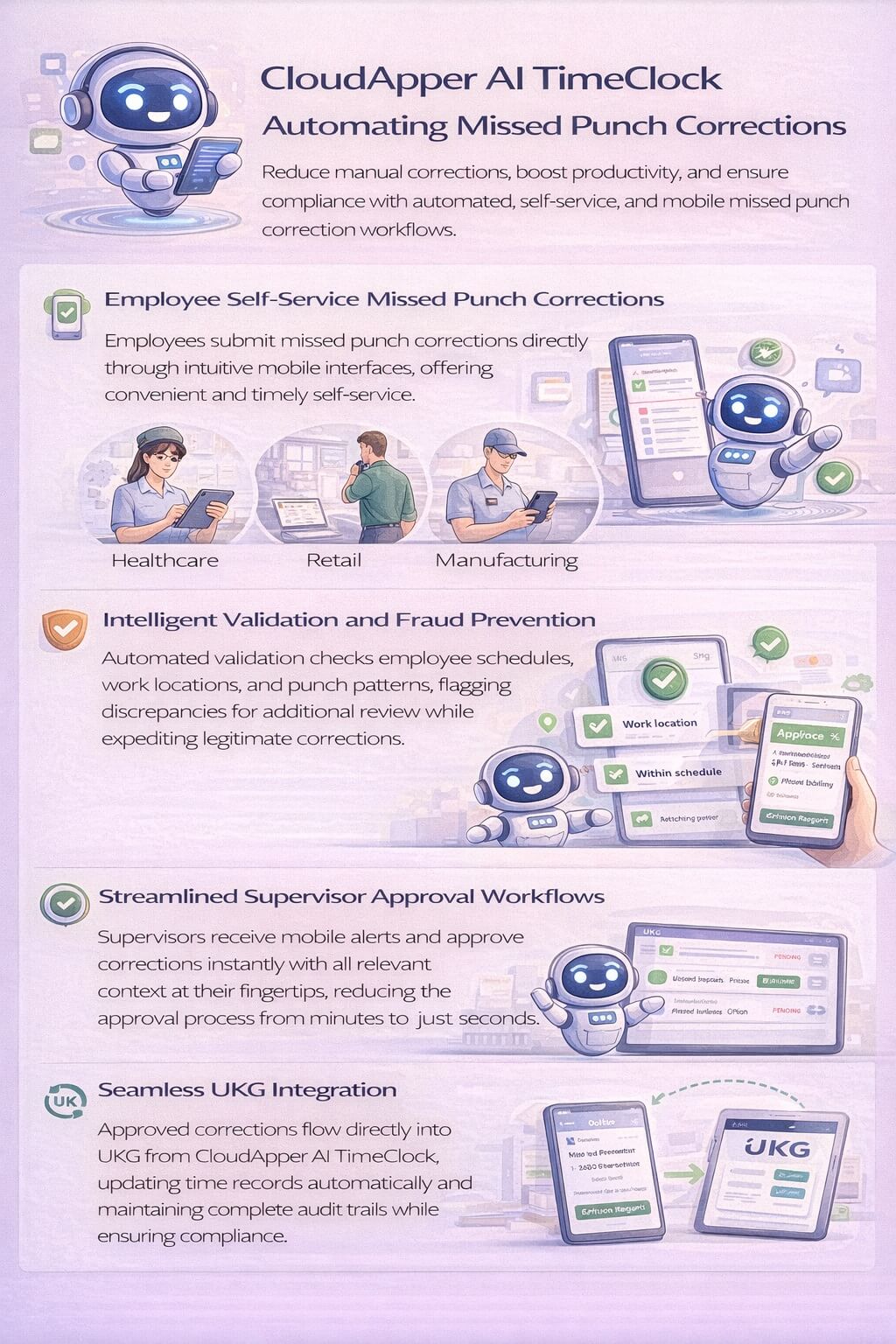
CloudApper AI TimeClock transforms missed punch correction workflows by extending UKG’s capabilities with intelligent automation, employee self-service, and mobile accessibility. The solution addresses the root causes of productivity drain while maintaining the compliance, accuracy, and control that organizations require.
Employee Self-Service Missed Punch Corrections
CloudApper AI TimeClock enables employees to submit missed punch corrections directly through intuitive mobile interfaces on iPads, Android tablets, or smartphones. When employees realize they’ve missed a punch, they can immediately submit a correction request through the same device they use for regular time tracking.
The AI-powered assistant guides employees through the correction process, prompting for necessary information including the time they actually worked, the reason for the missed punch, and any relevant context. This guided workflow ensures employees provide the information supervisors and HR need to approve corrections, eliminating the back-and-forth communication that often extends manual processes.
For healthcare nurses who missed a punch while responding to a patient emergency, the process takes less than a minute and can be completed at a nursing station between patient care activities. Retail associates can submit corrections during breaks without leaving the store floor or tracking down busy managers. Manufacturing workers can request corrections at shift change without disrupting production schedules.
Intelligent Validation and Fraud Prevention
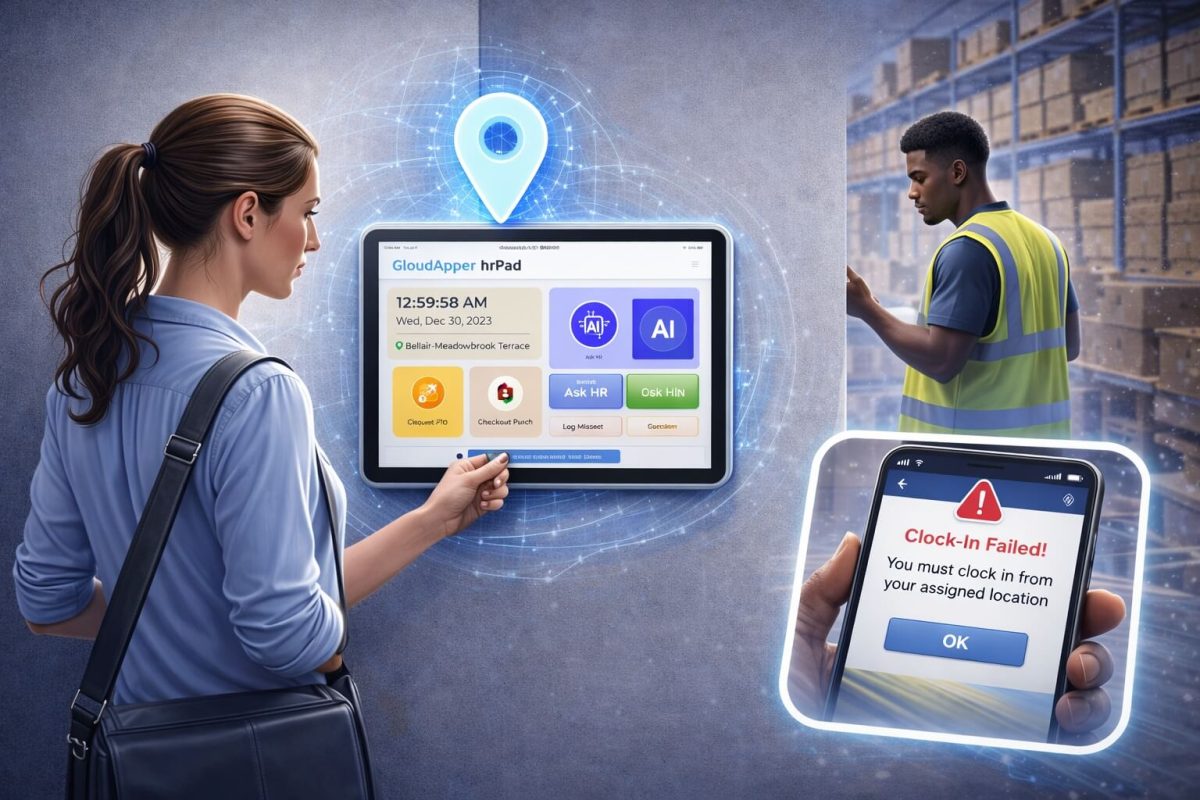
CloudApper AI TimeClock incorporates intelligent validation that reviews correction requests against multiple data sources before routing them for supervisor approval. The system checks correction requests against employee schedules to identify discrepancies, reviews geofencing data to verify the employee was at the work location during claimed work hours, and analyzes historical punch patterns to flag unusual requests.
This automated validation reduces the verification burden on supervisors and HR staff. Corrections that pass all validation checks can be fast-tracked for approval, while corrections that trigger validation flags are highlighted for additional review. This risk-based approach focuses human attention where it’s most needed while expediting clearly legitimate corrections.
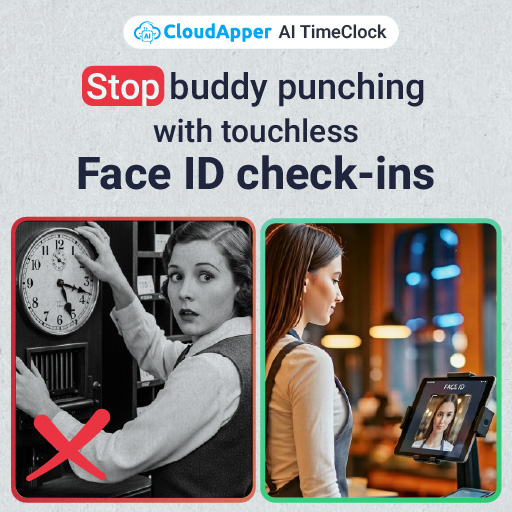
The system’s biometric authentication capabilities prevent one employee from submitting corrections on behalf of another employee, maintaining the individual accountability essential for time tracking integrity.
Streamlined Supervisor Approval Workflows
Supervisors receive mobile notifications when employees submit missed punch corrections, enabling them to review and approve requests immediately rather than waiting until they’re at a desktop computer or can access UKG directly. The notification includes all relevant context—the employee’s regular schedule, their recent punch history, any validation flags, and the specific details of the correction request.
Supervisors can approve legitimate corrections with a single tap, or request additional information for corrections that require clarification. This mobile-first approach is particularly valuable in healthcare environments where nurse managers are constantly moving between units, retail stores where managers spend most of their time on the sales floor, and manufacturing facilities where supervisors oversee production areas rather than sitting at desks.
The streamlined approval workflow dramatically reduces the time supervisors spend on missed punch corrections, often cutting the process from 15-30 minutes per correction to 1-2 minutes. For supervisors managing large teams, this time savings is substantial and allows them to focus on operational priorities rather than administrative tasks.
Seamless UKG Integration
Approved missed punch corrections flow automatically from CloudApper AI TimeClock into UKG, updating time records without manual data entry. This integration eliminates transcription errors, ensures corrections are applied to the appropriate pay periods, and maintains complete audit trails showing who requested each correction, who approved it, when it was processed, and what validation checks were performed.
System administrators maintain centralized control through UKG while gaining the flexibility and automation benefits of CloudApper AI TimeClock. All UKG payroll rules, overtime calculations, and compliance features work exactly as designed, with the correction data seamlessly integrated into existing workflows.
Comprehensive Audit Trails and Compliance Support
Every missed punch correction processed through CloudApper AI TimeClock is documented with comprehensive details including timestamps, user identifications, approval chains, validation results, and any supporting information provided by employees. This documentation creates the audit trail necessary to demonstrate compliance during Department of Labor investigations, wage and hour lawsuits, or internal audits.
The system generates reports showing missed punch correction volumes by department, location, and employee, enabling HR leaders to identify patterns that may indicate training needs, policy enforcement issues, or operational challenges. Manufacturing organizations can track corrections by shift to identify whether certain production schedules create more missed punches. Healthcare systems can monitor corrections by department to determine whether certain units need additional time clock access points. Retail chains can compare correction rates across stores to identify best practices or implementation gaps.
Quantifying the ROI of Automated Missed Punch Corrections
The return on investment from automating missed punch corrections comes from multiple sources: direct administrative time savings, reduced payroll errors, improved compliance, and enhanced employee satisfaction.
Administrative Time Savings: For an organization processing 500 missed punch corrections monthly with manual processes requiring 20 minutes per correction, automation that reduces processing time to 2 minutes saves 150 hours monthly—the equivalent of nearly one full-time employee. At a loaded HR cost of $30 per hour, this represents $4,500 in monthly savings or $54,000 annually.
Payroll Accuracy Improvements: Manual data entry for missed punch corrections introduces transcription errors. Industry estimates suggest error rates of 1-3% for manual data entry. Automated integration eliminates these errors, preventing overpayments, underpayments, and the administrative cost of researching and correcting payroll discrepancies.
Compliance Risk Reduction: The comprehensive audit trails and consistent processes enabled by automation reduce the risk of wage and hour violations and the associated penalties, legal fees, and settlement costs. While these costs are difficult to predict, a single wage and hour lawsuit settlement can easily exceed $100,000 when accounting for penalties, legal fees, and settlement amounts.
Employee Retention: Simplified correction processes and improved paycheck accuracy contribute to employee satisfaction and retention. In industries like healthcare, retail, and manufacturing where turnover costs range from $3,000 to $10,000 per frontline employee, even modest retention improvements generate substantial value.
Implementation Best Practices
Successfully implementing automated missed punch corrections requires attention to change management, training, and process optimization.
Communicate the Benefits: Help employees and supervisors understand how automated corrections will make their lives easier. Emphasize the time savings, improved accuracy, and reduced stress that come from streamlined processes.
Provide Comprehensive Training: Train employees on how to submit correction requests through mobile devices, what information they need to provide, and what timeline they should expect for approval. Train supervisors on their review and approval responsibilities, how to use mobile approval tools, and how to handle correction requests that require additional investigation.
Start with a Pilot: Consider implementing automated corrections in one department or location before rolling out organization-wide. Use the pilot to refine workflows, identify training needs, and build success stories that support broader adoption.
Monitor and Optimize: Track key metrics including correction request volumes, approval turnaround times, validation flag rates, and employee feedback. Use this data to continuously improve processes and maximize the value of automation.
Industry-Specific Applications
Healthcare Missed Punch Corrections
Healthcare organizations experience particularly high volumes of missed punch corrections due to the unpredictable nature of patient care. Nurses responding to emergencies, physicians transitioning between departments, and support staff handling urgent situations often cannot prioritize punching in or out during critical moments.
CloudApper AI TimeClock addresses these challenges by positioning convenient punch terminals at nursing stations throughout facilities and enabling mobile correction submissions that healthcare workers can complete between patient care activities. The intelligent validation can be configured to recognize patterns consistent with healthcare operations—such as corrections during typical emergency response times—while flagging unusual patterns for review.
Retail Missed Punch Corrections
Retail environments experience missed punches during peak customer service periods when associates prioritize customer needs over administrative tasks. New employees still learning procedures contribute to higher correction volumes, while busy managers struggle to find time for manual approval processes.
Automated correction workflows allow retail associates to submit requests during breaks using the same tablets they use for normal punching. Managers receive mobile notifications and can approve legitimate corrections while on the sales floor, dramatically reducing the time needed to keep time records accurate.
Manufacturing Missed Punch Corrections
Manufacturing operations with complex shift differentials, multiple pay codes, and large workforces experience substantial administrative burden from manual missed punch corrections. Verifying which production area an employee worked in, which shift premium applies, and what job code should be used requires detailed investigation.
CloudApper AI TimeClock can capture this context during the correction request process, prompting employees to specify the production area, job code, and other relevant details. Geofencing data provides additional verification of work location, reducing the investigation burden on supervisors and HR.
Frequently Asked Questions About Automated Missed Punch Corrections
How do automated missed punch corrections maintain accuracy and prevent fraud?
Automated systems like CloudApper AI TimeClock use multiple validation methods including schedule verification, geofencing, biometric authentication, and historical pattern analysis. These automated checks often provide better fraud prevention than manual processes while requiring less human time for verification.
Will automating missed punch corrections reduce supervisor oversight?
No. Supervisors still review and approve correction requests, but they do so through streamlined mobile workflows that provide better context and faster processing. Automation enhances supervisor effectiveness rather than eliminating their role in ensuring time tracking accuracy.
How long does it take to implement automated missed punch corrections?
Implementation timelines vary based on organizational size and complexity, but many organizations complete CloudApper AI TimeClock deployment within 2-4 weeks. The cloud-based architecture and pre-built UKG integration minimize technical complexity.
What happens if an employee submits an inaccurate missed punch correction?
The system flags corrections that don’t align with schedules, geofencing data, or historical patterns for additional supervisor review. Supervisors can request clarification or deny corrections that appear inaccurate, maintaining the same oversight that exists in manual processes.
Can automated systems handle complex correction scenarios?
Yes. CloudApper AI TimeClock can be configured to capture the specific information needed for complex scenarios such as department transfers, shift differentials, or multiple job codes. The AI assistant guides employees through providing necessary details based on your organization’s requirements.
How does automation integrate with existing UKG workflows?
CloudApper AI TimeClock integrates directly with UKG through certified APIs, ensuring correction data flows seamlessly into existing payroll and workforce management workflows. System administrators maintain centralized control while gaining automation benefits.
What training do employees need to use automated correction processes?
The intuitive mobile interface requires minimal training. Most employees can successfully submit corrections after a brief demonstration or quick reference guide. The AI assistant provides contextual help during the correction process.
How do we measure ROI from automated missed punch corrections?
Track metrics including time spent processing corrections before and after automation, payroll error rates, correction turnaround times, and employee satisfaction scores. Most organizations see ROI within the first few months through direct administrative time savings alone.
Can we customize the correction workflow to match our policies?
Yes. CloudApper AI TimeClock allows extensive customization of correction workflows, validation rules, approval requirements, and data collection to align with your organization’s specific policies and operational needs.
What reporting capabilities exist for missed punch corrections?
The system provides comprehensive reporting on correction volumes by employee, department, location, and time period. Reports show approval turnaround times, validation flag rates, and patterns that may indicate training needs or policy enforcement opportunities.
Reclaiming Productivity Through Automation
Manual missed punch corrections represent a hidden productivity drain that costs organizations thousands of hours annually in administrative time while introducing compliance risks and employee frustration. For healthcare, retail, and manufacturing organizations using UKG, this inefficiency persists not because alternatives don’t exist, but because the true costs of manual processes remain hidden and the benefits of automation remain underappreciated.
CloudApper AI TimeClock transforms missed punch corrections from a productivity drain into a streamlined, automated workflow that saves time, improves accuracy, enhances compliance, and delivers measurable ROI. By extending UKG’s capabilities with intelligent automation, employee self-service, mobile accessibility, and seamless integration, the solution addresses the root causes of productivity loss while maintaining the control and auditability that organizations require.
The question isn’t whether your organization can afford to automate missed punch corrections—it’s whether you can afford to continue losing productivity to manual processes that technology has made obsolete. Every payroll cycle spent manually processing corrections is an opportunity cost, diverting HR resources from strategic initiatives that drive organizational success.
Discover how CloudApper AI TimeClock can eliminate the productivity drain of manual missed punch corrections and transform your UKG time tracking operations with intelligent automation that delivers immediate, measurable results.