UKG Ready and Pro WFM execute whatever rounding rule is configured — they don't monitor whether that rounding is FLSA-neutral, California-compliant for meal periods, or defensible across multi-state deployments. Here's the audit framework every UKG admin needs before this becomes a liability.



Table of Contents
- What UKG Ready and Pro WFM Do Natively for Time Rounding
- The Federal Standard: What FLSA 29 CFR §785.48(b) Actually Permits
- What California Changed — and the Two Rules That Now Apply Simultaneously
- The Multi-State Administrative Tax
- What to Audit in UKG Before Rounding Becomes a Liability
- How CloudApper AI TimeClock Removes Rounding From the Compliance Equation
- Frequently Asked Questions
- Closing
Someone configured your UKG rounding rule. Maybe it was three years ago during implementation. Maybe it was carried over from a legacy system. It rounds to the nearest quarter hour, which means time from one to seven minutes before or after the hour rounds down, and eight to fourteen minutes rounds up. Nobody has audited whether it’s actually neutral since then.
That configuration is a rules engine executing a policy. It is not checking whether the policy is compliant. It is not checking whether California employees’ meal-break punches are being rounded in violation of a 2021 California Supreme Court ruling. It is not tracking whether the cumulative effect, across thousands of punches over two years, has resulted in employees receiving less pay than they worked for.

UKG Ready and Pro WFM do what they’re configured to do. Proving that what they’ve been doing is legally defensible is the employer’s problem — and that burden grows with every jurisdiction, union contract, and pay period.
CloudApper AI TimeClock for UKG runs on any standard Android tablet or iPad, syncing directly with UKG Ready and Pro WFM, and delivers to-the-minute punch timestamps that eliminate rounding as a compliance variable — capturing what happened at the terminal rather than approximating it. For multi-state organizations where rounding rules differ by location, that architectural simplicity has real operational and legal value.
What UKG Ready and Pro WFM Do Natively for Time Rounding
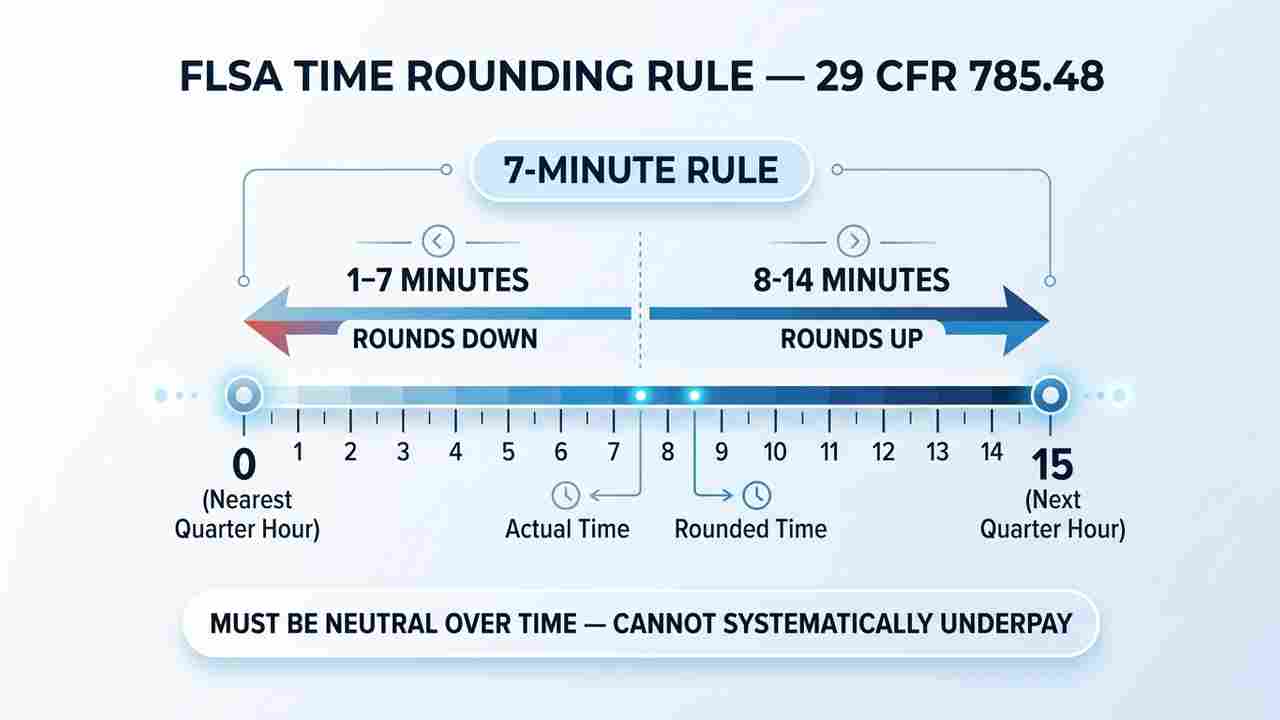
UKG’s timekeeping platform supports configurable time rounding as a standard feature. Rounding can be applied at the pay rule level, meaning it is applied to punches based on the employee group, schedule, or work rule assignment. The system supports rounding to the nearest five minutes, nearest one-tenth of an hour (six minutes), or nearest quarter hour (fifteen minutes). The quarter-hour implementation is what most organizations using UKG call the “7-minute rule”: punches from one to seven minutes before or after a quarter-hour boundary round to that boundary; punches eight or more minutes away round to the next quarter hour.
These settings are applied consistently and automatically. Once configured, they execute on every punch without deviation. For organizations that implemented UKG years ago and inherited rounding settings from their previous vendor or from implementation defaults, the rounding has been operating silently ever since — without any automatic audit of whether the configured policy is achieving neutral results.
This is not a criticism of UKG. The platform provides a configuration tool. Whether the configured tool produces a legally compliant outcome over time is a function of the policy itself, the workforce’s punch behavior, and the jurisdictions where those employees work — none of which UKG monitors on the employer’s behalf. Common UKG timekeeping errors often trace back to configuration choices made at implementation that nobody has revisited since the original go-live.
The Federal Standard: What FLSA 29 CFR §785.48(b) Actually Permits
The federal basis for time rounding is narrow. Under 29 CFR §785.48(b), employers using time clocks may record starting and stopping time to the nearest five minutes, one-tenth of an hour, or quarter hour. The regulation explicitly conditions this on one requirement: the practice must not result, over a period of time, in failure to compensate employees properly for all time they have actually worked.
That condition matters more than most organizations recognize when they configure rounding. FLSA does not authorize rounding because it’s administratively convenient. It tolerates rounding as long as the cumulative outcome is neutral — meaning employees receive no less pay over time than exact-minute tracking would produce.
The Department of Labor’s Fact Sheet #53 confirms this: quarter-hour rounding where one to seven minutes rounds down and eight to fourteen minutes rounds up is an example of a compliant implementation, but only if applied consistently and in a manner that doesn’t systematically favor the employer. An organization that always rounds down on clock-out and always rounds up on clock-in — even if each individual rounding increment is within the seven-minute window — is applying rounding in a non-neutral way that can create FLSA liability.
The compliance question for any UKG admin is not whether rounding is configured. It is whether the rounding, applied to actual punch data over the past two years, has produced results that are neutral on net. That requires pulling punch data, running the comparison against exact-minute equivalents, and verifying that no systematic underpayment exists — a step most organizations have never taken. Missed punch policy configuration in UKG compounds this issue: when missed punches are manually corrected using round numbers, the rounding analysis for those records is bypassed entirely.
What California Changed — and the Two Rules That Now Apply Simultaneously
California has historically been more restrictive than federal law on wage and hour matters, and time rounding is no exception. Two California court decisions define the current standard, and they apply to different aspects of time capture.
The See’s Candy standard for general hours. In See’s Candy Shops, Inc. v. Superior Court (2012), the California Court of Appeal held that an employer may use a nearest-tenth rounding policy if it is fair and neutral on its face and does not, over time, result in undercompensation for employees. This is effectively the same standard as FLSA §785.48(b): neutral rounding is permissible under California law for general working hours, provided the employer can demonstrate that the long-run effect is not employee-unfavorable.
The Donohue meal-period prohibition. In Donohue v. AMN Services, LLC (2021), the California Supreme Court prohibited rounding specifically for meal-period time punches. The Court held that California’s meal-period provisions are designed to prevent even minor infringements on the required 30-minute break — and that rounding punch timestamps for meal periods is incompatible with that objective. A California employee who clocks out for a 28-minute meal period cannot have that punch rounded to 30 minutes. The actual timestamp stands, the break duration records as 28 minutes, and the employer bears the burden of producing evidence that the break was compliant.
For UKG admins managing California locations inside a multi-state deployment, this creates a configuration requirement that does not exist at the federal level: rounding must be disabled for meal-period punches at California locations while general rounding may remain active. UKG supports location-specific pay rule configurations, meaning this separation is technically achievable — but it requires deliberate setup, documentation, and testing. The California meal and rest break compliance configuration in UKG is detailed elsewhere, but the rounding interaction is worth treating as a separate configuration audit item from the attestation workflow.
The Multi-State Administrative Tax
The compliance analysis above covers two regimes: federal and California. Organizations operating in multiple states are applying multiple simultaneous standards. A retail organization with stores in California, New York, Illinois, and Texas is operating under four different wage-and-hour frameworks, not one — and a single UKG instance with a single rounding configuration applied uniformly across locations may be creating audit exposure at every California location while being defensible everywhere else.
This is what makes time rounding genuinely complex for the organizations this article is addressing: not that the FLSA rule is hard to understand, but that managing rounding neutrality across a large, distributed frontline workforce with high punch volume, multi-state compliance requirements, and union pay rules creates an administrative burden that grows with scale.
The missed-punch dimension amplifies this. An organization running a 20% missed-punch rate — better than the industry average of 25–30% but still material — is producing a significant volume of manual timecard corrections each pay period. Manual missed-punch corrections in UKG bypass the automated rounding entirely and introduce a separate layer of inconsistency into the compensation record. When payroll auditors or plaintiff attorneys examine a two-year lookback, they are looking at both the automated rounding outcomes and the manual correction patterns — and whether the combination, across all records, favors the employer.
For organizations with union contracts, the analysis extends further. UKG union and CBA rule configuration creates pay rules that may specify how time is recorded and rounded for represented employees — adding a contractual dimension to the statutory compliance analysis. A rounding policy that is FLSA-neutral on average may still conflict with a CBA provision that requires exact-minute recording for zone premium calculations.
What to Audit in UKG Before Rounding Becomes a Liability
Before examining terminal-level options, there are four configuration and audit steps worth completing inside UKG.
First, pull the rounding configuration for every pay rule group in your UKG tenant. Confirm what rounding is applied, to which employee groups, and at which locations. It is common for implementations to have different rounding rules applied by department or schedule class without anyone having reviewed the complete map since go-live.
Second, run a punch data comparison. Export two years of punch records and compare exact-minute hours to rounded hours for a sample of employee groups. If rounded hours are consistently lower than exact-minute hours — even by small amounts per punch — the cumulative effect may represent non-neutral rounding that creates FLSA exposure. Tools in UKG’s reporting layer can support this export; the comparison calculation requires running it externally.
Third, confirm that California locations have rounding disabled for meal-period punches. This is the configuration requirement Donohue creates. Attestation workflows in UKG Ready address the documentation layer, but disabling meal-period rounding at California-specific pay rules is the prerequisite step.
Fourth, review manual correction patterns. If supervisors correcting missed punches are entering round-number estimates rather than actual times, the rounding audit will be incomplete. The missed punch record documentation — timestamps, supervisor notes, employee acknowledgment — needs to support the corrected time as accurately as a terminal punch would. Shift differential calculations in UKG that depend on exact start times are particularly sensitive to rounded or estimated manual entries.
How CloudApper AI TimeClock Removes Rounding From the Compliance Equation
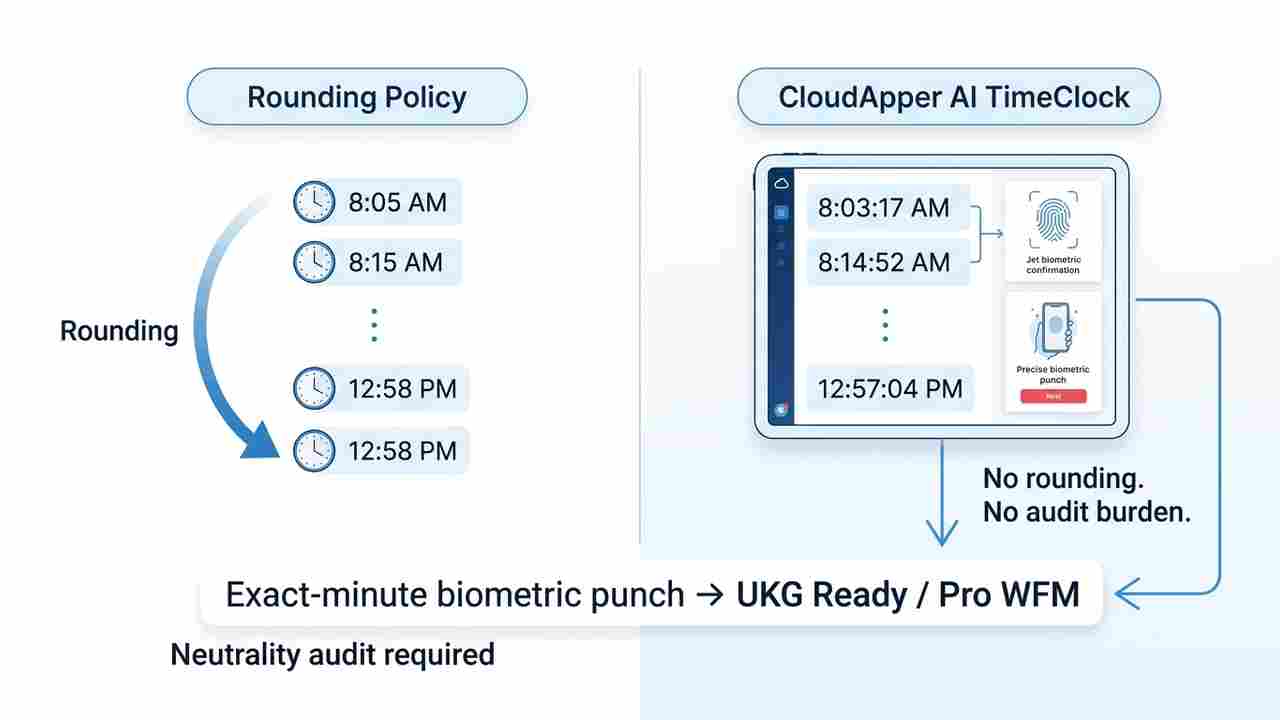
CloudApper AI TimeClock for UKG runs on standard Android tablets or iPads and captures punch timestamps to the minute, syncing those exact records directly to UKG Ready and Pro WFM. For organizations currently running time rounding in UKG, switching to to-the-minute capture eliminates the rounding policy entirely — there is no approximation to audit for neutrality, no California meal-period rounding to disable, and no cumulative underpayment risk to quantify.
This is not a workaround or a modification to UKG’s native timekeeping. CloudApper AI TimeClock sends exact-minute punch records into UKG as the source data. UKG processes those exact records through its pay rules engine without rounding them. The compliance question shifts from “is our rounding policy neutral?” to “are our punch records accurate?” — a question that biometric facial recognition answers at the terminal before the punch is submitted.
For multi-state organizations where maintaining location-specific rounding configurations in UKG is a recurring administrative task — California no rounding on meal breaks, other states neutral rounding permitted, union locations with CBA-specific recording requirements — CloudApper AI TimeClock’s uniform exact-minute capture simplifies the configuration landscape. One terminal standard across all locations produces one type of source record for UKG to process, regardless of which jurisdiction’s pay rules apply downstream.
The terminal also supports the attestation workflows that California, Illinois, and other high-compliance states require at clock-out: meal period confirmation, break acknowledgment, zone transfer documentation. These records sync to UKG alongside the exact punch timestamps, producing the contemporaneous documentation that the Donohue framework demands when punch records show a short or missed break. Premium pay calculations in UKG that depend on accurate time records — including holiday premiums, shift differentials, and overtime pyramiding — all benefit from exact-minute source data rather than rounded approximations.
CloudApper AI TimeClock runs at approximately 25% of the cost of proprietary UKG Intouch hardware, on any standard Android tablet or iPad the organization already owns, with biometric facial recognition included in the licensing — no add-on cost for the identity verification that eliminates buddy punching from the punch record at the same time it eliminates rounding. Buddy punching in UKG environments creates the same category of punch data integrity problem as non-neutral rounding: both corrupt the record that pay rules calculate from.
Frequently Asked Questions
Q: Is UKG’s 7-minute rounding rule compliant with FLSA?
Under 29 CFR §785.48(b), FLSA permits rounding to the nearest quarter hour — including the 7-minute rule where 1–7 minutes rounds down and 8–14 minutes rounds up — but only if the policy does not, over time, result in employees receiving less pay than they actually worked. The regulation tolerates rounding as a bookkeeping convenience; it does not authorize systematic underpayment. Whether a specific UKG rounding configuration is FLSA-compliant requires a historical data audit of actual punch records, not just a review of the configuration setting.
Q: Does California allow time rounding in UKG for hourly employees?
California allows neutral rounding for general working hours under the See’s Candy Shops standard (2012): a rounding policy that is fair and neutral on its face and does not, over time, result in undercompensation for employees is permissible. However, the California Supreme Court ruled in Donohue v. AMN Services (2021) that rounding is prohibited specifically for meal-period time punches. For UKG deployments with California locations, general-hours rounding may continue if it’s genuinely neutral, but meal-break punch timestamps must record exact times without rounding.
Q: Does UKG automatically ensure that configured rounding is FLSA-neutral?
No. UKG Ready and Pro WFM execute the rounding rules configured in pay rules — they do not monitor whether the cumulative outcome of that rounding is neutral over time, and they do not flag when state-law overrides apply. The burden of verifying neutrality sits with the employer. An organization that configured rounding at implementation and has never audited the cumulative compensation effect against exact-minute records is carrying an undetermined compliance exposure.
Q: What does the Donohue ruling require UKG admins to do differently for California?
UKG admins with California employees should audit their pay rule configurations to confirm that rounding is not applied to meal-period punch-out and punch-in timestamps. A California employee who takes a 28-minute lunch cannot have that punch rounded to 30 minutes — the actual 28-minute duration must record in UKG, triggering the one-hour meal period premium. If UKG’s rounding configuration applies uniformly across all punches including meal-period transitions, that configuration is non-compliant for California locations under Donohue.
Q: How does high missed-punch volume affect a time rounding compliance audit?
Manual corrections for missed punches bypass the automated rounding engine — supervisors entering corrected times may not be applying the same rounding conventions the terminal applies. A payroll audit examining whether rounding is neutral must account for how manual corrections interact with the rounding-adjusted records. If manual entries are systematically entered as round-number estimates, the correction pattern itself introduces a separate layer of compensation inaccuracy into the payroll record.
Q: Can we configure different rounding rules for California vs. non-California locations in UKG?
Yes. UKG Ready and Pro WFM support location-specific pay rule configurations, meaning you can apply a no-rounding or meal-break-specific no-rounding rule for California locations while maintaining rounding for locations in other states. This configuration requires deliberate setup and testing to confirm it is functioning correctly at the pay rule level for each employee group — and documentation of when the configuration change was made, which matters if a pre-change audit period is examined.
Q: What is the simplest way to eliminate time rounding compliance risk in UKG entirely?
Switching from a rounding-based terminal to exact-minute punch capture removes the rounding variable from the compliance equation. If UKG receives exact-minute timestamps from the time clock rather than pre-rounded inputs, there is no rounding policy to audit for neutrality, no California meal-period rounding to disable, and no multi-state configuration to maintain. The compliance question becomes whether the punch records are accurate and identity-verified — not whether the rounding policy that generated them is defensible.
Closing
The FLSA permits time rounding. California restricts it for meal periods. Multi-state operations require different configurations by location. UKG executes whatever is configured — accurately and automatically — but it does not verify that what it’s executing is achieving neutral results, meeting California’s meal-break requirements, or aligning with union contract recording obligations. That verification is the employer’s work, and it scales with the number of punch records, locations, and jurisdictions in scope.
If your UKG rounding configuration was set at implementation and has never been audited against actual punch outcomes, or if your California locations are applying rounding uniformly across all punches including meal periods, the compliance exposure is worth quantifying before it shows up in a demand letter. Explore how CloudApper AI TimeClock for UKG eliminates time rounding as a compliance variable entirely: https://ukg.cloudapper.ai/affordable-ukg-kronos-time-clock/



October 12, 2026
Donning and Doffing Time in UKG: Where the Workday Starts for PPE-Heavy Crews
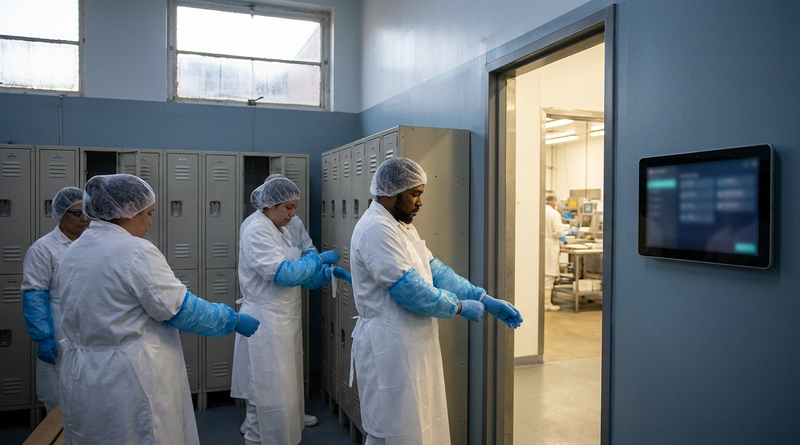
Donning and doffing PPE can be compensable time under the FLSA. Learn how UKG Ready and UKG Pro WFM handle it natively, what to configure first, and how CloudApper AI TimeClock puts an affordable tablet time clock in every changing room so the first punch matches the start of the workday.

October 9, 2026
Biometric Time Clocks in Canada: Quebec Law 25, PIPEDA, and Provincial Rules for UKG Sites
Biometric time clock rules in Canada change at provincial borders. Learn what Quebec Law 25 and its 60-day CAI notice require, when PIPEDA applies, how Alberta and BC PIPA treat employee information, and a five-step plan for consent and audit at UKG sites using Intouch devices or CloudApper AI TimeClock.

October 8, 2026
Locking a Tablet Down as a Dedicated UKG Time Clock: Kiosk Mode with Jamf, Intune, and Android Enterprise
IT's first objection to a tablet time clock is that someone will misuse it. Learn how to lock an iPad or Android tablet into a dedicated UKG time clock with Jamf, Intune, or Android Enterprise, a five-step day-one checklist, and what IT should manage after go-live alongside Intouch DX devices.

October 7, 2026
Moving Sites Off Paper Timesheets into UKG Without Buying Terminals
Some UKG sites still run on a clipboard because mobile punching and dedicated terminals never fit. Learn how to match each site to the right UKG capture method, why paper creates FLSA recordkeeping risk under 29 CFR 516, and a five-step cutover plan that includes a shared tablet kiosk option.