An insurance brokerage's obligations start the moment a broker's hire record is created. This is how one brokerage running UKG Ready derives each new broker's onboarding forms from their license and lines of authority instead of choosing among twenty static checklists.




Table of Contents
A broker’s obligations start running when the hire record is created, not at first sale. At creation the brokerage knows which lines of authority it is responsible for, which carrier appointments must be filed, and which continuing education clock has started. One insurance brokerage running UKG Ready treats its onboarding checklist as the place that captures that.
A Checklist That Functions as a Control
Producer licensing is issued by state, and one license can carry several lines of authority: life, auto, casualty. Appointment is a separate step, since a license authorizes the person while an appointment authorizes them to represent a carrier. Which forms a new broker owes depends on that combination plus where they will work.
Assemble that by hand and you maintain fifteen to twenty static checklist variants, choosing correctly every time. The failure mode is not administrative: a producer transacting outside the lines they hold is exposure for the brokerage, not only the individual.
“We were picking the right checklist from a folder of nearly twenty. Being right most of the time is not a control.”
HR Director, insurance brokerage
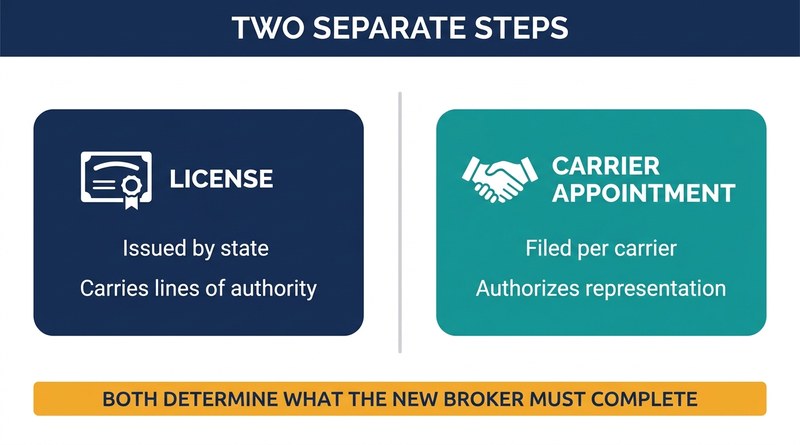
A license authorizes the person and carries the lines of authority; a carrier appointment is filed separately and authorizes representation.
What Happens at the Hire Trigger
CloudApper intercepts the hiring trigger in UKG Ready, reads the broker’s license and location data, and applies conditional logic to determine the onboarding path. The broker gets a guided flow by SMS or web: chatbot prompts, the forms their licensing requires, certification uploads, e-signature. Completion syncs back into UKG Ready.
One thing to state plainly, since people assume otherwise: UKG Ready remains the system of record for the employee and the onboarding record. What CloudApper AI Recruiter adds is the decision at hire time, so the path is derived rather than selected. The pattern recurs wherever credentials drive the workflow, from CDL and DOT pre-screening to clinical experience verification, and it is why audit-ready hiring records come easier when the record is assembled from data rather than judgement.
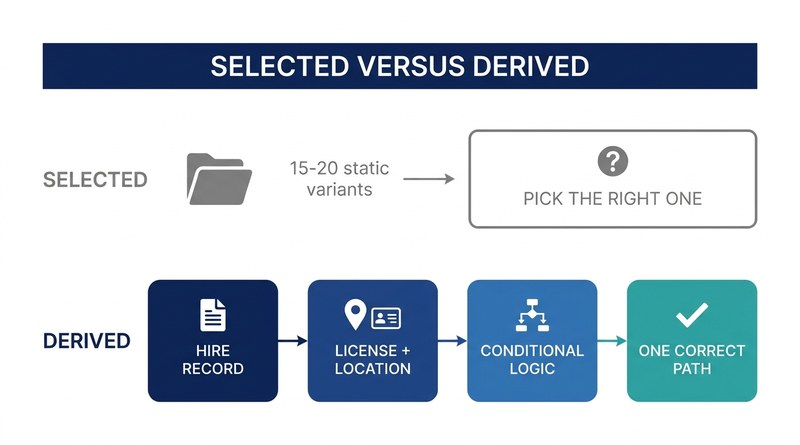
The shift is from choosing correctly among fifteen to twenty static variants to deriving one path from the hire record.
The Logic Is Only as Good as the License Data
One person matters more than the software and is rarely in the project meeting: the licensing administrator who maintains lines of authority, state coverage and appointment status. The logic reads what they record. If a line of authority is stale, the checklist is confidently wrong, which is worse than manually uncertain.
“My records used to be reference material. Now they decide what a new broker is asked to sign, so I keep them differently.”
Licensing Administrator, insurance brokerage
According to the brokerage’s Compliance Manager, that shift in how the source data is treated was the real change, and it is what any credential-regulated employer should settle first.
One Question Brokerages Ask
How can UKG Ready support license-based onboarding for insurance producers across multiple states?
Trigger on the hire event, read the producer’s license, lines of authority and work location, and apply conditional logic to derive the required forms rather than picking a static checklist. Deliver it as a guided mobile flow, sync completion back to UKG Ready, and assign ownership of the license data the logic depends on.
If your onboarding forms depend on what a new hire is licensed to do, talk to the CloudApper team about deriving that path from license data you already hold.


September 15, 2026
One-Way Video Interviews in UKG: Know Who’s Worth Interviewing Before the Interview
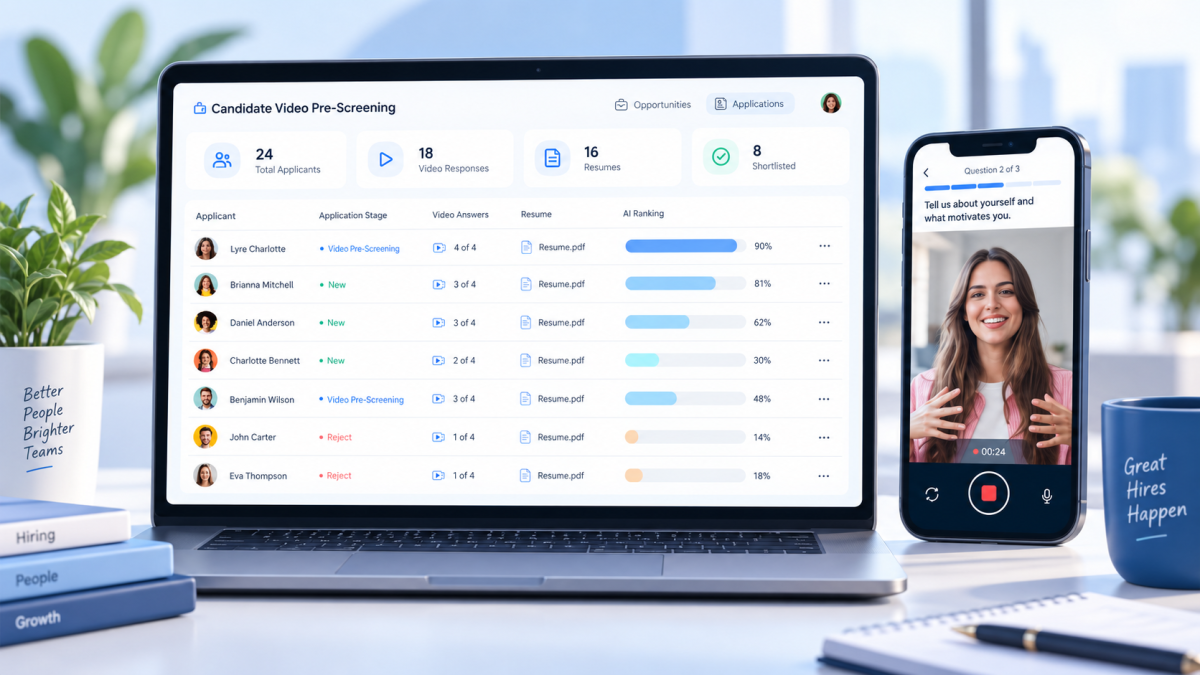
UKG video interviews let shortlisted candidates record answers on their phone, on their own time, so recruiters hear from a real person before booking any interview. The step runs alongside UKG Pro Recruiting or UKG Ready, and the ratings, transcripts, and recordings write back to the applicant record.

August 3, 2026
How to Filter Spam and Bot Applications Out of High-Volume UKG Job Postings
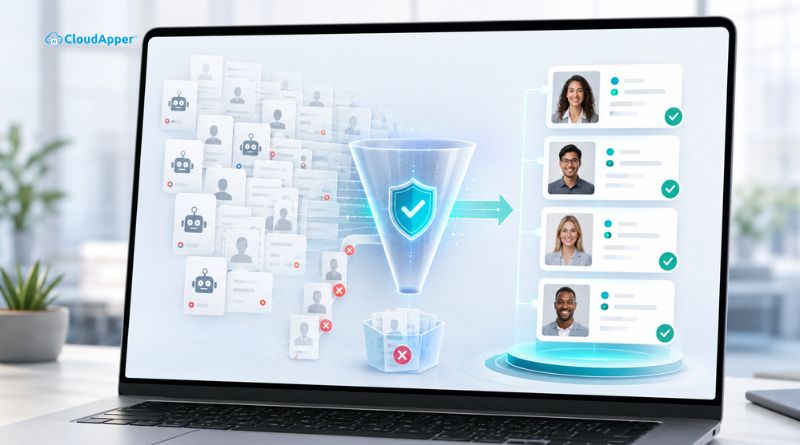
Looking to filter spam and bot applications in UKG before they reach your recruiters? CloudApper AI Recruiter uses early knockout questions and scenario-based conversational screening to automatically block junk submissions, saving your team hours and securing top candidates faster.
July 30, 2026
How to Keep Reference Check Data In UKG Audit-Ready for Compliance Reviews
Compliance reviews ask for proof, not just completion. See how CloudApper extends UKG to keep reference check data in UKG audit-ready, logging every request, reminder, and submission automatically in a timestamped, tamper-evident record with controlled, role-based access for every hire.

July 29, 2026
Generate AI Screening Questions in UKG Pro Recruiting
Preparing screening questions for every requisition wastes time across departments. See how CloudApper AI Recruiter generates AI screening questions in UKG Pro Recruiting straight from the job requisition, so managers approve a ready set instead of drafting one from scratch.