Looking to filter spam and bot applications in UKG before they reach your recruiters? CloudApper AI Recruiter uses early knockout questions and scenario-based conversational screening to automatically block junk submissions, saving your team hours and securing top candidates faster.




Table of Contents
- What Junk Applications Actually Look Like on a High-Volume Posting
- Why Filtering Volume Costs More Than the Hours It Takes
- How CloudApper AI Recruiter Screens Applications Before a Recruiter Sees Them
- What Changes for Recruiters
You post a high-visibility role and the applications start arriving faster than anyone can read them. Some are from people who genuinely want the job. But plenty aren’t. They came from auto-apply tools, got abandoned halfway through, or were sent by someone who was never going to show up. If you want to filter spam and bot applications in UKG without hiring someone whose entire job is triage, the screening has to happen before any of it reaches a recruiter’s queue. That’s what CloudApper AI Recruiter for UKG does, using early knockout questions and a short scenario-based conversation that a submission with nothing behind it can’t get through.
What Junk Applications Actually Look Like on a High-Volume Posting
Before you can screen any of the applications out, it helps to know what you’re actually staring at. Junk applications turn up in three fairly distinct shapes, and each one causes a different headache.
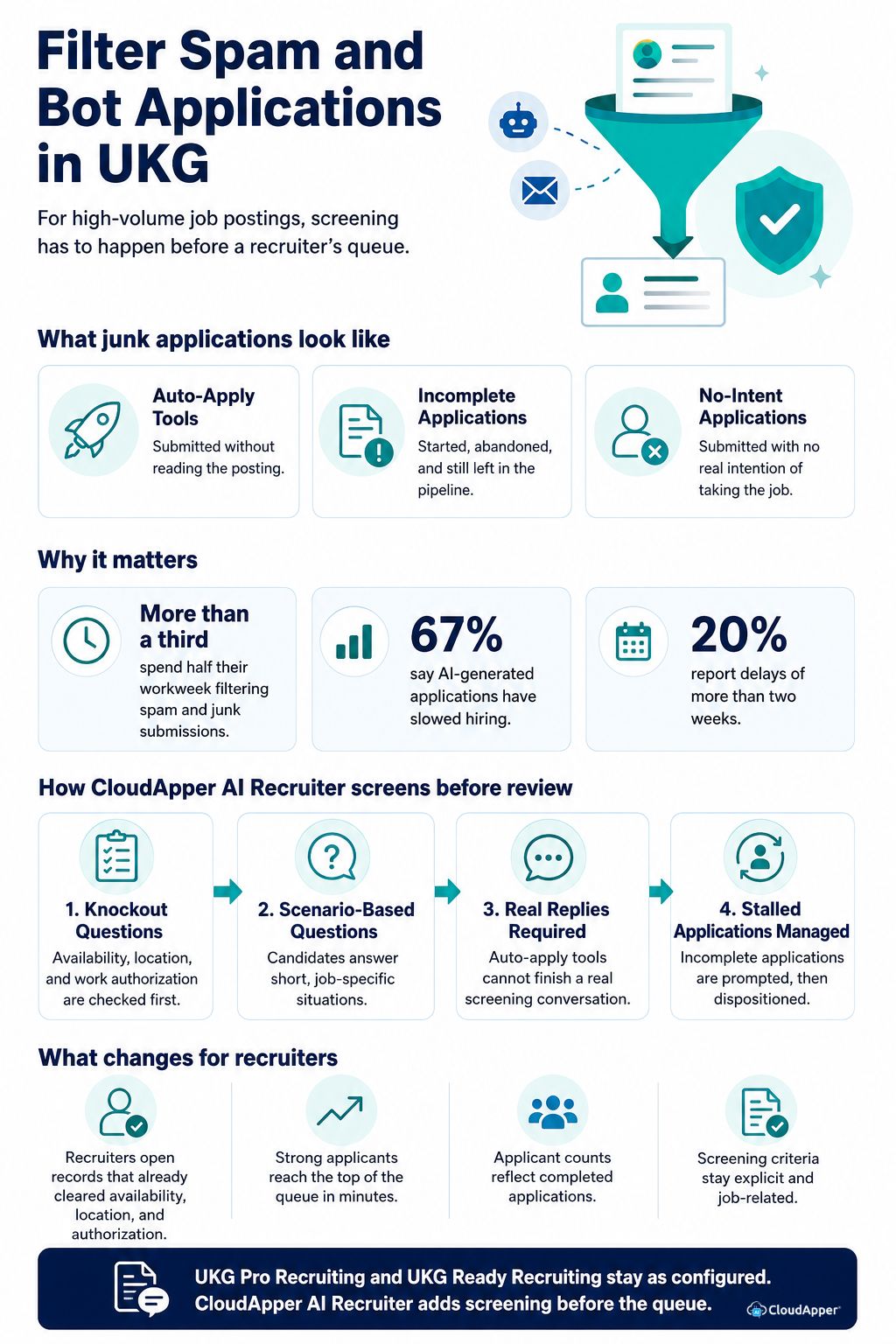
Auto-Apply Tools Submit Without Reading the Posting
A lot of what lands in your pipeline comes from tools that submit on a candidate’s behalf, sometimes hundreds a day, at any posting that loosely matches a keyword. They look fine, too. Clean formatting, polished resume, skills language echoing your job description back at you because that’s where it came from. What’s missing is any sign the person read the role. Nobody checked the shift or the site, and on a posting with a few hundred applicants, this is your biggest single source of noise.
Applications Arrive Incomplete and Stay in the Pipeline
Then there’s the quieter kind. Someone starts an application on their phone, gets three screens in, and gives up. The record sticks around anyway, counts toward your applicant total, and a recruiter still has to open it to find nothing inside. Nobody’s being malicious, which is why these pile up, and nobody deletes them either, so they quietly inflate every number you’d use to judge a posting.
Some Applications Were Never Meant to Lead to a Job
And then there’s the category nobody enjoys talking about. Part of every pipeline gets submitted for reasons that have nothing to do with wanting the work. Somebody documenting a job search to keep a benefit. Somebody applying four states away with no intention of moving. On paper you can’t tell these from a real application, and they give themselves away only when someone tries to make contact and hears nothing back.
Three different problems, one shared symptom. A recruiter has to open every one to work out which is which, and that’s where the real damage starts.
Why Filtering Volume Costs More Than the Hours It Takes
The hours add up faster than you’d think. In a Greenhouse survey of roughly 1,230 recruiters and hiring managers reported by Bloomberg, more than a third said they now spend half their workweek filtering spam and junk submissions, much of it AI-generated. A Robert Half survey of more than 2,000 US hiring managers found that 67% of HR leaders say reviewing AI-generated applications has slowed hiring, with 20% reporting delays of more than two weeks.
Here’s the thing, though. The hours aren’t the expensive part. The expensive part is the good candidate you lose while working through the pile. Strong applicants are usually talking to several employers, and whoever reaches them first tends to win. Every day you spend triaging noise is a day that person spends getting hired somewhere else, and you’ll never see it in a report, because the candidate nobody called doesn’t show up as a loss.
Which means the question isn’t how to review faster. It’s how to keep the noise from reaching the review stage at all.
How CloudApper AI Recruiter Screens Applications Before a Recruiter Sees Them
The idea is straightforward. Move the screening to the moment someone applies, make it something a person has to answer, and let a recruiter see only what survives. You may already use one or two of these pieces. What changes is when they run.
Knockout Questions Run Before the Application Reaches a Queue
The most reliable way to filter spam and bot applications in UKG is to move your disqualifying questions right to the front. CloudApper AI Recruiter asks them the moment the screening conversation starts, so anyone who can’t meet a hard requirement gets dispositioned before a recruiter ever opens the record.
You decide what it asks, and most junk falls over on something basic. The shift is overnight, and the applicant isn’t available overnight. The role sits at one site, and they’re nowhere near it. The job needs authorization they don’t have. Each of those becomes a knockout question you set up once, and a single failing answer ends the application there, with the reason recorded against the candidate in UKG.
Scenario-Based Questions Ask What Someone Would Do on the Job
Past the hard requirements, AI Recruiter puts a short scenario-based question set in front of the candidate, built around situations the role involves. A caregiver gets asked about a resident refusing medication. A warehouse candidate gets asked about a pallet that turns up damaged late in a shift. These do something a resume can’t anymore. When every application is polished, the document stops telling you who can do the work. A specific answer about a specific situation still does.
The Conversation Requires a Reply an Auto-Apply Tool Cannot Produce
This is where the actual filtering happens. AI Recruiter asks a real question and waits for a real answer before it counts an application as finished, which puts every submission through an exchange an automated tool was never built to have.
That’s the whole mechanism. An auto-apply tool submits and moves on, since volume is the whole point, and a conversation about your availability or a situation on the job asks for more attention than a spray-and-pray submission was ever going to spend. Intent-free applications don’t get blocked outright. They just stall out, because nothing on the other end was going to send back a real reply
Qualified Candidates Reach a Recruiter in Minutes
Because all this runs the moment someone applies, a candidate who meets your requirements and handles the scenario questions well surfaces straight away, whatever time of night they applied. That’s where the recovered time pays for itself. Instead of reaching your strongest applicant on day four, a recruiter finds them at the top of the queue on the first pass.
Incomplete Applications Get Prompted, Then Dispositioned
Applications that stall get a nudge to finish, and the ones that still go nowhere get dispositioned rather than sitting in your pipeline. Your applicant numbers start describing actual people again, and duplicates across locations get handled the same way. There’s more on catching duplicate and repeat applicants if that’s your bigger headache.
What Changes for Recruiters
Once you filter spam and bot applications in UKG at the point of submission, the difference shows up less in your reporting than in how the week actually feels.
- Recruiters open records that already cleared availability, location, and authorization.
- Strong applicants hear from you while they’re still on the market.
- Applicant counts reflect completed applications, so you can finally judge a posting.
- Screening criteria are explicit and job-related, so they hold up if questioned.
- Nobody loses half their week deciding what’s worth reading.
Frequently Asked Questions
Will This Screen Out Good Candidates Along With The Junk?
You configure the knockout criteria, and they should be genuine requirements such as shift availability, site location, and work authorization. A candidate who meets them and answers the scenario questions reaches a recruiter faster than they would have before.
Are These Screening Criteria Defensible If Somebody Challenges Them?
Availability, commute, authorization, and role-specific scenario responses are all job-related, which is the standard that matters. Because you configure the criteria in CloudApper AI Recruiter rather than infer them, you can show exactly what was asked and how it was applied to every applicant.
Does Any Of This Require Changes To Our UKG Recruiting Setup?
No. Your requisitions, hiring stages, dispositions, and candidate records stay in UKG and keep working as configured. CloudApper AI Recruiter adds the screening conversation in front of the queue and writes the outcome back.
Stop Junk Volume at the Front, Not the Back
So the practical way to filter spam and bot applications in UKG is to stop treating it as a review problem and start treating it as a sequencing problem. Nothing you do after a junk application lands in the queue gives back the time it costs. Ask the disqualifying questions the moment someone applies, ask something about the actual work, and let the submissions with nothing behind them fail on their own. UKG Pro Recruiting and UKG Ready Recruiting carry on holding your requisitions, stages, and candidate records exactly as now. CloudApper AI Recruiter just makes sure what gets there is worth a recruiter’s time.
Drowning in applications nobody has time to read? Contact us to see how CloudApper AI Recruiter screens them before they reach your team.



October 26, 2026
Candidate Disposition Automation in UKG Pro Recruiting: The Decision Layer Between the Requisition and the Hire
At a growing healthcare network, UKG Pro Recruiting handles posting and onboarding well, but screening, status changes and manager review pile up in the middle. This piece looks at 14 manual dispositions, missing drop-off data and clinical hiring managers, and how CloudApper adds a decision layer on top of UKG Pro Recruiting.

October 8, 2026
Multi-Round Interviews in UKG Pro Recruiting: Automating Executive Panel Scheduling for Fund Administrators
Senior hiring at a global fund administrator runs through many interview rounds and executive calendars across time zones. CloudApper AI Recruiter extends UKG Pro Recruiting to support every round, schedule executive panels through Outlook and Teams, and give recruiting leadership real-time KPIs on where each search stands.

September 15, 2026
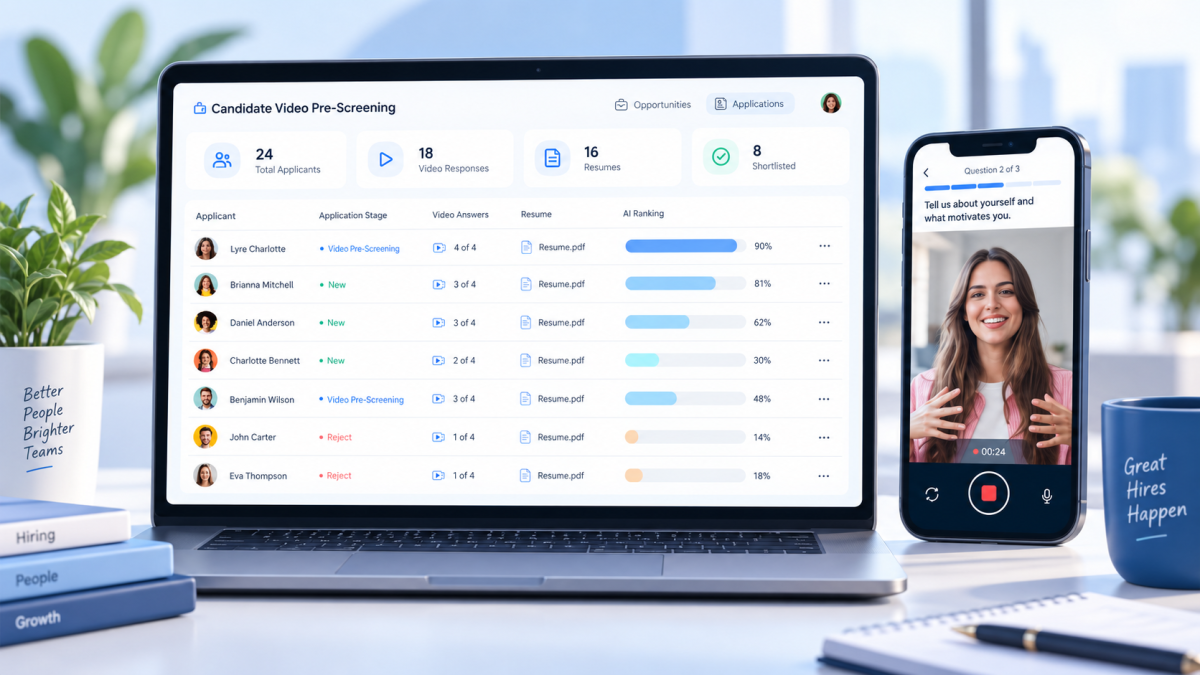
One-Way Video Interviews in UKG: Know Who’s Worth Interviewing Before the Interview
UKG video interviews let shortlisted candidates record answers on their phone, on their own time, so recruiters hear from a real person before booking any interview. The step runs alongside UKG Pro Recruiting or UKG Ready, and the ratings, transcripts, and recordings write back to the applicant record.

September 9, 2026
License-Based Onboarding in UKG Ready: Assigning Broker Forms by Line of Authority
An insurance brokerage's obligations start the moment a broker's hire record is created. Here is why license and location should decide each new broker's onboarding forms in UKG Ready, and how CloudApper derives that path from license data instead of relying on a choice among twenty static checklists.