UKG video interviews let shortlisted candidates record answers on their phone, on their own time, so recruiters hear from a real person before booking any interview. The step runs alongside UKG Pro Recruiting or UKG Ready, and the ratings, transcripts, and recordings write back to the applicant record.



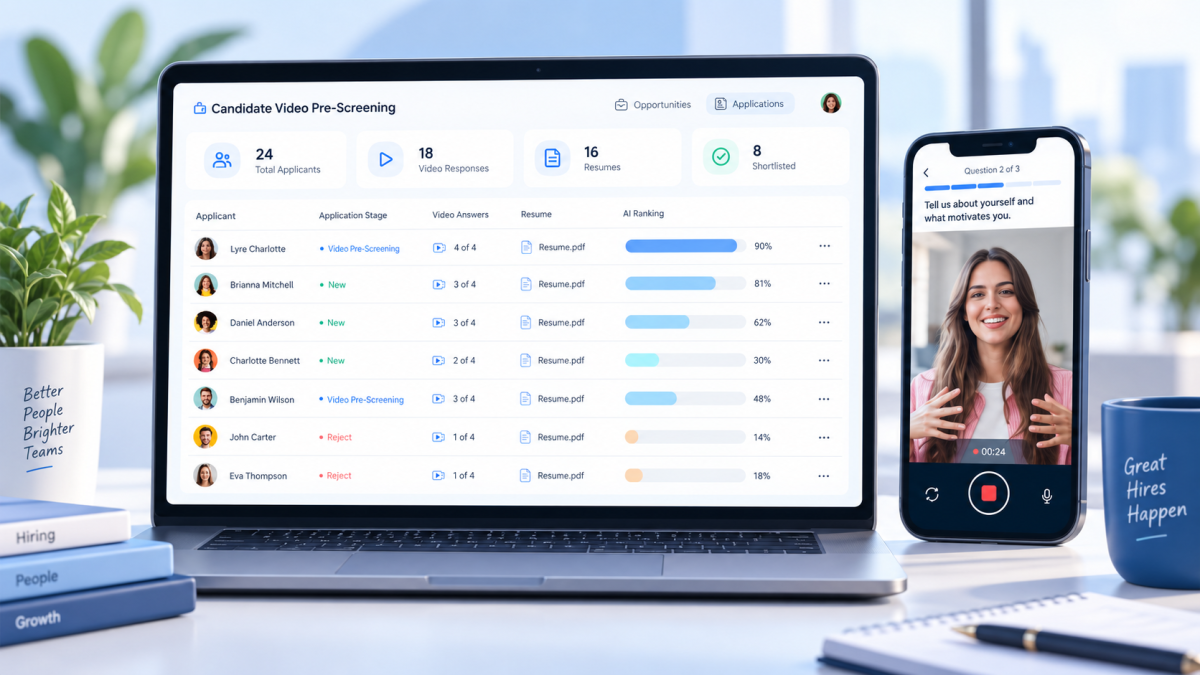
Table of Contents
- What is a one-way video interview?
- Why is resume screening no longer enough?
- Why doesn’t adding another interview round work?
- How do one-way video interviews work in a UKG hiring flow?
- One-way video interview vs. phone screen vs. live interview
- Does UKG Pro Recruiting include video interviewing?
- Can UKG video interviews confirm you are talking to the real candidate?
- Are one-way video interviews fair to candidates?
- What should you look for in a UKG video interview tool?
- What changes when hiring teams close this gap
- Frequently asked questions
For thirty years, hiring ran on a quiet agreement: the resume is evidence. It was never great evidence, but the person applying wrote it, and that made it worth something. A recruiter could read twenty resumes and form a defensible opinion about which five deserved an hour.
That agreement has collapsed. Roughly 65% of job seekers now use AI to write their applications. Applications per opening have climbed well past the 115 that was normal three years ago. The documents arriving in your UKG requisition are better written, more closely matched to the job description, and less informative about the candidate than anything recruiters have handled before. They are optimized artifacts, not evidence.
Recruiting teams noticed, and the most common response has been to add an interview round whose entire purpose is confirming what the resume claims. A meaningful share of HR teams have now done exactly that. Think about what that means: the industry’s answer to a broken screening signal was to spend more of the most expensive resource in hiring, human interview hours, on verification. It is rational, it does not scale, and it solves the problem in the wrong place. Verification belongs before the interview, not inside it.
This is the gap one-way video interviews close.
What is a one-way video interview?
A one-way video interview is a recorded screening step. The employer sets the questions in advance, the candidate records video answers without a live interviewer present, and the hiring team reviews the responses asynchronously. It replaces the phone screen, not the interview, and it typically runs two to four questions at thirty to ninety seconds each.
Recruiters also call this video pre-screening, asynchronous video interviewing, or on-demand interviewing. The mechanics are the same.
Why is resume screening no longer enough?
Because the signal degraded and nothing replaced it.
Your system of record does its job well. UKG Pro Recruiting holds the requisition, the applicant record, the status history, the approvals, and the offer. It is the authoritative account of what happened, and that is what a system of record is built for.
What no system of record was built to do is judge. Forming a confident opinion about a stranger before spending an hour with them has always been human work, performed with whatever evidence was available. When the evidence degrades, the record cannot compensate. It will faithfully store a thousand AI-polished applications and tell you nothing about which twenty are real.
That space, between the record of what happened and the work of deciding what happens next, is where recruiting teams currently lose weeks per requisition.
Why doesn’t adding another interview round work?
Three responses are common right now, and each trades one problem for another.
Adding an interview round spends senior time on verification and lengthens time to fill exactly when speed matters most. The candidates you most want are the least willing to sit through a fourth conversation.
Better resume parsing applies more AI to a document AI already wrote. You end up with two models negotiating over text neither the candidate nor the recruiter fully authored. The signal does not improve, because the input was never the problem.
Sending video invitations to the whole applicant pool is how most video interviewing tools work by default, and it is why the format has a reputation problem. Invite 240 people to record and you have created a burden for candidates, a review pile for recruiters, and a reason for strong applicants to drop out. Gartner found only 26% of candidates trust AI to evaluate them fairly, and 62% said they are more likely to apply when a role involves real human interaction. Mass automated screening has a cost, and it lands on the candidates you wanted most.
The stretch between “we like your resume” and “you are on the calendar” is where candidates go quiet, and reducing candidate drop-off in UKG Pro Recruiting starts with removing a round rather than adding one.
All three scale the process instead of sharpening the decision.
How do one-way video interviews work in a UKG hiring flow?
The model that works inverts the default. You do not send video to everyone. You shortlist first, then only the qualified candidates you selected get the video step.
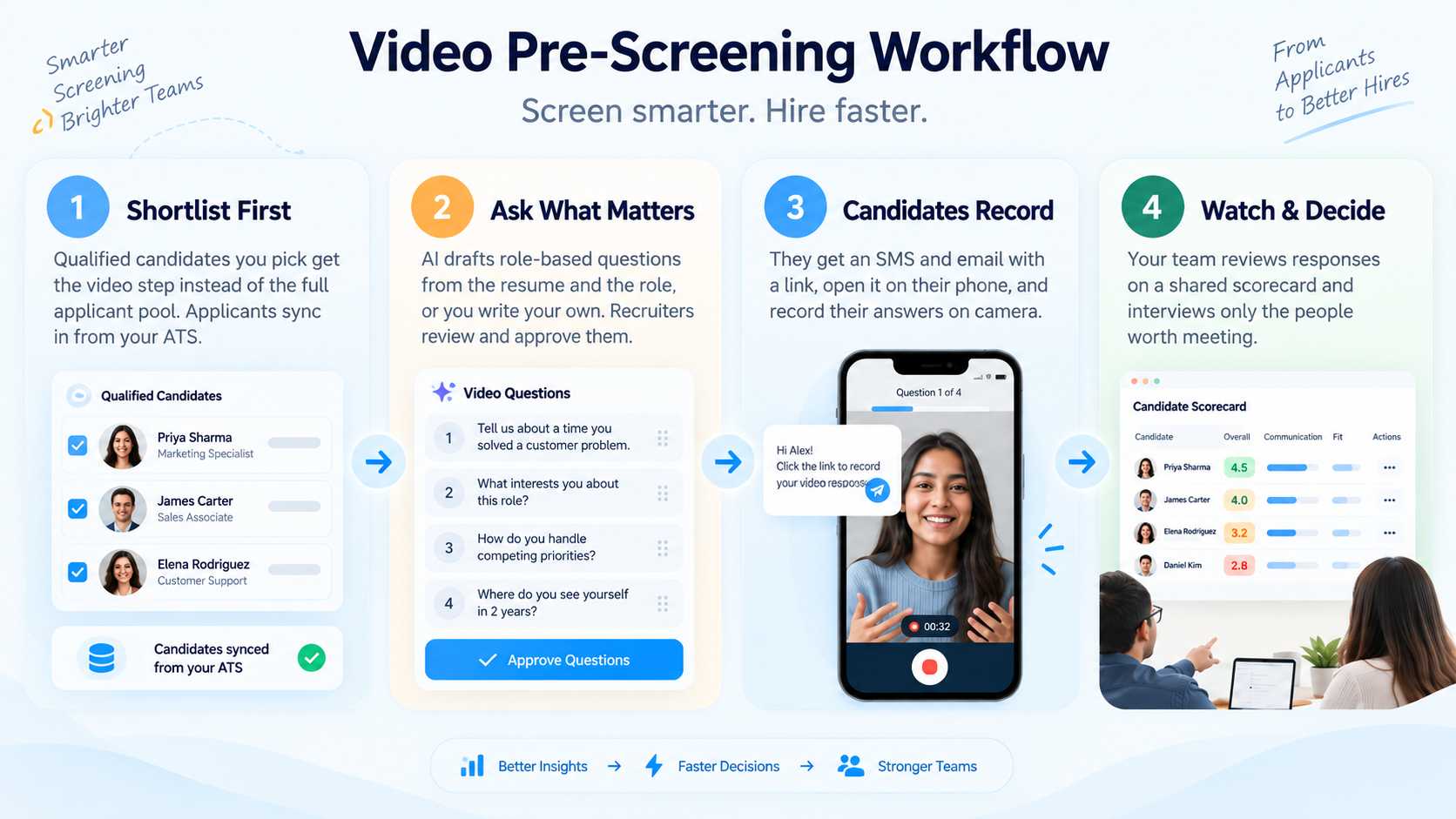
1. Shortlist first
Qualified candidates you pick get the video step, never the whole applicant pool. You work from the applicant list in UKG Pro Recruiting or UKG Ready as you already do, and advance the people worth hearing from. That single sequencing choice changes both the economics and the ethics. An invitation reads as interest, not as a filter.
2. Ask what matters
AI drafts questions from each candidate’s resume and the role. This is what answers the verification problem directly. If a resume claims six years running a warehouse crew of thirty, the question set asks about that specifically. A generic five-question template cannot verify a specific claim. Questions generated from the individual resume can.
3. Candidates record on their phone
They get an SMS and email with a link and open it on their phone. No app to install, no account to create, no scheduling negotiation. They record when it suits them, which for hourly and frontline candidates usually means between shifts rather than during one.
4. Your team watches and decides
Recruiters and hiring managers watch, rate on a shared scorecard, and interview only the people worth meeting. Every answer arrives with a transcript and a summary, so reviewing twenty candidates takes less time than one phone screen. The decision stays with your team. The automation organizes the evidence; people draw the conclusion.
Outcomes, ratings, and recordings write back to your HR system or ATS, so the applicant record in UKG stays authoritative and the audit trail stays in one place. That detail decides whether this saves time or creates a second system to reconcile.
One-way video interview vs. phone screen vs. live interview
| Phone screen | One-way video interview | Live interview | |
|---|---|---|---|
| Scheduling required | Yes | No | Yes |
| Recruiter time per candidate | 20 to 30 min | 2 to 4 min review | 45 to 60 min |
| Who receives it | Shortlisted | Shortlisted | Shortlisted and pre-qualified |
| Reviewable later | Notes only | Full recording and transcript | Notes only |
| Multiple reviewers | Sequential, repeated calls | Same recording, shared scorecard | Panel required |
| Verifies resume claims | Partly | Yes, questions drawn from the resume | Yes |
| Candidate effort | Must be available at a set time | Records on own schedule | Must be available at a set time |
Does UKG Pro Recruiting include video interviewing?
UKG Pro Recruiting manages the requisition, applicant records, workflow, approvals, and the offer process. Teams that want recorded video pre-screening typically run it as a connected step alongside that flow, so the applicant record stays in UKG while the video evaluation happens in a tool built for it. Available modules differ by product and package, so confirm your own configuration and licensing with your UKG contact.
The division of labor looks like this.
| What it holds | Where it lives |
|---|---|
| Requisition, applicant record, status history, approvals, offer | UKG Pro Recruiting or UKG Ready |
| Questions, recordings, scorecards, transcripts, ratings | The process layer running alongside it |
| Final outcome and audit trail | Written back to UKG |
Nothing is replaced and nothing is bypassed. The record stays where records belong, the work happens in a layer built for work, and the result returns to the record.
Can UKG video interviews confirm you are talking to the real candidate?
Partly, and the honest answer matters more than the marketing one.
The identity problem is real and growing. Gartner projects that by 2028, one in four candidate profiles worldwide could be fake. In a Gartner survey of 3,000 candidates, 6% admitted to interview fraud by impersonating someone or having another person pose as them. Checkr found in 2025 that 35% of hiring managers had a virtual interview in which someone other than the listed applicant took part. Jamie Kohn, senior research director at Gartner, put it plainly: employers are finding it harder to evaluate candidates’ true abilities and, in some cases, their identities.
Seeing and hearing a person answer questions drawn from their own resume is a strong early signal, and it produces a reviewable artifact attached to a specific applicant record. Inconsistencies between recorded answers and a later live conversation surface quickly. What it does not do is constitute formal identity verification. For roles where the risk justifies it, pair this step with background checks and identity verification, and with the controls you already use to catch duplicate applicants and bot applications before they reach a recruiter.
For roles where the risk justifies it, pair this step with background checks, formal identity verification, and the controls you already use for candidate fraud detection in UKG , including catching duplicate and repeat applicants and filtering spam and bot applications before they reach a recruiter.
Are one-way video interviews fair to candidates?
They can be, and fairness here is a set of design decisions rather than a disclaimer. Five decisions separate a step candidates accept from one they resent.
Only the shortlisted are asked. Candidates who receive an invitation have already been evaluated and advanced, and they know it. This is the single largest factor in how the format is received.
Blind review. Names and photos can be hidden from hiring managers during review, so the rating reflects the answer rather than the applicant. It applies the logic of blind resume screening to a stronger signal.
A shared scorecard. Multiple reviewers rate against the same criteria, which surfaces disagreement instead of burying it and produces a documented, consistent basis for advancing someone.
Consent and audit logs. Recorded interviews are hiring records. Capture candidate consent, control access, and log who reviewed what and when. Several jurisdictions regulate recorded and AI-assisted interviews specifically, so confirm notice requirements where you hire and check with your own counsel before rollout.
A human decides, and candidates can ask for an alternative. The transcript, summary, and scorecard help a person decide faster and more consistently. They do not decide. A candidate without reliable video access, or with a disability that makes recording difficult, should be able to request a phone screen instead.
What should you look for in a UKG video interview tool?
- Does it shortlist first, or does it invite the entire applicant pool?
- Are questions generated from each candidate’s resume and role, or is it one global template?
- Do candidates record in a browser on a phone, with no app and no account?
- Do results, ratings, and recordings write back to the UKG applicant record?
- Is there a shared scorecard, or does each reviewer form a private opinion?
- Is blind review available for hiring manager review?
- Does every answer come with a transcript and a summary, so review is genuinely batched?
- Are consent capture, access control, and audit logging present by default?
- Does it work across the systems you actually run, not just one?
See who’s worth interviewing, before the interview
Watch the walkthrough: how candidates get shortlisted, how AI drafts questions from each resume, how candidates record on their phone, and how ratings land back on the applicant record in UKG.
What changes when hiring teams close this gap
The measurable part is straightforward. Interview calendars fill with people someone has already heard from. The verification round disappears because verification happened earlier and cheaper. Time to fill compresses at the stage where it was leaking.
The part that matters more is harder to tabulate. Recruiters stop performing triage on documents they cannot trust and go back to recruiting, which is the work they were hired for and the work they are good at. Hiring managers stop screening and start interviewing. And candidates who are real and qualified and currently getting lost behind better-optimized applications get heard by a person instead of filtered by a keyword match.
That last group is who this is ultimately for. Every hourly worker hired faster is a household that stops waiting. Every school district, hospital, plant, and hotel that fills roles in days instead of weeks is an institution serving the people who depend on it better. Hiring speed is not an HR metric. It is the rate at which organizations can do what they exist to do.
The teams pulling ahead are not the ones with the largest recruiting budgets or the newest system of record. They are the ones who recognized that the resume stopped being evidence and refused to wait for a vendor roadmap to hand them a replacement.
CloudApper is the process layer that closes the gaps enterprise software cannot, across HR, ERP, CRM, and beyond, on any platform, in weeks not quarters. Because the organizations that move fastest aren’t the ones with the biggest budgets or the best vendors. They’re the ones that stopped waiting for permission to close the gap.
Frequently asked questions
What is a one-way video interview?
A one-way video interview is a recorded screening step. The employer sets the questions, the candidate records answers without a live interviewer present, and the hiring team reviews the responses on their own schedule. It replaces the phone screen rather than the interview.
How long should a one-way video interview be?
Keep the whole exercise under eight minutes. Two to four questions at thirty to ninety seconds each works well for hourly and frontline roles. Longer formats raise abandonment without adding signal.
Do candidates abandon one-way video interviews?
Some do, and setup drives the rate. Inviting only shortlisted candidates, explaining what to expect, keeping the question set short, recording in a browser with no install, and allowing one retake all raise completion. Pool-wide, app-gated, no-retake formats drive the highest abandonment.
Does UKG Pro Recruiting include video interviewing?
UKG Pro Recruiting manages the requisition, applicant records, workflow, and offer process. Teams that want recorded video pre-screening usually run it as a connected step alongside that flow, with ratings and recordings writing back to the UKG applicant record. Modules differ by product and package, so confirm your configuration with your UKG contact.
Can hiring managers review candidates without seeing names or photos?
Yes. Blind review hides names and photos during review, so managers rate the substance of the answers rather than the applicant.
Can video interviews confirm a candidate’s identity?
They give you a strong early signal and a reviewable artifact tied to a specific applicant record, which surfaces inconsistencies before you spend interview time. They are not formal identity verification. For higher-risk roles, pair them with background checks and identity verification.
Do one-way video interviews create legal risk?
>Recorded interviews are hiring records, so treat them accordingly. Ask every candidate for a given requisition the same core questions, keep a human in the decision, document retention and access controls, offer an alternative format on request, and confirm notice and consent rules in the states and countries where you hire.
Where do one-way video interviews fit in high-volume hourly hiring?
Immediately after shortlisting, replacing the phone screen. At high volume the phone screen is the bottleneck, so removing it is where the time comes back.



October 26, 2026
Candidate Disposition Automation in UKG Pro Recruiting: The Decision Layer Between the Requisition and the Hire
At a growing healthcare network, UKG Pro Recruiting handles posting and onboarding well, but screening, status changes and manager review pile up in the middle. This piece looks at 14 manual dispositions, missing drop-off data and clinical hiring managers, and how CloudApper adds a decision layer on top of UKG Pro Recruiting.
October 8, 2026
Multi-Round Interviews in UKG Pro Recruiting: Automating Executive Panel Scheduling for Fund Administrators
Senior hiring at a global fund administrator runs through many interview rounds and executive calendars across time zones. CloudApper AI Recruiter extends UKG Pro Recruiting to support every round, schedule executive panels through Outlook and Teams, and give recruiting leadership real-time KPIs on where each search stands.

September 9, 2026
License-Based Onboarding in UKG Ready: Assigning Broker Forms by Line of Authority
An insurance brokerage's obligations start the moment a broker's hire record is created. Here is why license and location should decide each new broker's onboarding forms in UKG Ready, and how CloudApper derives that path from license data instead of relying on a choice among twenty static checklists.

August 3, 2026
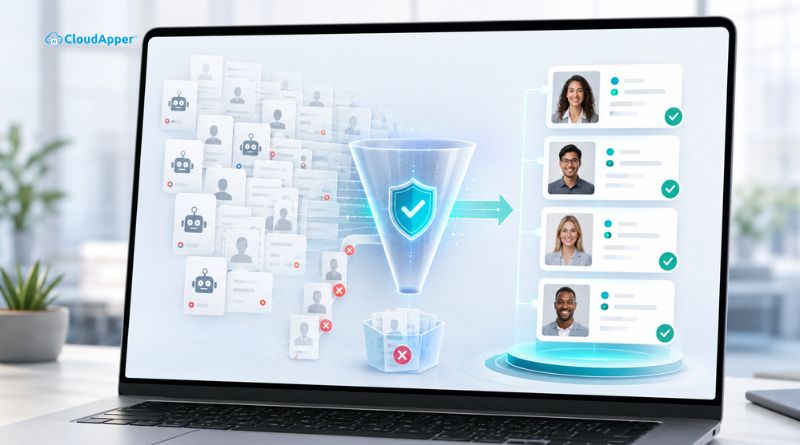
How to Filter Spam and Bot Applications Out of High-Volume UKG Job Postings
Looking to filter spam and bot applications in UKG before they reach your recruiters? CloudApper AI Recruiter uses early knockout questions and scenario-based conversational screening to automatically block junk submissions, saving your team hours and securing top candidates faster.