Unconscious prejudice often derails fair hiring. Reduce bias in recruitment using CloudApper AI for UKG. This guide explains how automated blind screening, standardized resumes, and objective scoring help HR teams build diverse pipelines and easily meet DEI goals.



Table of Contents
Let’s be honest—bias in recruitment isn’t always easy to spot. Most recruiters don’t want to treat anyone unfairly. But even when you try to stay neutral, a candidate’s college or background can quietly influence your decisions. That’s called unconscious bias, and it can lead to great candidates being overlooked without anyone realizing it. Thankfully, there’s a better way to handle this. If your team uses UKG Pro or Ready Recruiting, you can bring fairness into your process by adding a layer of AI screening with CloudApper’s AI Recruiter for UKG. It helps you focus on what truly matters—skills, certifications, and job-specific experience—while removing things that don’t belong in the decision.
TL;DR
-
Unconscious bias causes missed opportunities: Human mental shortcuts often lead to overlooking top talent based on names, ages, or educational backgrounds.
-
AI standardizes the process: AI recruiting tools remove identifiable markers from resumes to ensure candidates are evaluated purely on hard skills and experience.
-
Seamless UKG integration: CloudApper AI Recruiter connects directly with UKG Pro and Ready Recruiting to automate blind screening without custom development.
-
Data-driven shortlisting: AI conducts scenario-based pre-screening and automatically ranks candidates mathematically, creating a fair, objective pipeline.
-
Supports DEI goals: Using a uniform, AI-driven evaluation process helps organizations prove compliance and build truly inclusive hiring practices.
What is Bias in Recruitment?
Bias in recruitment happens when a hiring decision is influenced by personal prejudices, stereotypes, or preconceived notions rather than a candidate’s actual ability to do the job. While explicit bias is intentional, the vast majority of hiring bias is unconscious—meaning recruiters and hiring managers aren’t even aware it’s affecting their choices.
Here are a few common ways this manifests during the hiring process:
-
Affinity Bias: Favoring candidates who share your background, went to the same school, or have similar hobbies.
-
Name Bias: Unconsciously judging a candidate’s competency or “cultural fit” based on whether their name sounds familiar or foreign.
-
Pedigree Bias: Placing too much value on the prestige of a candidate’s university rather than looking at their demonstrable skills or equivalent work experience.
-
Confirmation Bias: Forming an initial snap judgment about a candidate (often from a quick resume glance) and then using the interview to seek out information that proves that judgment right.
-
Age Bias: Making assumptions about a candidate’s tech-savviness, reliability, or salary expectations based on their age or graduation dates.
Why Bias in Recruitment Still Happens
You may not think you’re making biased choices. But human brains work fast, and they often rely on mental shortcuts. That’s where human bias shows up. None of this is intentional, but when these small biases add up, you risk missing out on top talent. Some of the best candidates may never get the interview just because their background didn’t “look right” on paper.
Here is why these shortcuts happen in the first place:
High Application Volume
When a single job posting generates hundreds of resumes, recruiters simply do not have the time to read every single word. Faced with a mountain of applications, the brain naturally relies on quick mental filters—like scanning for familiar company names or universities—to quickly whittle down the pile.
Pressure to Hire Quickly
“Time-to-fill” is one of the most heavily tracked HR metrics. When recruiters are under immense pressure to get a candidate into a seat, they are forced to rush. Rushing leads to relying on gut feelings and intuition rather than a slow, objective evaluation of a candidate’s actual qualifications.
Deep-Rooted Stereotypes
We are all influenced by the society and culture we grow up in. Even the most well-intentioned hiring managers carry subconscious stereotypes about gender, age, race, university degree, or socioeconomic status. When not actively managed with structured hiring processes, these stereotypes can quietly dictate who gets moved to the next round.
How CloudApper AI Recruiter for UKG Helps Reduce Bias in Recruitment
CloudApper AI Recruiter works seamlessly with your UKG Pro or Ready Recruiting system. Instead of judging resumes based on their colleges or resume formatting, it screens candidates based on hard data: skills, licenses, certifications, and work experience.
Statistics
According to a recent study by Harvard Business Review, AI hiring tools improve workforce diversity by 35%, helping reduce unconscious bias in recruitment
Here is exactly how CloudApper removes bias from the equation:
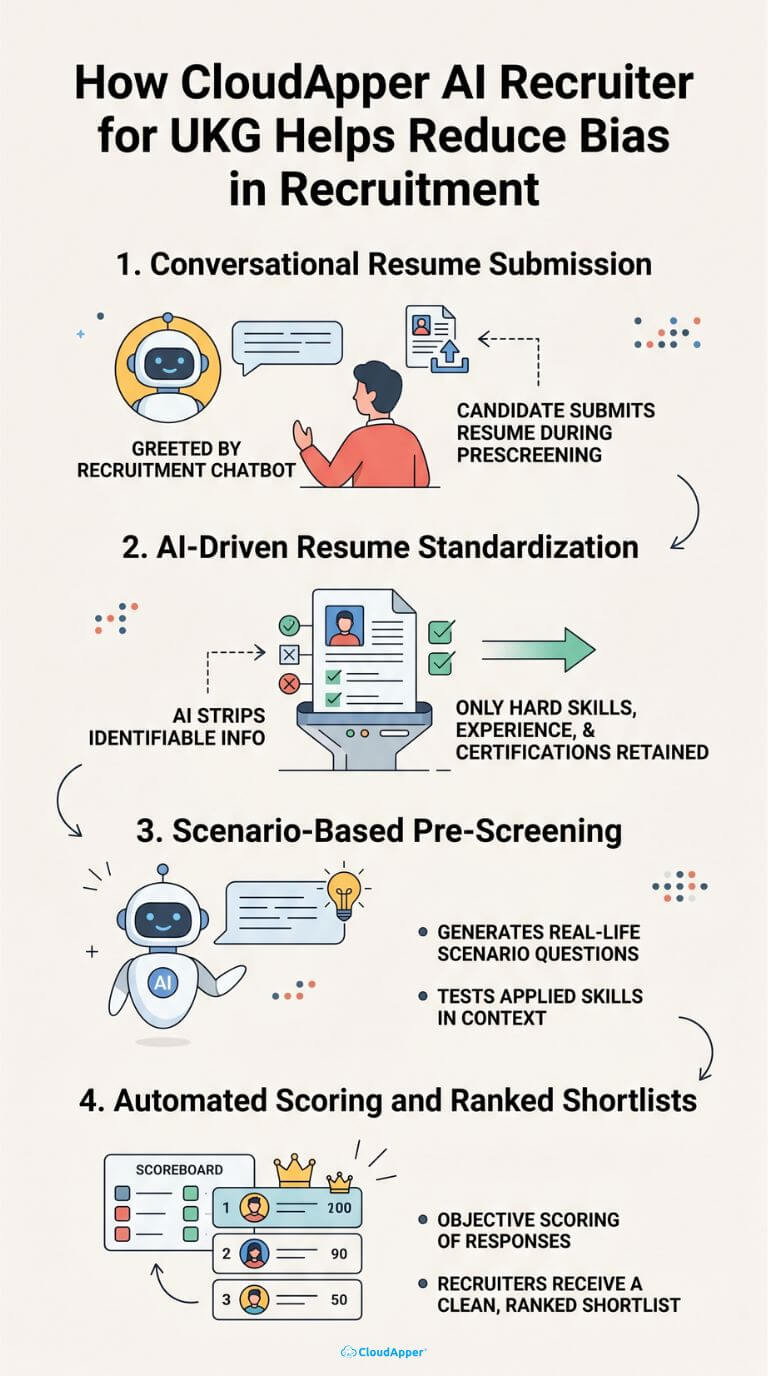
Conversational Resume Submission
The process starts simply and accessibly. When someone applies for a role, they are greeted by a recruitment chatbot. During this initial prescreening conversation, the chatbot politely asks the candidate to submit their resume, creating a smooth, engaging experience right from the start.
AI-Driven Resume Standardization
This is where the bias is eliminated. The AI Recruiter takes the submitted resume and completely standardizes it. It strips away all identifiable information that could trigger unconscious bias—including the candidate’s name, age, gender, address, and educational institutions. It only parses the qualifying details that actually matter: hard skills, years of experience, and certifications.
Scenario-Based Pre-Screening
Once the AI has parsed the candidate’s core skills, it doesn’t just stop at keyword matching. Based on the specific information it found, the AI Recruiter generates and asks real-life, scenario-based pre-screening questions. This ensures the candidate actually knows how to apply their skills in context, creating a merit-based evaluation.
Automated Scoring and Ranked Shortlists
Finally, based on how the candidates respond to the scenario questions, the AI Recruiter objectively scores them. It then provides recruiters with a clean, mathematically ranked shortlist of the top candidates. You evaluate the talent based purely on their ability to succeed in the role.
Supporting DEI Regulations Without the Headaches
Meeting your DEI regulations doesn’t have to be complicated. In fact, CloudApper’s AI Recruiting Solution makes it simpler. Because all candidates are screened using the same structured process, you can prove that everyone went through a fair review.
It also means your team has a stronger foundation when it comes to making inclusive hiring decisions. You’re not starting from a pile of resumes—you’re starting with a clean, ranked shortlist built on facts, not feelings.
Why It Works So Well with UKG Pro & Ready Recruiting
If your company uses UKG, you already know it’s a solid system. But when you pair it with CloudApper AI Recruiter, you add a layer of clarity and fairness that traditional workflows can’t offer alone. Resumes get screened. Candidates get ranked. And candidate data flows directly into your UKG environment. No extra steps. No need for custom development. Just a smoother, smarter way to review applicants.
Frequently Asked Questions
How does AI reduce bias in recruitment?
AI reduces bias by anonymizing resumes—removing identifiable markers like names, ages, and educational institutions—and evaluating candidates strictly on their hard skills, certifications, and relevant work experience.
Does CloudApper AI Recruiter integrate directly with UKG?
Yes, CloudApper integrates seamlessly with both UKG Pro and Ready Recruiting. It automatically syncs parsed candidate data and ranked shortlists directly into your existing UKG environment without requiring any custom development.
What types of bias does AI blind hiring prevent?
Blind hiring using AI helps prevent affinity bias, name bias, pedigree bias, and age bias by completely stripping away the demographic, geographic, and personal details that often trigger human prejudices.
Will AI make the hiring process impersonal for candidates?
Not at all. CloudApper uses an interactive, conversational recruitment chatbot to engage candidates, request resumes, and conduct scenario-based pre-screening, providing a smooth and responsive experience for applicants.
How does AI scoring work for job applicants?
The AI asks role-specific, scenario-based questions based on the applicant’s parsed skills. It then objectively scores the candidates’ responses and generates a mathematically ranked shortlist so recruiters can focus on top-tier talent.
Can AI hiring tools help with DEI compliance?
Absolutely. Because AI applies the exact same structured, blinded evaluation process to every single candidate, it provides a transparent, data-driven foundation that supports inclusive hiring practices and helps prove DEI compliance.
Make Your Process Fair and Efficient
Bias in recruitment is hard to eliminate completely when humans are doing all the filtering. But when you let AI take care of the initial review—based only on job relevance—you get better candidates and a more inclusive hiring process. CloudApper AI Recruiter helps you do just that. Whether you’re hiring in high volumes or looking to fill a few key roles, it gives your team an extra layer of confidence that you’re making decisions for the right reasons.
So if you’re ready to cut through bias and focus on real talent, contact us today to take a closer look at CloudApper’s AI Recruiting Solution.


October 8, 2026
Multi-Round Interviews in UKG Pro Recruiting: Automating Executive Panel Scheduling for Fund Administrators
Senior hiring at a global fund administrator runs through many interview rounds and executive calendars across time zones. CloudApper AI Recruiter extends UKG Pro Recruiting to support every round, schedule executive panels through Outlook and Teams, and give recruiting leadership real-time KPIs on where each search stands.

September 15, 2026
One-Way Video Interviews in UKG: Know Who’s Worth Interviewing Before the Interview
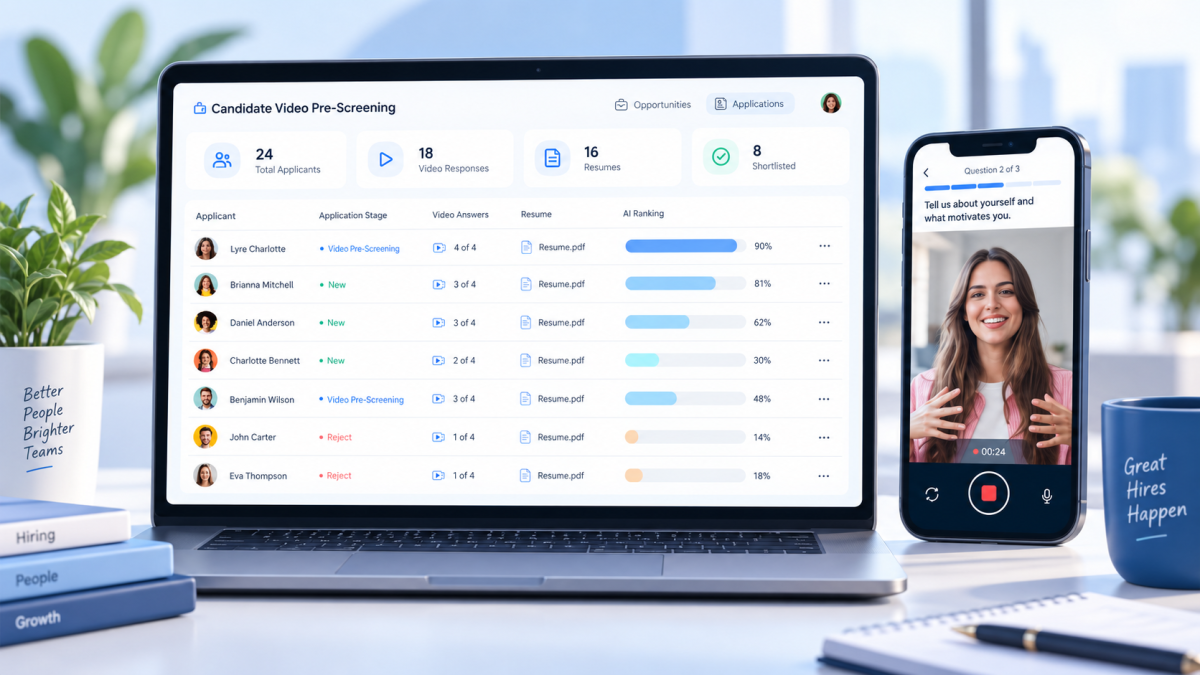
UKG video interviews let shortlisted candidates record answers on their phone, on their own time, so recruiters hear from a real person before booking any interview. The step runs alongside UKG Pro Recruiting or UKG Ready, and the ratings, transcripts, and recordings write back to the applicant record.

September 9, 2026
License-Based Onboarding in UKG Ready: Assigning Broker Forms by Line of Authority
An insurance brokerage's obligations start the moment a broker's hire record is created. Here is why license and location should decide each new broker's onboarding forms in UKG Ready, and how CloudApper derives that path from license data instead of relying on a choice among twenty static checklists.

August 3, 2026
How to Filter Spam and Bot Applications Out of High-Volume UKG Job Postings
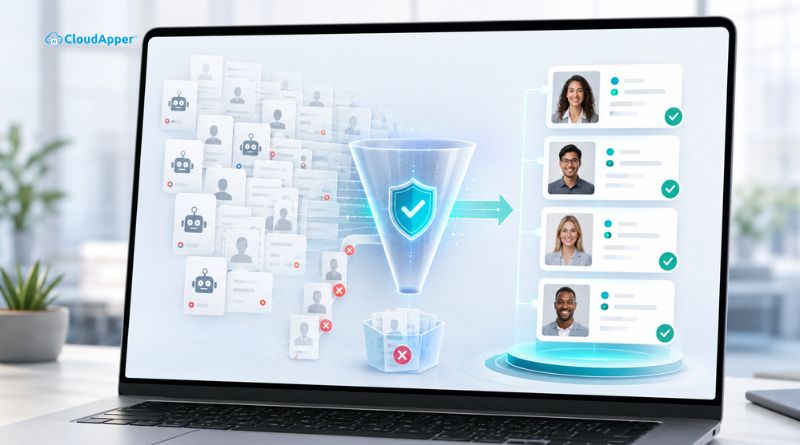
Looking to filter spam and bot applications in UKG before they reach your recruiters? CloudApper AI Recruiter uses early knockout questions and scenario-based conversational screening to automatically block junk submissions, saving your team hours and securing top candidates faster.