When you hire for unionized roles, minor screening inconsistencies can trigger costly grievances. CloudApper AI Recruiter for UKG removes this compliance risk by automating external candidate evaluations against documented Collective Bargaining Agreement criteria, delivering objective screening and instant audit trails.




Table of Contents
- TL;DR:
- Why Hiring Into Represented Roles Is Different From Any Other Requisition
- Where Manual Screening Creates Compliance Risk in Union Hiring
- The Solution: Automating External Hiring While Staying Within AI Hiring Laws and the CBA
- How CloudApper AI Recruiter Screens Candidates for Represented Roles Without Adding Risk
- Benefits of Criteria-Based AI Screening for Union Workforce Hiring
- Consistency Is the Compliance Strategy
When you hire into unionized roles, every screening decision must hold up under the collective bargaining agreement, and a single inconsistency can trigger a grievance that ends with a hire being overturned months later. That risk is why many HR teams hesitate to hire for unionized roles with AI. CloudApper AI Recruiter for UKG removes the concern by never making judgment calls. It screens external candidates entering your UKG pipeline against the criteria you configure, identically for every applicant, with a documented record of how each ranking was produced. Here’s why these hires are different, and how that workflow runs.
TL;DR:
-
Replaces subjective human judgment with strict, rule-based screening to satisfy Collective Bargaining Agreements (CBAs).
-
Screens every external applicant identically against pre-configured qualification standards without variance or bias.
-
Automatically generates real-time documentation showing exactly which criteria drove every candidate ranking.
-
Provides immediate proof during union reviews, ending the need to reconstruct hiring decisions from memory.
-
Delivers qualified candidates directly into your UKG recruiting pipeline with their complete compliance files attached.
Why Hiring Into Represented Roles Is Different From Any Other Requisition
If you recruit for both represented and non-represented positions, you already know the difference in your gut. A regular requisition gives you room to use judgment. A represented one gives you a rulebook. Here’s what that means in practice for hiring in unionized environments.
The CBA Sets the Rules, Not the Recruiter
In a represented workforce, the collective bargaining agreement is a binding contract between your organization and the union, and it governs how jobs get filled. It defines qualification standards, posting requirements, and selection order. Most contracts require an opening to be posted internally first, so current employees can bid on it before anyone outside is considered, and only after that process runs its course does the requisition open to external candidates. Even at that external stage, the contract still shapes what you can do, because the qualification standards you screen against and the consistency you screen with can both be challenged later.
Every Hiring Decision Can Be Grieved
A grievance is a formal complaint that the employer violated the contract. It is not someone venting to a manager. It follows a defined escalation path, usually starting with a meeting between the employee, their shop steward, and a supervisor, and if it doesn’t get resolved, it climbs step by step until it reaches binding arbitration. Here’s the part that should get your attention: if an arbitrator finds that a hiring decision violated the contract, the remedy can include placing the grievant into the role with back pay. In other words, a screening mistake can undo a hire months after the person started. That is what makes union workforce hiring feel high stakes, even when the role itself is routine.
You Have to Show Your Work
When a grievance meeting happens, the union asks three questions. How was the decision made? What criteria were used? Were those criteria applied to everyone equally? “The recruiter felt the other candidate was stronger” is not an answer that survives that room. Neither is a ranking from a tool nobody can explain. What survives is documentation showing that defined criteria existed before screening started and were applied the same way to every applicant. In union hiring, documentation isn’t paperwork after the fact. It is the decision’s defense.
Where Manual Screening Creates Compliance Risk in Union Hiring
Here’s the assumption most HR leaders bring to this topic: AI is the new risk, and manual screening is the safe, defensible baseline. It’s worth questioning that, because manual screening has problems that unions know how to find.
Inconsistent Screening Between Candidates
When human recruiters screen manually, variation creeps in everywhere. Two recruiters weigh the same qualification differently. A phone screen with one candidate covers ground that another candidate’s screen never touched. One applicant gets a callback in a day, another waits a week. None of this comes from bad intent. It comes from busy people doing judgment work under time pressure. But in a represented environment, every one of those inconsistencies is a thread a union representative can pull. If two candidates with similar qualifications got different processes, you have a problem that no amount of good faith explains away.
Missing or Reconstructed Documentation
Grievances rarely arrive the week of the hire. They arrive weeks or months later, after the passed-over candidate has compared notes with coworkers and talked to their steward. By then, your recruiters are reconstructing decisions from memory, calendar entries, and email fragments. Records built after the fact are exactly what escalates a grievance past the first step, because they look like justification invented under pressure rather than criteria applied at the time. If your screening process doesn’t create its own record as it runs, you are always going to be rebuilding history when compliance comes asking.
The Solution: Automating External Hiring While Staying Within AI Hiring Laws and the CBA
So manual screening carries real risk, and automation is the obvious answer, but it has to be the right kind of automation. States and cities are rolling out laws that require transparency and accountability in automated hiring tools, and that patchwork keeps growing. Unionized employers feel these rules doubly, because the union is an organized counterparty with the resources and the motivation to actually exercise those transparency rights.
That doesn’t mean automation is off the table. It means the bar for any AI tool you bring into union workforce hiring is twofold: it has to screen candidates in a way that respects your contract, applying documented qualification standards consistently to every applicant, and it has to be transparent enough to satisfy the AI hiring laws, meaning you can explain exactly what it does and that explanation holds up in front of people whose job is to test it. Here’s how CloudApper AI Recruiter clears both bars.
How CloudApper AI Recruiter Screens Candidates for Represented Roles Without Adding Risk
CloudApper AI Recruiter works alongside your UKG system, screening external applicants before they enter your pipeline. In a union environment, its value comes from what it refuses to do as much as what it does. Here’s how the workflow runs.
You Define the Criteria, the AI Applies Them
Screening and scoring rules in CloudApper AI Recruiter are configured by role, location, or department, so they match the qualification standards your contract and your job descriptions establish. If the role requires a specific certification, two years of relevant experience, and availability for rotating shifts, those become the screening criteria, in writing, before the first application arrives. The AI doesn’t improvise, infer, or make judgment calls about who seems like a better fit. It executes the rules you documented. That distinction matters enormously in a grievance conversation, because the decision logic existed before the candidates did.
Every Candidate Gets the Same Process
Every applicant answers the same structured screening questions and gets evaluated against the same criteria with the same scoring logic, whether they apply at 2 PM on a Tuesday or 2 AM on a Sunday. No candidate gets a longer conversation, a friendlier screen, or a faster response because of who happened to pick up the file. In most hiring contexts, consistency like this is a nice-to-have. In candidate screening for represented roles, it is the compliance defense itself, because “everyone got the identical process” is the answer that ends most challenges before they start.
An Auditable Record of Every Ranking
For every candidate, recruiter dashboards show how the score was generated and which criteria drove it. When a labor representative asks how a decision was made, you answer in minutes, with documentation that was created at the moment of screening rather than reconstructed after the grievance landed. That changes the entire tone of the conversation. You are no longer defending a memory. You are walking someone through a record.
Qualified Candidates Flow Into UKG With the Paper Trail Attached
Candidates who pass screening enter your UKG recruiting pipeline with their complete screening record attached. The documentation lives where your hiring process already runs, alongside the candidate record in UKG, and stays retrievable for as long as your contract’s grievance windows require. Your recruiters work their normal process in UKG, just with cleaner inputs and a defense file that built itself.
Benefits of Criteria-Based AI Screening for Union Workforce Hiring
Here’s what changes for your team when screening runs on documented criteria instead of individual judgment:
- Consistent screening, every time. Recruiter-to-recruiter variance disappears because every external applicant goes through the identical process against the identical criteria.
- Documentation that creates itself. Screening records are generated at the point of decision, so nothing depends on anyone’s memory when a question comes months later.
- Faster, stronger grievance responses. When the union asks how a decision was made, you show the record instead of reconstructing it, which resolves most challenges at the first step.
- Recruiter time back. Your team stops doing defensive record-keeping and repetitive first-round screens, and spends that time actually moving qualified candidates forward.
- Confident conversations with labor representatives. A transparent, criteria-based process gives you something concrete to walk through with the union, which builds credibility over time.
- Faster external fills without cutting corners. Automated screening and scheduling compress time-to-hire while keeping every procedural protection intact.
Consistency Is the Compliance Strategy
If you want to hire for unionized roles with AI, the standard you should hold any tool to is simple: it applies your documented criteria to every candidate identically, and it can show its work. That’s the whole game, because the real compliance risk in union hiring was never automation. It was inconsistency, and inconsistency is a human problem that the right automation removes. UKG runs your hiring process and holds your candidate records. CloudApper AI Recruiter makes sure every external candidate entering that process was screened by the same documented rules, with the audit trail to prove it. If your recruiters spend more time defending hiring decisions than making them, book a demo of CloudApper AI Recruiter for UKG and see the screening workflow in action.



October 26, 2026
Candidate Disposition Automation in UKG Pro Recruiting: The Decision Layer Between the Requisition and the Hire
At a growing healthcare network, UKG Pro Recruiting handles posting and onboarding well, but screening, status changes and manager review pile up in the middle. This piece looks at 14 manual dispositions, missing drop-off data and clinical hiring managers, and how CloudApper adds a decision layer on top of UKG Pro Recruiting.

October 8, 2026
Multi-Round Interviews in UKG Pro Recruiting: Automating Executive Panel Scheduling for Fund Administrators
Senior hiring at a global fund administrator runs through many interview rounds and executive calendars across time zones. CloudApper AI Recruiter extends UKG Pro Recruiting to support every round, schedule executive panels through Outlook and Teams, and give recruiting leadership real-time KPIs on where each search stands.

September 15, 2026
One-Way Video Interviews in UKG: Know Who’s Worth Interviewing Before the Interview
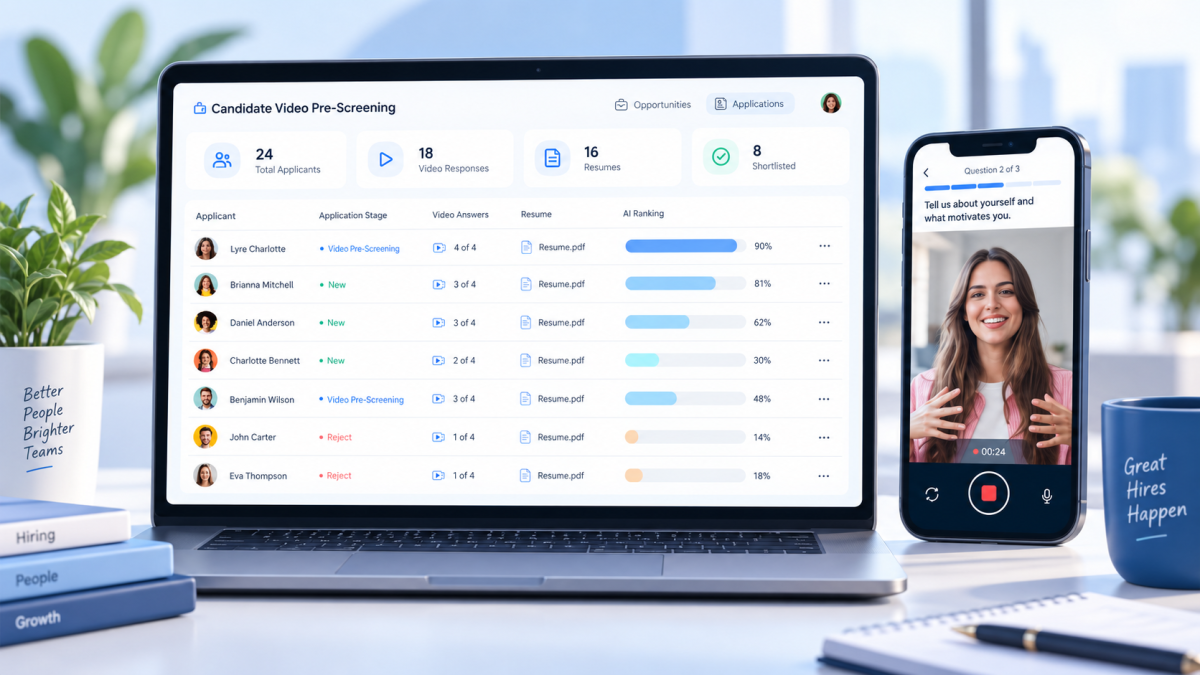
UKG video interviews let shortlisted candidates record answers on their phone, on their own time, so recruiters hear from a real person before booking any interview. The step runs alongside UKG Pro Recruiting or UKG Ready, and the ratings, transcripts, and recordings write back to the applicant record.

September 9, 2026
License-Based Onboarding in UKG Ready: Assigning Broker Forms by Line of Authority
An insurance brokerage's obligations start the moment a broker's hire record is created. Here is why license and location should decide each new broker's onboarding forms in UKG Ready, and how CloudApper derives that path from license data instead of relying on a choice among twenty static checklists.