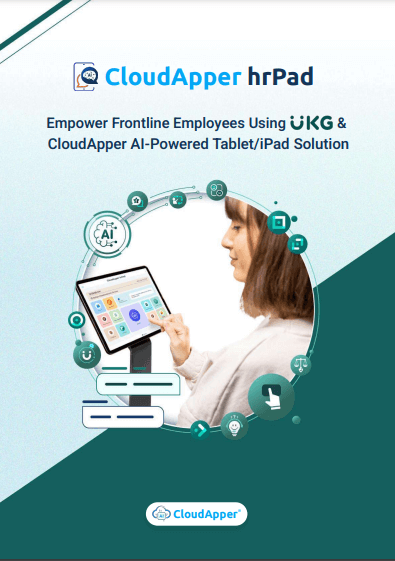
Repayment clauses are under growing legal scrutiny—and California’s new law is just the beginning. Learn how combining UKG with CloudApper hrPad helps you protect your business, streamline HR compliance, and stay ahead of evolving labor laws.




HR compliance is becoming more complicated, especially as more states begin cracking down on repayment clauses. These are the agreements that require employees to pay back things like training costs, bonuses, or relocation expenses if they leave the company early.
If your HR team isn’t keeping a close eye on this, you could be exposed to serious risks. In fact, a new California law (AB 692) going into effect in 2026 is a perfect example of what’s coming—and it won’t be the last. Now’s the time to rethink how your systems are set up to handle this type of compliance issue.
If you’re using UKG (whether it’s Pro, Ready, or Dimensions), pairing it with CloudApper hrPad gives you the extra control you need to stay ahead of these laws and avoid costly mistakes.
What’s the Risk?
Some employers are still using onboarding or exit processes that include automatic deductions, training repayment language, or bonus clawbacks. That’s a big problem if you have employees in states that are starting to outlaw those practices.
California’s AB 692 is just one example. Starting in 2026, it’ll ban most repayment clauses entirely. Companies that don’t comply could face lawsuits, penalties, and reputational damage. Even if you’re not in California, the trend is spreading—and it’s better to get ahead of it now.
Where UKG Falls Short (and What You Can Do About It)
UKG is great at handling core workforce data, but it doesn’t automatically block unlawful clauses or flag non-compliant workflows. It’s still up to your HR team to make sure the right rules are applied to the right employees in the right states.
That’s where CloudApper hrPad comes in. It works with UKG to apply the right logic based on each employee’s location, job role, or any other condition you define.
How CloudApper hrPad Helps You Stay Compliant
Here’s what hrPad adds to your UKG setup to reduce compliance risk and simplify your processes.
Location-Based Workflow Control
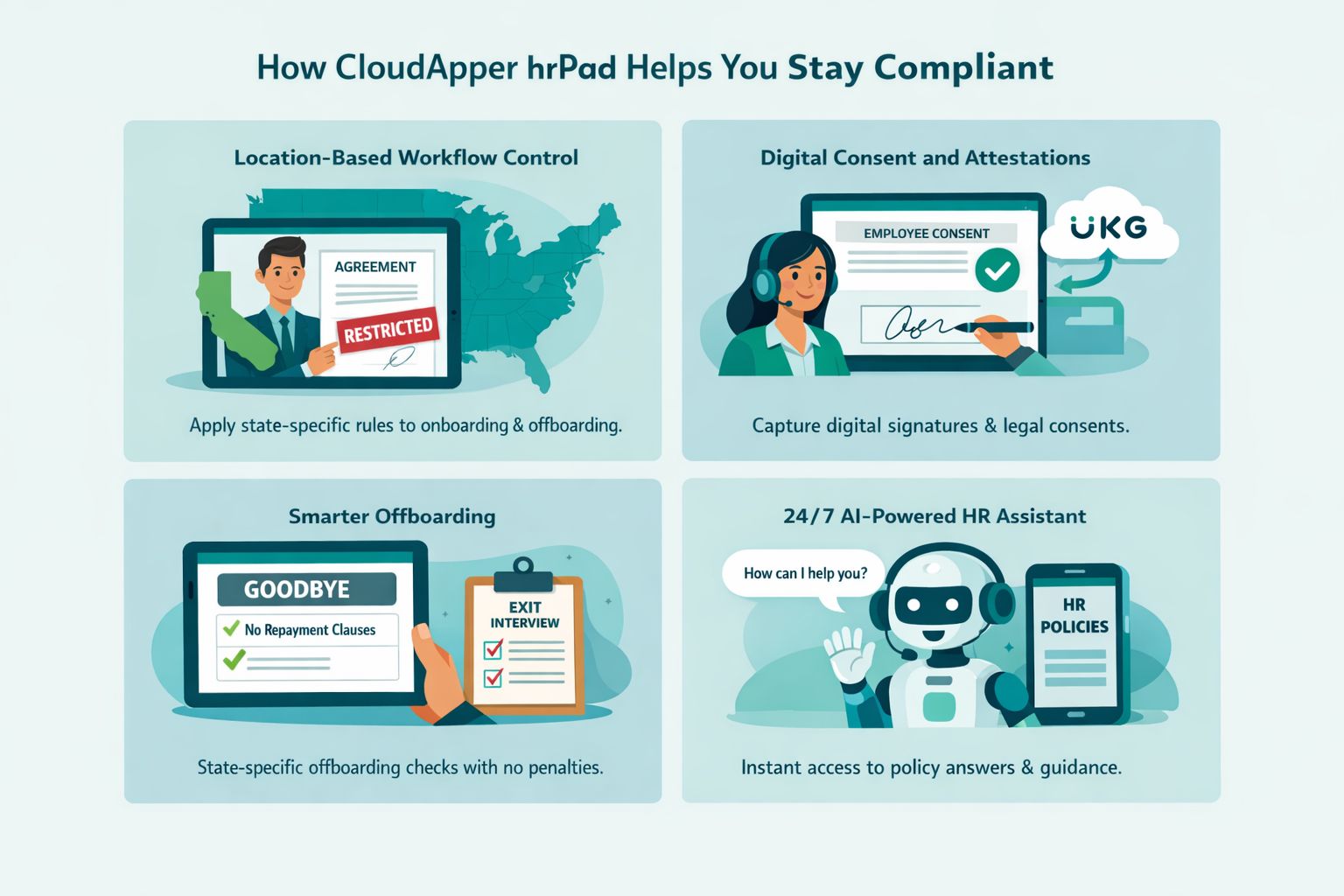
With hrPad, you can apply specific rules based on where your employees work. So if someone is in California, the system automatically skips or blocks repayment clauses during onboarding or offboarding. It’s built right into the flow—no manual checks required.
Digital Consent and Attestations
If there are exceptions that still require some form of agreement (like in other states), hrPad can handle that too. It collects digital consent, captures attestations, and pushes that data back into UKG for safe recordkeeping.
Smarter Offboarding
When someone leaves, hrPad makes sure the exit process follows state-specific rules. That might mean skipping repayment clauses, customizing the final checklist, or adding surveys or confirmations—all depending on where the employee is based.
24/7 AI-Powered HR Assistant
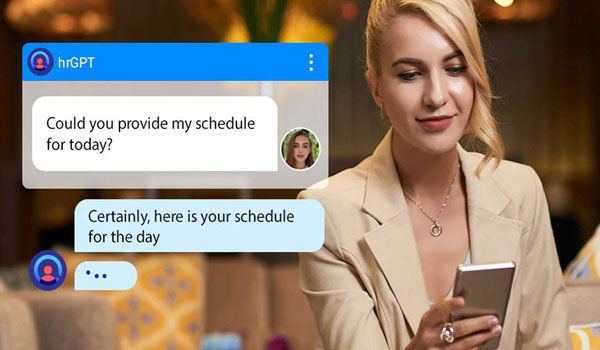
Employees often have questions about policies or pay. Instead of clogging up HR’s inbox, hrPad gives them instant access to answers through an AI assistant. It can be trained on your specific policies, including repayment rules and other compliance topics.
Real-Time Sync with UKG
Everything that happens through hrPad is synced to UKG. That includes clock-in/out data, approvals, policy acknowledgments, and more. You still use UKG as your system of record—but now it has more context and fewer gaps.
A Quick Look at California’s AB 692
To put this in perspective, California’s Stay-or-Pay Ban (AB 692) makes it illegal to require most repayment clauses, even if the employee leaves early. That includes things like:
-
Paying back training fees
-
Reimbursing relocation expenses
-
Clawbacks on sign-on bonuses or tuition programs
There are a few exceptions, but most repayment provisions will no longer hold up—and trying to enforce them could get you in serious trouble.
If your workflows or agreements are still using this kind of language in California, you’ll need to fix that before January 1, 2026.
Why This Should Matter to Everyone, Not Just California Employers
Even if your business isn’t based in California, it’s likely you have employees in states that will follow suit—or you eventually will. Taking a proactive approach to managing repayment clauses isn’t just smart legally—it also protects your brand, keeps your policies consistent, and reduces HR stress.
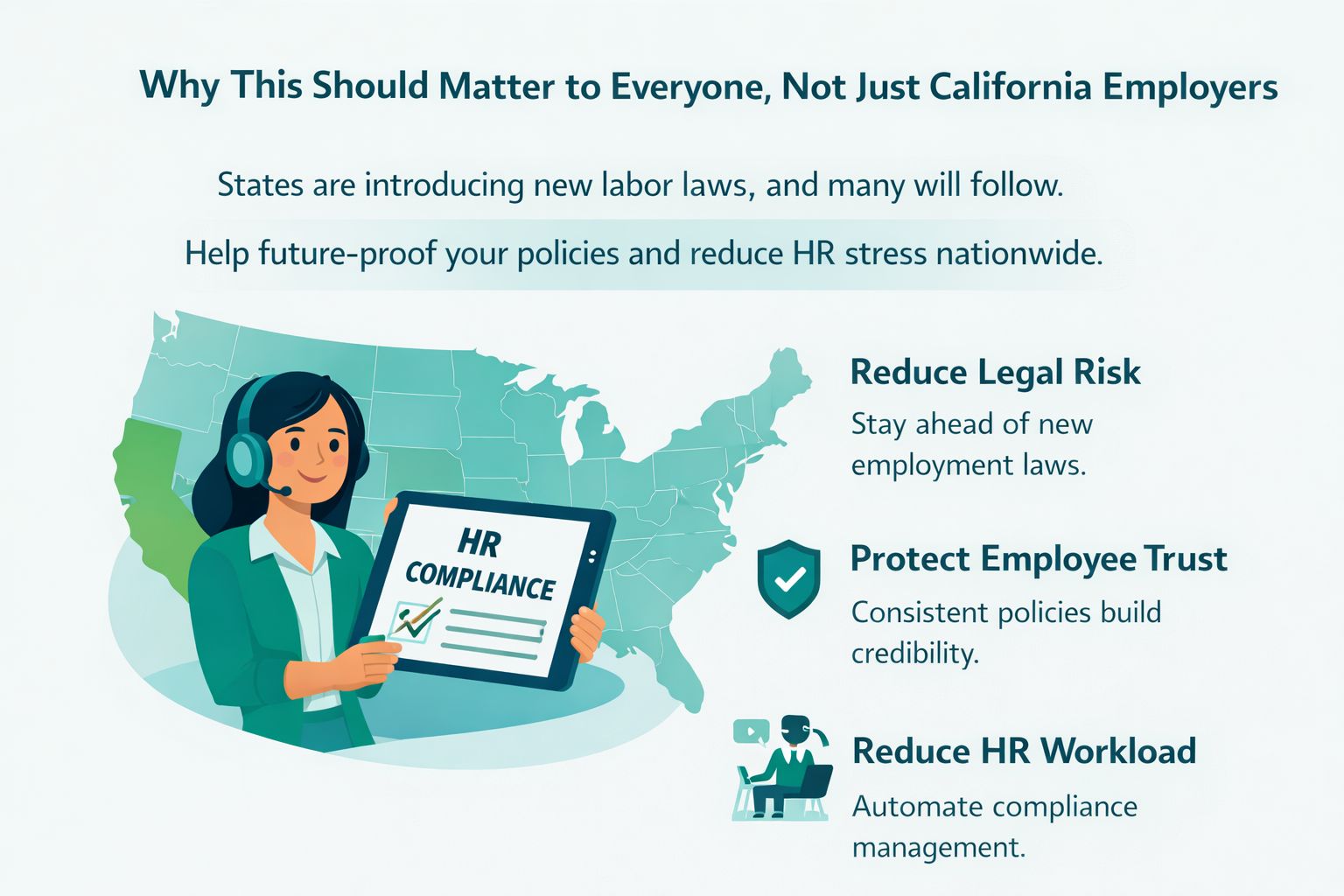
And let’s be honest, manually checking every workflow for compliance just isn’t scalable. That’s why having tools like hrPad working alongside UKG is so important.
What This Looks Like in Practice
Here’s a simple breakdown of how UKG and hrPad work together:
| Task or Risk | UKG Alone | UKG + hrPad |
|---|---|---|
| Block illegal repayment clauses by state | Manual | Automated |
| Capture consent and legal exceptions | Limited | Fully digitized |
| Adjust offboarding steps per location | Manual | Automated |
| Provide employees with policy access | Not built-in | 24/7 AI assistant |
| Store documentation for audits | Possible | Enhanced and linked to workflows |
| Report on potential compliance risks | Limited | Real-time insight |
Final Thoughts
Repayment clauses are just one piece of the larger HR compliance puzzle, but they’re a big one—and they’re only going to get more complex as states start introducing new legislation.
By combining UKG with CloudApper hrPad, you get ahead of these risks, protect your organization, and give your HR team the tools they need to operate with confidence.
If you’re already using UKG, it’s time to make sure your workflows can adapt to what’s coming. CloudApper hrPad makes that easy.
Let me know if you’d like this repurposed for email, sales collateral, or web copy.