A global agency on UKG Pro WFM has to tie every hour to a client, project and task, across hourly, salaried, on-site and warehouse staff in five languages. This piece looks at the visibility and approval problems underneath, and how CloudApper adds a role-based time entry layer while UKG stays the system of record.



Table of Contents
An agency sells time. Every hour a designer, project manager or warehouse worker spends has to land on a client, a project number, a task and a show, or finance cannot compare estimated hours with actuals and billable reporting falls apart. For a global experiential marketing agency of about 1,000 people in nine countries, that requirement sits on top of UKG Pro WFM with Activities, which calculates pay and activity costs. The hard part is not the system of record. It is getting the right hours into it from people who work in very different ways, and this is where CloudApper adds a layer on top of UKG.

As the agency’s business owner for global time entry put it, “We have a very large employee population and very different working styles for these groups of people. It would be good to be able to accommodate either or.”
Why UKG Pro WFM Project Time Tracking Gets Hard at an Agency
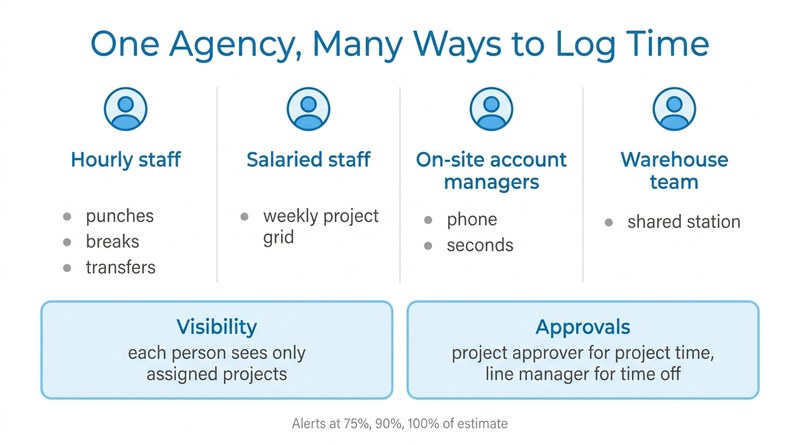
Hourly staff need true punches, with breaks and labor-category transfers, for wage-and-hour compliance. Salaried staff think in a weekly grid of projects and days. Account managers spend much of the week on client sites and want to log time on a phone in seconds. Creatives work at a desk. A warehouse team of more than 100 people switches between projects all day, and some of them will not install an app on a personal phone.
“Sometimes one of the hindrance to potentially not logging your time could be. The fact that you have to have dedicated time towards doing it.”
UK creative team lead, global experiential marketing agency
Two structural tensions sit underneath the entry problem. The first is visibility. Each employee should see only the projects they are assigned to, and modeling every combination of client visibility as separate activity profiles could run into the thousands. The second is approval. Hourly project time is approved by the project’s approver, who usually sits outside the HR reporting line. Time off is approved by the line manager, with automatic approval after three days. Salaried project hours need no approval at all. Approvers also want warnings as hours reach 75, 90 and 100 percent of the estimate. Agencies that have worked through client-owned time data feeding UKG Pro WFM will recognize the same question of whose definition of an hour wins.
One Activity Profile, Visibility Handled in the Front End
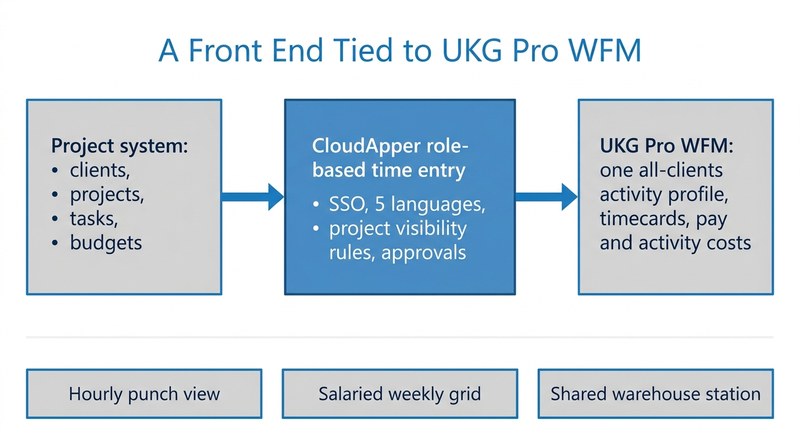
CloudApper’s approach keeps UKG Pro WFM as the system of record and builds a role-based time entry front end on top of it through the CloudApper AI for UKG Personalization layer. Employees sign in with single sign-on and land on the view for their role: a punch screen with breaks and labor-category transfers for hourly staff, or a weekly project grid with quick lookup and copy-last-week for salaried staff. Punches and hours post to the UKG timecard, and UKG continues to calculate pay and activity costs.
Project context comes from the agency’s project system through CloudApper iPaaS for UKG. Instead of thousands of activity profiles, UKG holds a single all-clients profile and CloudApper controls which projects each person sees at the interface level. Project approvals route to project owners without changing the HR hierarchy, the same separation of duties covered in role-based transfers for salaried and hourly employees. The agency’s IT lead framed the boundary this way:
“You’re not building within UKG, you’re tying it to UKG, right? Integrating API.”
IT lead, global experiential marketing agency
Shared Devices and Five Languages
For the warehouse, CloudApper offers an enrolled shared station rather than an app on personal phones, an approach similar to locking a tablet down as a dedicated UKG time clock. The interface runs in English, French, Dutch, German and Polish, which matters for a workforce where many people have never used UKG before and for anyone working through global workforce management in UKG across borders.
“Some people are hesitant to actually put an app on their phone, on their personal phones. So that could be bit of a barrier for us.”
Business owner, global time entry initiative, global experiential marketing agency
The Takeaway for Project-Based Businesses on UKG
For agencies, events companies and other project-based employers, the question is rarely whether UKG Pro WFM can hold the hours. It is how many ways people need to enter them, who approves them, and how visibility is controlled without multiplying activity profiles. CloudApper answers those questions in a front end tied to UKG, so the timecard stays the system of record and every hour carries the project data finance needs.
If your project time still arrives through several regional tools or late spreadsheets, talk to CloudApper about a role-based time entry layer on top of UKG Pro WFM.



October 6, 2026
Union Vacation Accrual in UKG Ready: How Manager Self-Service Keeps Time-Off Approvals Contract-Compliant
Union contracts decide how vacation accrues and what managers may approve, yet approvals rely on the balance on screen. For a unionized envelope and packaging manufacturer moving to UKG Ready, CloudApper calculates CBA tenure tiers and carryover caps and posts contract-accurate balances that managers approve against.

October 1, 2026
12-Month Pay for 10-Month Employees in UKG Ready: Automating Pay Spreading for School-Based Nonprofits
A school-based services nonprofit pays ten-month staff over twelve months, and the pay spread math lives in a fragile spreadsheet. CloudApper adds a pay spread engine to UKG Ready that splits school-year earnings across every pay period, recalculates mid-year changes and handles true-ups when staff leave.

September 25, 2026
Substitute Teacher Management in UKG Ready
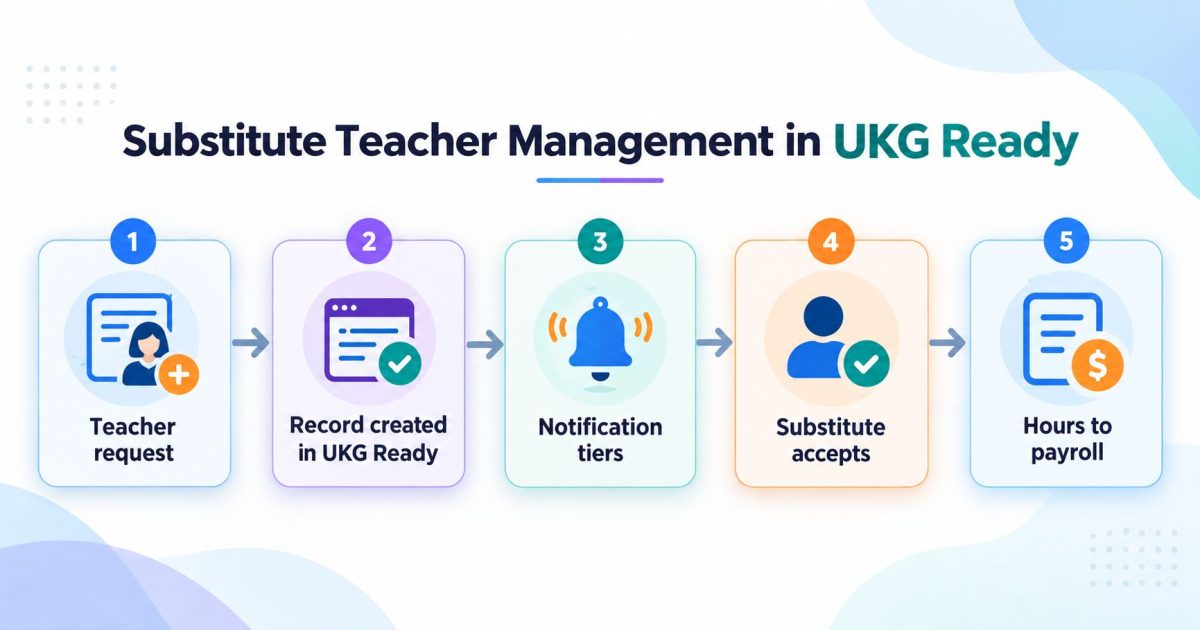
Substitute teacher management is the process of turning a staff absence into a covered classroom. In UKG Ready, the absence record and the approval rules already exist. What sits on top is the dispatch process: who gets asked, in what order, and how the hours reach payroll with the right code.

August 25, 2026
Manager Self-Service in UKG Pro Built for SOX: Why the Delegation Matrix Comes Before the Forms
Enterprises have automated parts of the workforce change process, but the parts are scattered across email, chat, the HCM and a ticket queue, so the control exists while its evidence does not. Here is why SOX-ready manager self-service in UKG Pro starts with the delegation matrix, and how CloudApper adds a leader portal inside UKG Pro.