A casino resort's tip records say how much a department collected but assign nothing to anyone, leaving allocation to a weekly spreadsheet. Here is why department-specific tip pool rules at a tribal gaming resort need to be written down, and how CloudApper turns them into a per-employee record in UKG.



Table of Contents
A restaurant tip pool has a manageable shape. One room, one shift, a handful of roles, and a total that everyone in the building watched accumulate. The math can be argued about, but it can be held in one person’s head.
A casino resort does not work that way. Table games, slots, a buffet, two restaurants, a bar, banquet service, and a hotel operate on different hours with different tipping conventions and different pools. An employee might deal cards on Friday and work a banquet on Saturday. Tip sheets or a point of sale system record the money. The workforce platform records the hours. Nothing in between decides who is owed what.
For one tribal gaming resort, that space between the two systems is a spreadsheet and one person’s review.
Where Multi-Department Allocation Actually Breaks
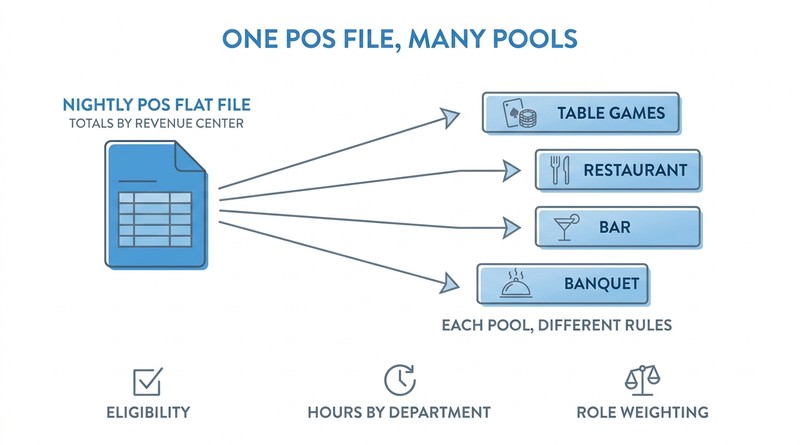
At the resort, team members submit tip sheets through an internal forms application, recording the gaming date, department and amount. The sheets say how much a department collected. What they do not do is assign anything to anyone, and every allocation decision comes after that: which employees are eligible for which pool, whether paid time off or training hours count in that department, whether a pool spans both properties or stays with one, and how someone who works in more than one area of the casino should be counted.
Each of those decisions is a formula in a spreadsheet maintained by the accounting team, rebuilt every pay week, with hours and dollars compiled by hand and keyed into payroll.

“There are certain rules. Every department has… if they have PTO, sometimes the tips apply, sometimes they don’t. It’s based on whether or not the hours were approved,” the resort’s Accounting Manager said.
The workload is one problem. Employee trust is the sharper one. Tip income is a large share of take-home pay for a casino floor employee, and when the allocation is produced by a spreadsheet nobody outside the back office can see, disputes have no clean resolution. Someone questions a number, the back office reopens the workbook, and both sides end up comparing recollections of a busy Saturday.
The Accounting Manager was direct about the stakes of a manual review that misses something: the goal is to avoid “paying people wrong because that creates really big problems for us every time it happens.”
Making the Rules Explicit Instead of Implicit
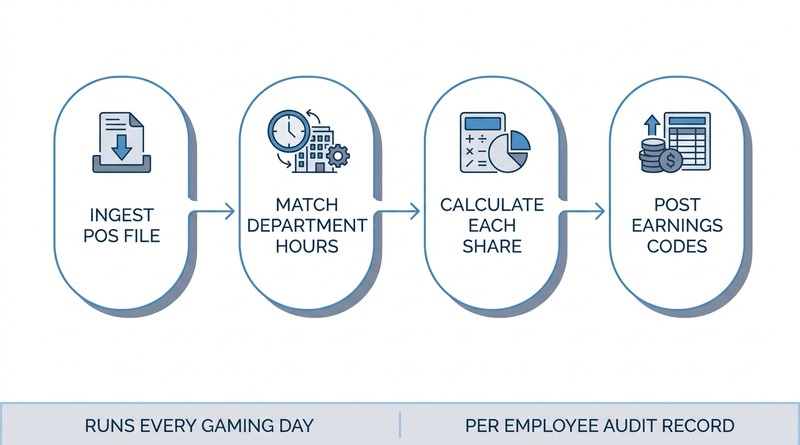
CloudApper’s approach is to move the allocation logic out of the spreadsheet and into a process that runs on its own. CloudApper ingests approved tip sheets from the forms system, builds each department pool by property, reads approved hours by pay code from UKG Ready, calculates each employee’s share according to that department’s configured rules, holds the distribution for review, and writes the results to the UKG timecard as earnings codes.
The hard part is not the arithmetic. It is writing down rules that live in a spreadsheet and one person’s head. Which pay codes count in which department, which supervisory positions are excluded, how a pool that spans two properties is built, and what happens when a tip sheet arrives late or carries the wrong date all have to be specified explicitly before they can run automatically.
Even rounding has moved over time. “The three decimal points is part of the calculation… we were doing it for a period of time and then we went to two and then we were back to three now,” the Accounting Manager said.
That is a recurring pattern in CloudApper Tip Management for UKG work. The system of record already holds the hours and the earnings codes. What has usually never existed is a single authoritative statement of the allocation rules, applied the same way every gaming day, with a record of what it did.
Time capture matters more to tip work than it first appears. Allocation is only as good as the hours behind it, so a missed punch on one shift distorts everyone else’s share in that pool. Gaming operations already carry specific badge requirements for clocking in and out, and tablet capture through CloudApper hrPad adds biometric options that address the shared-badge problem that quietly inflates payroll in high-headcount operations, giving the calculation clean department-level hours to work from. Employees who move between areas of the casino, each with its own rate, are also where multi-role coding confusion makes allocations hard to defend.
What the Resort Needs From the Result
The obvious return is the time the accounting team spends compiling hours and dollars every week. That matters, but it is not the most important part.
The more important part is the ability to answer a question. When an employee asks why their share differs from a coworker’s, the answer should be a record: this pool, these hours in this department, this weighting, this total. The dispute becomes a five-minute explanation instead of an investigation, and the explanation is the same regardless of who gives it.
The Accounting Manager had set that as a condition from the start: “I think we just need to make sure there’s an audit trail as well for everything, which it looks like you can build in.”
There is a fairness dimension here that is easy to state too grandly and worth stating plainly instead. Tipped employees at a resort are not highly paid people. Their income depends on an allocation performed by someone else, from data they cannot inspect, on a rule set nobody wrote down. Making that process consistent and inspectable is not a payroll efficiency. It is a change in how a large group of employees experiences their own pay.
For the tribal enterprise, there is an institutional dimension too. Gaming revenue supports government services and community programs, and enterprises operating under that responsibility carry a higher expectation that internal processes will hold up to review. A tip allocation that produces its own record satisfies that expectation in a way a rebuilt workbook cannot, whatever the quality of the person maintaining it.
UKG remains the system of record for time, earnings, and payroll throughout. What CloudApper adds is the layer that turns tip records and department hours into defensible per-employee amounts and hands them back as earnings codes. Operations facing similar allocation work elsewhere, from restaurant tip pools to the broader workforce demands of a 24/7 gaming floor, hit the same structural problem from different directions. Manual allocation also ranks among the more common contributors to avoidable payroll error exposure.
The CloudApper AI Platform for UKG exists for rules like these: specific to an industry, a property, or a set of departments that each count differently, too particular to live in any platform’s core, and too consequential to leave in a workbook. CloudApper is the process layer that holds the work on top of UKG. The organizations that move fastest are not the ones with the biggest back offices. They are the ones that write their rules down and stop rebuilding them every week.
If your property calculates tip pools outside UKG and the allocation logic lives in a spreadsheet, talk with the CloudApper team about encoding those rules into your existing UKG environment.



September 17, 2026
No Tax on Tips: What It Means for Your UKG Payroll
Starting in 2026, employers using UKG must report tips correctly on the W-2 to support the new No Tax on Tips deduction, and tip tracking commonly breaks down before that data reaches payroll. CloudApper Tips Management for UKG keeps tip data accurate from the point it's earned.


December 9, 2024
Automate Tip Pools Calculation in Restaurants Using UKG/Kronos TimeClock
Simplify tip management with CloudApper hrPad for UKG/Kronos users. Automate tip tracking, reduce errors, and ensure IRS compliance effortlessly. Save time, boost employee trust, and focus on growing your restaurant business with streamlined, accurate tip management.
August 31, 2023
Success Story: Restaurant Chain Automates Workforce Management
Capano Management's partnership with CloudApper AI TimeClock for UKG Dimensions exemplifies the impact of integrating AI technology into workforce management. Their commitment to accuracy, efficiency, and compliance in clock-ins, tip recordkeeping, and job transfers underscores the value of innovation.