Nurse Shift Scheduling in hospitals is increasingly complex due to shortages and compliance demands. This article explains how AI-powered hospital time clocks integrated with UKG help improve nurse coverage, reduce overtime risk, and strengthen frontline compliance without disrupting core workforce systems.


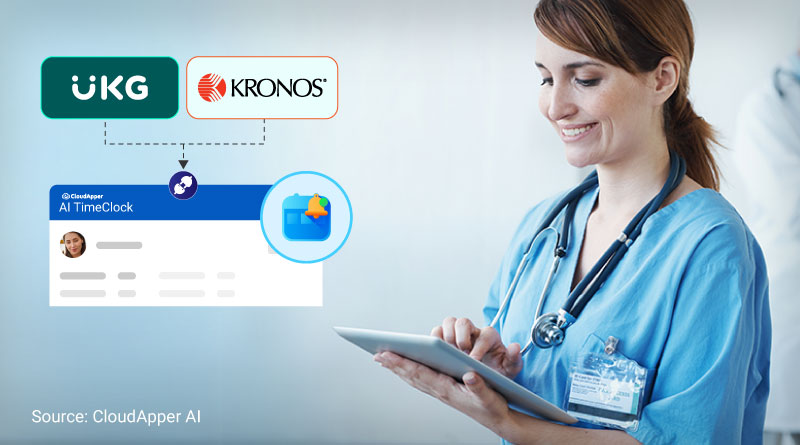
Table of Contents
Efficient shift management is mission-critical in healthcare. Hospitals operate 24/7, staffing needs fluctuate constantly, and nurse shortages continue to strain operations long after COVID. While UKG (Kronos) provides a strong workforce management foundation for nurse shift scheduling, timekeeping, and compliance, many hospitals still encounter frontline challenges around real-time time capture, shift adjustments, and consistent enforcement at the unit level.

This is where CloudApper AI TimeClock for UKG can make a big difference. It acts as a frontline time and attendance layer, helping hospitals improve nurse shift responsiveness, strengthen compliance, and support staff where day-to-day workforce interactions actually happen, without disrupting existing UKG workflows.
TL;DR
-
Hospitals using UKG face ongoing challenges with nurse shortages, last-minute call-outs, and overtime pressure
-
Manual or rigid time clock workflows can create visibility gaps at the unit level
-
AI-powered hospital time clocks like CloudApper AI TimeClock for UKG enhance nurse shift scheduling and compliance
-
Nurse self-service, real-time alerts, and automated compliance tracking reduce HR strain
-
CloudApper AI TimeClock extends UKG by improving frontline time capture, shift coordination, and compliance monitoring
Nurse Shift Scheduling & Compliance Challenges in Healthcare
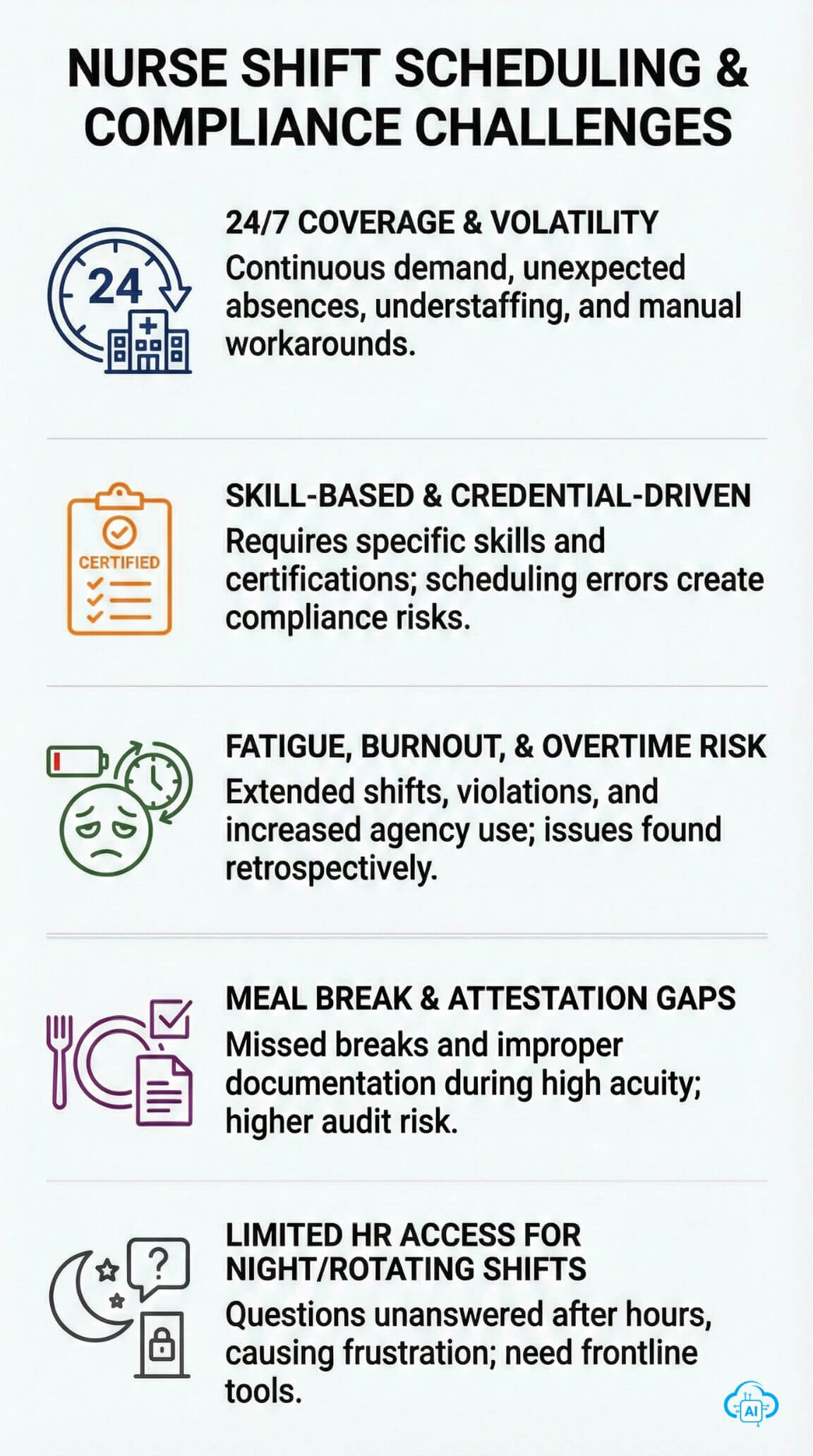
Hospital shift management is fundamentally different from other industries. Even with a robust workforce platform like UKG, healthcare environments introduce frontline realities that make time tracking and scheduling far more complex—especially for nursing teams.
24/7 Coverage Requirements and Staffing Volatility
Hospitals never close. Nurse schedules must account for rotating shifts, night coverage, weekends, and sudden surges in patient demand. A single unexpected absence can cascade into understaffed units, overtime escalation, or compromised patient care.
Traditional time clock workflows are often not designed to respond dynamically at the unit level, leaving HR teams to manually intervene after issues surface.
Skill-Based and Credential-Driven Scheduling
Unlike standard hourly roles, nurses cannot be scheduled interchangeably. Units require specific certifications, experience levels, and skill sets. Scheduling errors—such as assigning underqualified staff—can create compliance risks and operational disruptions.
This makes frontline visibility and accurate time capture essential to support downstream scheduling decisions in UKG.
Fatigue, Burnout, and Overtime Risk
Post-COVID labor shortages have pushed many nurses into extended shifts and frequent overtime. Without real-time alerts and enforcement at the clock-in point, hospitals risk:
-
Unintentional overtime violations
-
Nurse fatigue and burnout
-
Increased reliance on agency staff
These risks are often detected too late when the time-data is reviewed retrospectively.
Meal Break and Attestation Compliance Gaps
Healthcare compliance extends beyond hours worked. Missed meal breaks, improper attestations, and inconsistent documentation are common challenges, especially during high-acuity periods.
When time clocks lack enforcement or guidance mechanisms, compliance depends heavily on manual follow-up, increasing audit exposure.
Limited HR Access for Night and Rotating Shifts
Many nurses work outside standard HR office hours. Questions about schedules, accruals, or policies often go unanswered until the next business day, creating frustration and disengagement.
This disconnect highlights the need for frontline tools that support staff independently while still feeding accurate data into UKG.
How CloudApper AI TimeClock Improves Nurse Shift Scheduling & Compliance in UKG
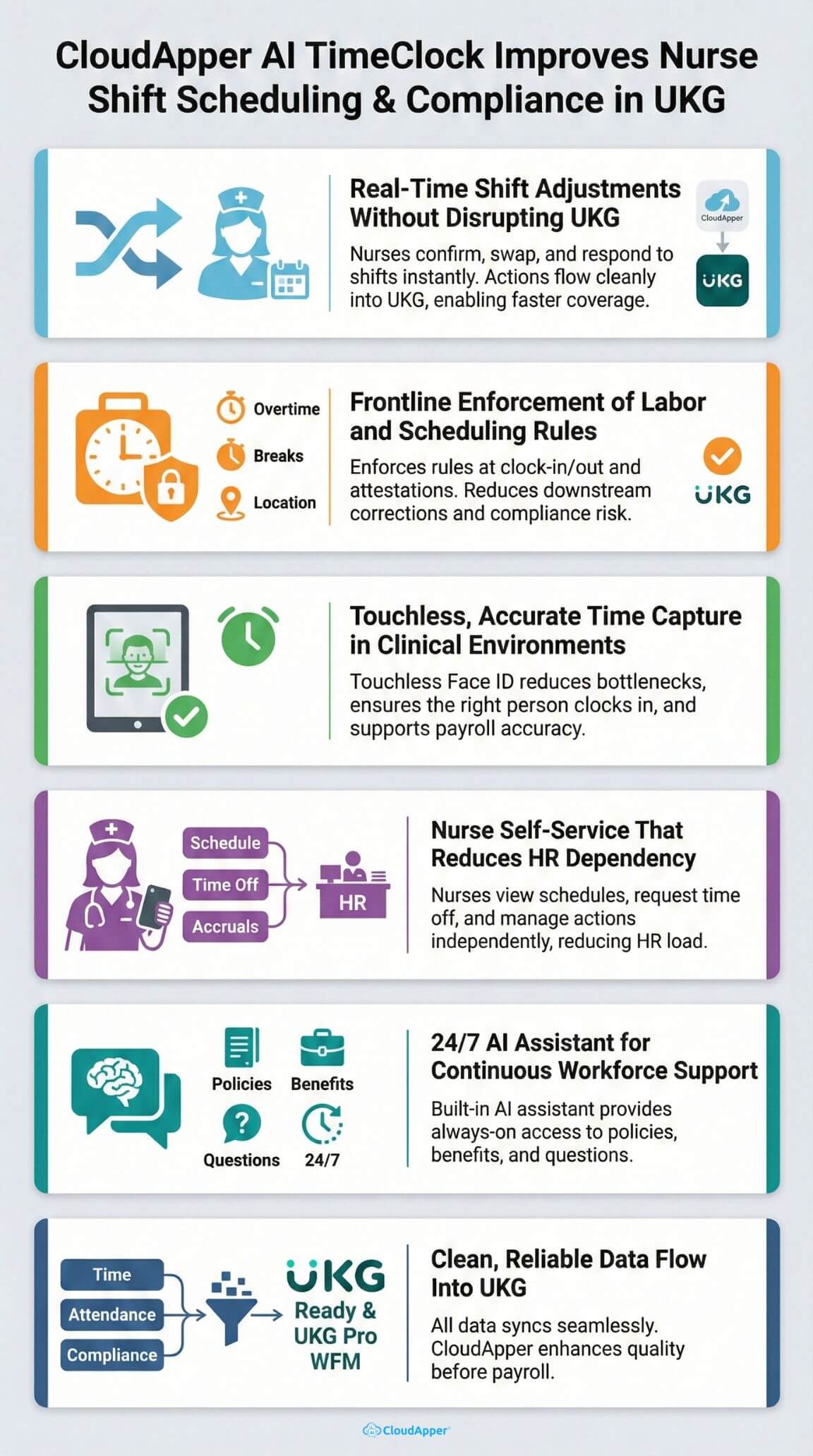
CloudApper AI TimeClock is built to enhance UKG at the frontline, improving how time, shifts, and compliance events are captured—without altering UKG’s core workforce logic.
Real-Time Shift Adjustments Without Disrupting UKG
When absences or emergencies occur, speed matters. Nurses can confirm availability, respond to shift change notifications, and swap shifts through CloudApper AI TimeClock. These actions flow cleanly into UKG workflows, enabling faster coverage while preserving system integrity.
Frontline Enforcement of Labor and Scheduling Rules
UKG defines workforce rules. CloudApper AI TimeClock helps enforce them at the point of interaction—clock-in, clock-out, and attestations—reducing downstream corrections and compliance risk.
This includes guardrails for overtime thresholds, break requirements, and location-based policies.
Touchless, Accurate Time Capture in Clinical Environments
In busy hospital settings, speed and accuracy are critical. Touchless Face ID clock-ins reduce bottlenecks during shift changes and help ensure the right person is clocking in—supporting payroll accuracy without adding friction for staff.
Nurse Self-Service That Reduces HR Dependency
Nurses can view their schedules, request time off, check accruals, and manage shift-related actions independently. This autonomy improves satisfaction while reducing the administrative load on already stretched HR teams.
24/7 AI Assistant for Continuous Workforce Support
The built-in AI assistant provides always-on access to HR-related information—policies, benefits, schedules, and common questions—especially valuable for night and weekend staff.
This improves employee experience without increasing HR headcount.
Clean, Reliable Data Flow Into UKG
All time, attendance, and compliance data captured at the frontline syncs seamlessly with UKG Ready and UKG Pro WFM. UKG remains the system of record, while CloudApper enhances data quality before it reaches payroll and reporting.
Before vs After Implementing CloudApper AI TimeClock for Nurse Shift Scheduling & Compliance
| Area | Before | After (UKG + CloudApper AI TimeClock) |
|---|---|---|
| Nurse shift responsiveness | Manual interventions for call-outs and swaps | Faster shift confirmations and frontline responsiveness |
| Time capture at shift change | Badge or PIN-based, prone to delays | Touchless, accurate clock-ins at the point of care |
| Meal & overtime compliance | Reviewed later | Timely notifications are sent to nurses, and their clock-in/out data is recorded |
| Nurse self-service experience | Available but fragmented across tools | Simplified, frontline-friendly self-service |
| HR support for night shifts | Limited to business hours | 24/7 AI-assisted support for staff |
| Data quality entering payroll | Requires downstream corrections | Cleaner, validated data synced into UKG |
Conclusion
For hospitals using UKG (Kronos), improving shift scheduling and compliance doesn’t require replacing existing platforms. It requires strengthening the frontline layer where time capture, shift changes, and employee interactions actually happen.
By extending UKG with CloudApper AI TimeClock, healthcare organizations can improve nurse scheduling agility, reduce compliance risk, and support staff—ultimately protecting both operational stability and patient care.
Want to see how the CloudApper AI TimeClock would work in your workforce management workflow? Schedule a quick demo today.
Frequently Asked Questions
-
What is a hospital time clock for nurse shift scheduling?
A hospital time clock is a frontline system that captures nurse time, supports shift changes, and feeds accurate data into workforce platforms like UKG to improve scheduling and compliance. -
How does AI improve nurse shift scheduling in hospitals?
AI enables real-time alerts, faster shift adjustments, self-service access, and proactive enforcement of labor rules, helping hospitals respond quickly to staffing changes. -
Does CloudApper AI TimeClock replace UKG (Kronos)?
No. CloudApper AI TimeClock works with UKG as a frontline extension while UKG remains the system of record for scheduling, payroll, and compliance. -
How does an AI hospital time clock help with compliance?
It enforces meal breaks, overtime thresholds, and attestations at clock-in and clock-out, reducing manual follow-ups and audit risk. -
Can nurses manage shifts and schedules without HR intervention?
Yes. Nurses can view schedules, swap shifts, request time off, and access HR information through self-service tools while data syncs back to UKG.
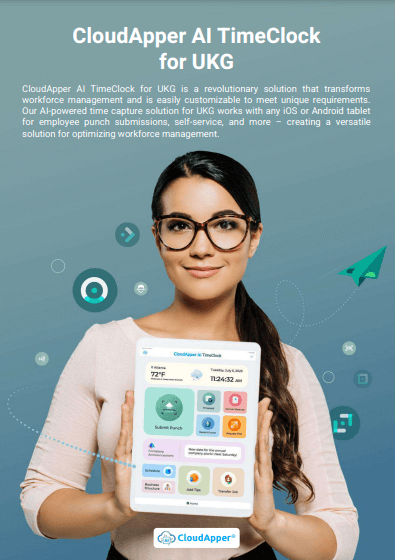


September 18, 2026
UKG Intouch DX Replacement: Tablet Time Clocks, Real Ownership Costs, and What to Test First
Evaluating a UKG Intouch DX replacement? This guide covers integration reality, total five-year ownership costs, the pre-deployment checklist your IT team needs, and where CloudApper AI TimeClock for UKG changes the hardware cost calculation.
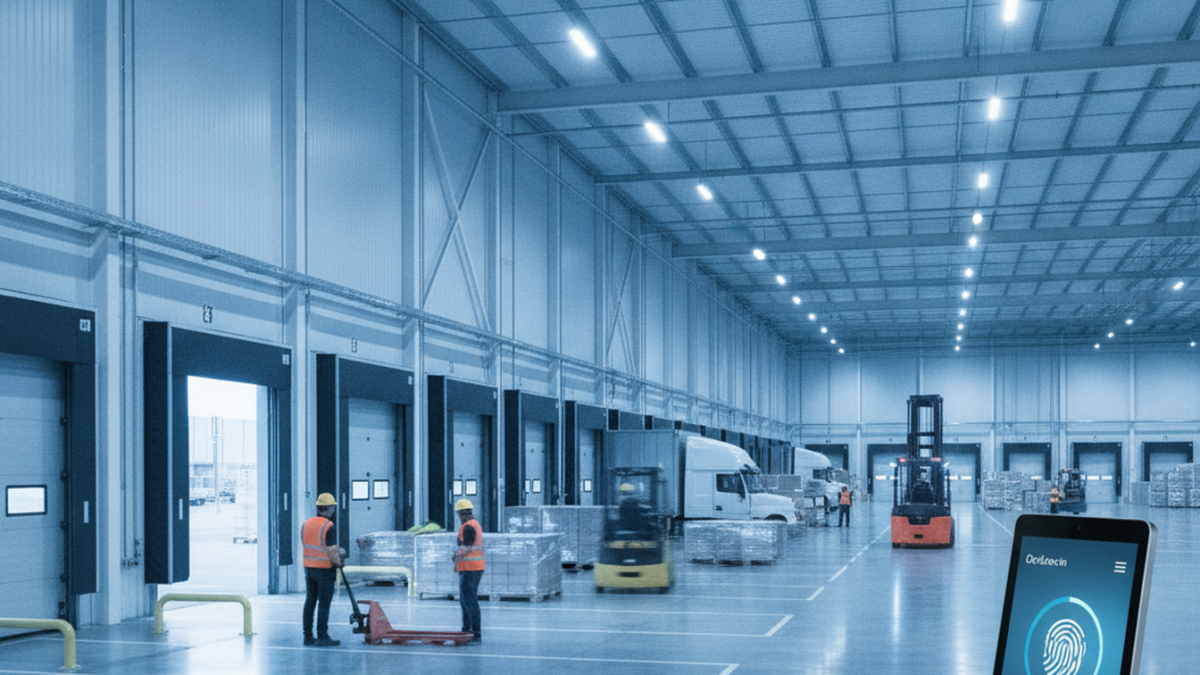
September 17, 2026
UKG Time Clock for 3PL and Distribution Centers: The Job Transfer and Dock Assignment Gap Driving Payroll Errors
Distribution centers and 3PL operators running UKG Ready or Pro WFM face a recurring payroll problem: dock workers who move between client cost centers mid-shift without a transfer punch. This article examines the hardware placement gap that causes billing errors, the limits of native Intouch terminals in high-movement environments, and how CloudApper AI TimeClock for UKG closes the dock-level transfer punch gap.
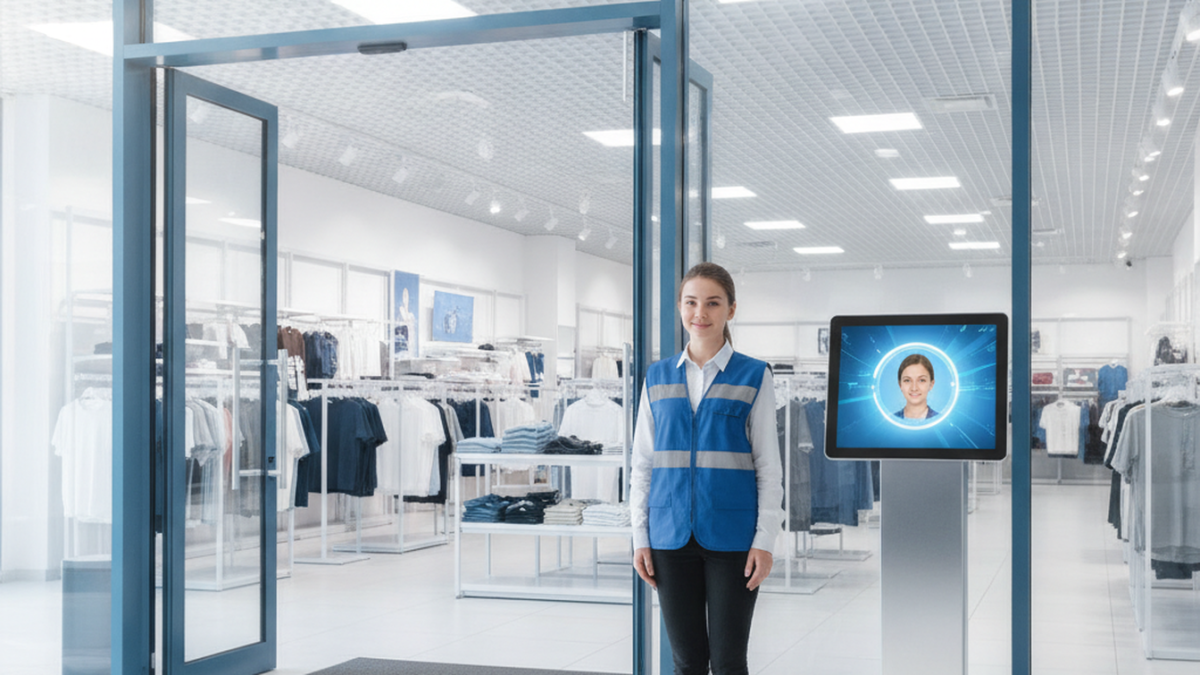
September 16, 2026
UKG Time Clock for Multi-Location Retail: The Shared-Kiosk Problem Hiding in Your Payroll Costs
Retail chains running UKG across 20+ locations face a punch compliance architecture problem — not a scheduling one. Shared kiosks, high turnover enrollment gaps, and multi-state attestation rules create hidden payroll leakage and audit exposure. Here's where it originates and how to close it.
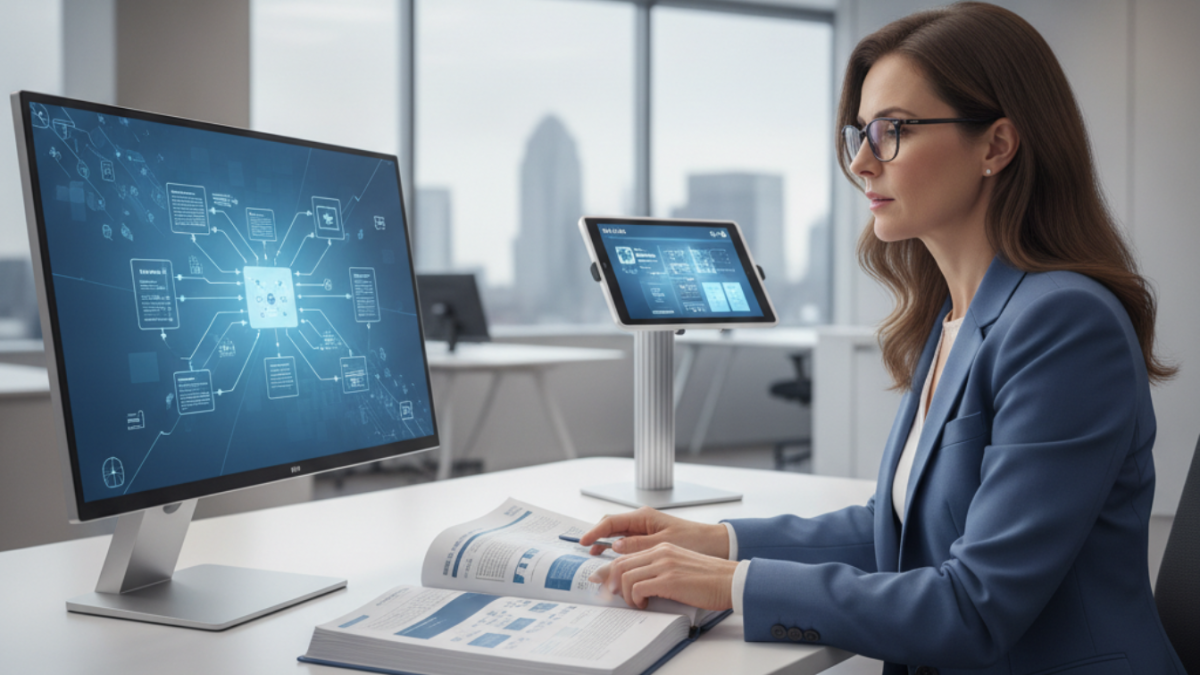
September 15, 2026
Before IT Signs Off on Your UKG Time Clock Replacement: The Security Questions That Stall Every Deployment
When HR sends the tablet time clock proposal to IT, four security questions surface that no vendor presentation answers directly: where biometric data lives, what FIPS 140-2 actually certifies, whether MDM enrollment is supported, and how the UKG integration authenticates. Here is the complete IT review framework.