Learn how CloudApper hrPad enforces meal break rules in UKG/Kronos — from the $97.2M Wells Fargo judgment to state-specific laws in New York, Connecticut, and beyond. See how AI automates compliance so nothing falls through the cracks.


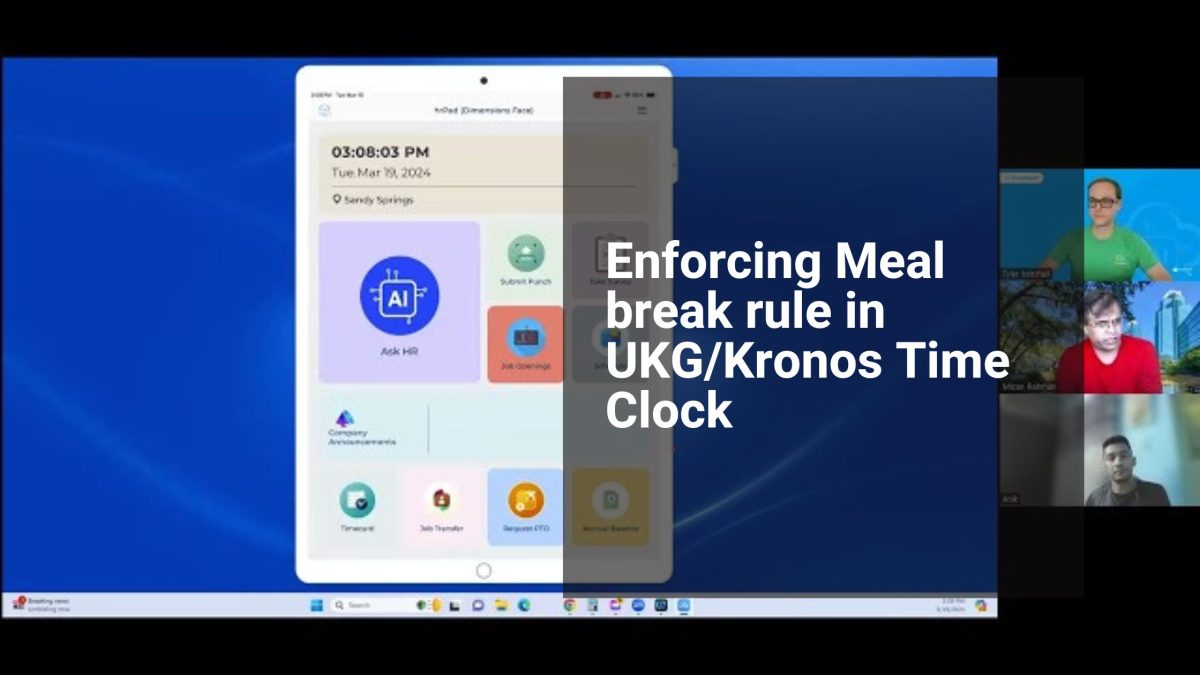
Table of Contents
- What a $97.2 Million Judgment Can Teach Every UKG Employer
- Why Standard UKG Configuration Is Not Enough
- How hrPad Enforces Meal Breaks in UKG
- State-Specific Meal Break Rules
- What This Looks Like in Practice
- Results
- Frequently Asked Questions
- Ready to Configure This in UKG Pro WFM?
What a $97.2 Million Judgment Can Teach Every UKG Employer
In 2024, Wells Fargo was hit with a $97.2 million judgment for meal break violations in California. The case was not about willful misconduct — it was about a system that could not consistently enforce its own break rules across a large hourly workforce. The breaks existed on paper. The enforcement did not.
If you run a workforce of hourly employees across multiple states, that number should get your attention. Meal break law is not uniform across the United States. It varies by state, by industry, by employee age, by shift length, and by union contract. Keeping track of all those variables manually — or relying on your core HCM alone — is how violations happen.

This article explains how CloudApper hrPad, integrated with UKG/Kronos, automates meal break enforcement so your organization does not rely on memory, manual oversight, or luck.
Jump to a specific state:
- New York Meal Break Rules
- Connecticut Meal Break Rules
- Colorado Meal Break Rules
- How to Set Up Break Notifications in UKG Pro WFM
Why Standard UKG Configuration Is Not Enough
UKG Pro WFM and UKG Ready are powerful platforms, but their native punch interpretation rules handle what type of punch was submitted — not whether a break was taken at the right time, for the right duration, by the right employee group. That gap is exactly where violations occur.
The variables that a compliant system must account for include:
- State law — requirements differ significantly between California, New York, Connecticut, Colorado, and Florida
- Employee age — workers under 18 are subject to stricter break requirements in most states
- Shift length — break obligations typically trigger at specific hour thresholds (5 hours, 6 hours, 7.5 hours)
- Break timing windows — some states specify not just duration but when within the shift the break must occur
- Union contracts — may impose requirements stricter than state minimums
- Employee group rules — different teams on the same floor can have different break schedules
CloudApper hrPad handles all of these variables through a configurable AI rules engine that sits at the time clock — the exact point where compliance either happens or fails.
How hrPad Enforces Meal Breaks in UKG
Rule-Based Clock-Out Prevention
If an employee attempts to clock out without having taken a required meal break, hrPad blocks the punch and displays a reminder: “You have not taken your required 30-minute meal break. Please complete your break before clocking out.” The block is configured per employee group, so exempt employees (those over 18, for example, in states where the adult break rule is discretionary) are not affected.
Proactive SMS Reminders
Rather than waiting for an employee to hit the clock-out block, hrPad sends an SMS notification before the break window closes. For a 5-hour break requirement, a message goes out at the 4.5-hour mark: “Your meal break is required within the next 30 minutes. Please begin your break by [time].” The employee acts; the violation never occurs.
Dynamic Break Time Display at Clock-In
For workforces with different break schedules across employee groups, hrPad shows each employee their required break time at the moment they clock in. An employee whose contract requires a break after 4 hours sees: “Your required meal break is at [clock-in time + 4 hours].” An employee on a 6-hour schedule sees a different time. No manager tracking. No spreadsheet. No guesswork.
Age-Based Rule Enforcement
For workplaces with a mixed adult and minor workforce, hrPad calculates employee age from their date of birth in UKG and applies the correct rule set automatically. An employee under 18 is required to take their break and is blocked from skipping it. An adult employee on the same tablet, same shift, is not subject to the restriction. The system handles the distinction without any manual configuration at the point of use.
Two-Stage Early Return Prompt
If an employee returns from a break before the required duration has elapsed, hrPad triggers a two-stage prompt. The first screen notifies them that their break is not yet complete. If they choose to return early anyway, a second screen requires them to select a reason from a configured list. That reason is logged and, if configured, a notification is automatically sent to the compliance team for review.
Attestation Capture
In states like California and Florida — and for any employer that needs documented proof of break compliance — hrPad captures a punch-time attestation. The employee confirms what type of punch they are submitting and, where required, verifies that they received their required break. This creates an auditable record that holds up in wage-and-hour disputes.
State-Specific Meal Break Rules
State law is where most employers get caught. The rules below cover the states most commonly relevant to CloudApper customers. For deeper detail on each state, see the dedicated guides linked above.
New York
New York distinguishes between factory and non-factory workers:
| Employee Type | Shift Duration | Required Break | Timing |
|---|---|---|---|
| Non-factory | 6 hours or more | 30 minutes | Between 11:00 a.m. and 2:00 p.m. |
| Non-factory | More than 6 hours (shift crosses 1:00 p.m.–6:00 a.m.) | 45 minutes | Midway through shift |
| Factory workers | Any qualifying shift | 60 minutes | Designated lunch period |
Violations are enforced by the New York Department of Labor. Employers with multiple shift types (day, swing, overnight) face the most complexity — the 45-minute rule for shifts crossing the 1:00 p.m.–6:00 a.m. window catches many multi-shift operations off guard.
Full guide: Enforcing New York Meal Break Rule in UKG/Kronos →
Connecticut
Connecticut requires a minimum 30-minute unpaid meal break for any employee working 7.5 or more consecutive hours. The break must occur after the first 2 hours of work and before the last 2 hours (i.e., after hour 2 and before hour 5.5 of a 7.5-hour shift).
Key exemptions:
- Employers with fewer than 5 employees on the same shift at the same location
- Positions that can only be performed by a single employee (where relief is not feasible)
- Situations where compliance would harm public safety
Penalties are assessed by the Connecticut Labor Commissioner. Employers who rely on voluntary compliance — without a system that enforces the timing window — are the ones who end up paying them.
Full guide: Enforcing Connecticut Meal Break Rule in UKG/Kronos →
Colorado
Colorado requires a 30-minute unpaid meal break for shifts exceeding 5 hours, plus a 10-minute paid rest break for every 4 hours worked (or major fraction thereof). Both obligations run concurrently, which means a typical 8-hour shift triggers the meal break and two paid rest breaks.
Full guide: Enforcing Colorado Meal Break Rule in UKG/Kronos →
What This Looks Like in Practice
Here is a real configuration example from an hrPad deployment covering a mixed-age workforce with employees across two states:
- Adult employees (18+) in New York — system monitors for 30-minute break between 11 a.m.–2 p.m. SMS reminder sent at 10:45 a.m. if no break punch recorded. Clock-out blocked until break is confirmed.
- Minor employees (under 18) in New York — stricter rules applied automatically based on DOB in UKG. Break enforcement triggers earlier; no override permitted without manager escalation.
- Night-shift employees (shift crosses 1 p.m.–6 a.m. window) — 45-minute break rule applied automatically. Different notification timing configured for overnight shift start.
The rules engine in hrPad inherits employee group data, shift schedule, and state location directly from UKG — there is no separate configuration at the tablet level each time a rule changes.
Results
Organizations using CloudApper hrPad for meal break enforcement have reported:
- 40% increase in meal break compliance (retail HR Director, 10+ years experience)
- 25% reduction in HR administrative tasks related to break tracking and exception management
- 40% reduction in compliance issues for New York-specific break rule enforcement (CHRO, charitable organization)
Frequently Asked Questions
Can hrPad enforce different break rules for different employee groups on the same device?
Yes. hrPad identifies each employee via facial recognition, QR code, or PIN at the time clock and applies the correct rule set for that individual based on their profile in UKG — age, employee group, shift type, and location.
What happens if an employee tries to clock out without taking their break?
hrPad blocks the clock-out and displays a message reminding the employee they have not completed their required break. The block is only applied to employees whose rule set requires the break.
Can the system send SMS reminders before the break window closes?
Yes. Reminders are sent at a configurable interval before the break deadline — typically 30 minutes before the required break window closes. The message includes the specific time by which the employee must begin their break.
Does hrPad support shift attestation for California and Florida?
Yes. For states that require employees to attest to receiving their breaks (California’s add-a-station rules, for example), hrPad captures attestation at the time of punch and stores it in UKG.
What if an employee returns from their break early
hrPad’s two-stage prompt notifies the employee their break is not complete. If they return early, they must select a documented reason. The compliance team is automatically notified.
Can hrPad handle union contract break requirements that are stricter than state law?
Yes. The rules engine is configured per employee group. If a union contract requires a 45-minute break in a state that only mandates 30, the union group gets the 45-minute rule; non-union employees get the state minimum.
How does hrPad know which state rules to apply to which employees?
hrPad inherits location and employee group data from UKG. Rules are applied based on the employee’s home location or work location, depending on how the organization configures the integration.
Is there an audit trail of break compliance?
Yes. hrPad logs all break punches, attestations, early returns (with reason codes), and block events. These records are available for reporting inside UKG and can be exported for audits or legal review.
Ready to Configure This in UKG Pro WFM?
The rules above describe what hrPad enforces. If you want to see exactly how to configure short break notifications inside UKG Pro WFM (Dimensions) — including the two-stage prompt system and compliance workflow — the setup guide walks through it step by step.
How to Set Up Short Break Notifications in UKG Pro WFM (Dimensions) →
To see hrPad in action for your specific workforce configuration, contact CloudApper for a free trial.
Session Transcript:
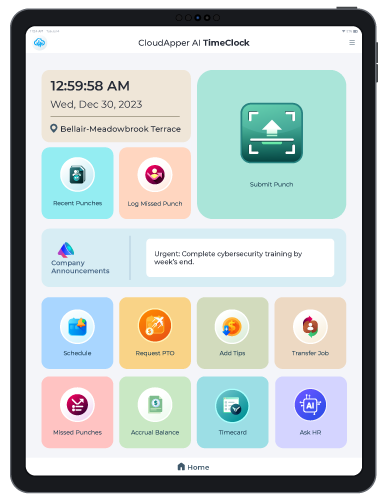
Tyler: what we have right here is just a single button, say for punch. So because the HCM system that is connected to has punch interpretation rules, where they can accept any type of punch, it knows if it’s in punched out, punch a luncheon or lunch out. But the same button can also be expanded. So if your employees are more used to seeing like punch in punch out lunch and lunch out, then they can also be set up for that configuration, as well as you have some compliancy pieces to that as well. So in states like California, who have ADD A station, they actually need to define, you know, what their, what they’re actually punching to, and be able to attest to it. And so for some states, like California, and even some parts of Florida who have those added station rules that say the punch in experience needs to be tailored.
Mizan Rahman: So yeah, show us some of the magic with this punching capabilities you have.
Tyler: So right now I have it actually served for facial recognition. It’s very quick, you don’t need any prerequisite or anything like that. It’s a finds employee. I’m Elijah in the system. And so now it’s identified me, it uses the API and since the punch directly to the timecard, but it does not actually have to be just facial recognition, it can also be something like a QR code, for instance. So there’s other QR codes.
Mizan Rahman: So pretty simple to change out, right?
Tyler: Exactly And you can toggle in between them very quickly as well. So if you want it to be even be like a pin or something along those lines, they can even be a pin interface for you.
Mizan Rahman: Are you saying something Anik?
Anik: Yeah. So you know, like, right now, it’s pretty straightforward. submitting the punch through once a big push button. But as Tyler was touching on it, it does not have to be that way. For one use case, you might want people to clock in, clock out, then go out for a meal, then go back for a meal. But if we look a bit further, there are instances where you might want your employees to take a mandatory 30 minute lunch break. Now, if you hit punch in, and if you can just simply punch out without any validation, that purpose is not served, what we can do is internally directly from HR bad, build up a ruleset, where if you have clocked in for your day, if you haven’t taken a 30 minute break, you won’t be able to clock out, if you try to clock out, it will remind you like Hey, you didn’t take your meal break today. Or if you did, it was not for 30 minutes. So please make sure you’ve completed your meal break and took a punch out, we can enforce similar things between punch in and punch out as well. So it’s it doesn’t always have to be simple, or it doesn’t always have to be complicated.
Mizan Rahman: So let me clarify, there are rules like employees must take 30 minute break during their working shift, right? So without them taking that break, they will be clocked out for the day.
Anik: Exactly And this is a real use case, if I dive into like, like a bit deeper into actually a real case scenario that hrPad solved. So we had this particular use case where there are employees who are below 18, who are working part time and there are employees who are adults . So if we’re if you’re an employee who is below 18, you are definitely supposed to take a meal break. But if you are not below 18, you are not bound by those rules. So you can punch in and punch out, do whatever you want. We knew what the employees age were, we were actually calculating it based on their date of birth. And if they were below 18. We had them going through like all those hoops. They had to take a meal break. They had to do a bunch voting a certain way. But in the same hrPad in the same tablet. If you are an employee who is above 18 You don’t have to pull any of those. You can hop in you can clock out the very next minute that is fine where If you are under 18, you cannot do that it will enforce lunch break for you. And that is like a very good use case where the WFM (HR software) couldn’t do that. But he could do that very easily.
Mizan Rahman: So this is the interesting. So imagine someone comes in, you have eight hour shift. And when are they supposed to take the meal break? Is there any rule like you have to take the meal break in the middle of it, or the rule is anytime?
Anik: For this particular use case, there was and then again, there are use cases where you might want to take a meal, you might enforce and we will break after five, five hours of working. So there has to be a good gap between your clocking and you’re going in from for a meal break. The great thing is he can also facilitate that. So what is the gap?
Mizan Rahman: How would see, imagine this now? employees working busy forgot about it. It’s already five hours, and they didn’t take the break? What can you tell me? Right?
Tyler: Just to kind of get it from before the probably even start is that we can even trigger like text messages (SMS) even be sent to these employees before the need to take a break, kind of given them a soft reminder, hey, you know, in 15 minutes, you know, 20 minutes, whatever the case may be whatever you deem necessary, just to give them that nudge to let your breaks coming up, you need to prepare, you know, start finishing up your task, so you can go and get on your break. And that way the company is not penalized.
Mizan Rahman: you’re saying that. So if someone has to take meal break within five hours, and as five hour window coming up, hrPad (AI tablet time clock) can send them a text message, SMS, remind them, it’s like, Hey, you will need to take that meal break within the next 30 minutes or so is that correct?
Anik: Absolutely.
Tyler: Let’s say like four and a half hours into the shift, so we give them a half hour, you know, we will go ahead and send them a message letting them know, hey, you know, you’ve not taken a meal break yet, you know, you need, you need to go ahead and start picking up your cat. So you can start taking start taking a meal break by X amount of time even. So we can give them those instructions and make sure that your accompany stays compliant.
Mizan Rahman: Wow, this is amazing. So so we can enforce with hrPad all these meal break rules based on the state or company policy or union labor contract, whatever it is that we can enforce all these rules. And also we can add that SMS capabilities that we can remind the employees how to behave or how to interact with the system as required by the law or contract – is it correct?
Tyler: Yes, it doesn’t have to be limited to just like meal breaks, it can even be for like before their shifts even start. So we can ask them like, Hey, are you going to be able to make it into a in, you know, we can set to like, let’s say an hour before their shift, and then you know, it comes up a half hour goes by and they haven’t responded? You know, it can send a notification to the manager even and let them know, you know, hey, we did not receive a notification yet you can follow up with them.
Mizan Rahman: Yeah, this is this, this is amazing. Um, well, you know what other cases like is any other break rules? Like maybe some company may require you to take 10 minute break every two hours is anything like that?
Anik: Yep. So amazing use case that we have seen is, so there was this particular use case where employees had different hourly rule sets. So if like there are some employees whose hourly rules was they had to take a meal break, like after four hours after clocking in, and there were employee groups that had to take their meal break six hours after clocking in, it’s very difficult to for an employer to keep track of that. So what hrPad (UKG, Workday, Ceridian Dayforce) did for them is the employee walks up to the tap the clock in during their clock in, when it’s done, they actually see a pop up, which says like, Hey, Mr. X, you’re clock in time was this and you’re supposed to take your meal break at that time, so it added four hours to their working time and showed them what their exact meal time is gonna be. And it was all dynamic. It was not like a fixed number that we’re adding up. What it was doing is based on what type of rule said that that employee falls under, it would inherit that information. And if someone is required to take their meal break six hours after clocking in, it would add that six showed that information. If it was different, it would show that information for them. At this time there was no texting, they’re actually seeing it when they’re clocking in they’re getting a reminder they’re seeing the exact time they’re supposed to go on a break, which worked wonders for this this use case.
Mizan Rahman: Just fantastic. So basically this AI engine We can configure it any way and it will orchestrate all the rules whatever the local rules, companies rules and basically employee nothing will fall through the cracks and both parties will be saved – is that correct?
Tyler: Yeah.


October 27, 2026
Multilingual Time Clocks for UKG: Making Sure Workers Understand What They Attest To
An attestation is only as defensible as the employee's understanding of the question. Learn how UKG Pro WFM and UKG Ready handle languages, where custom prompts fall short, and how CloudApper AI TimeClock delivers multilingual attestation on affordable tablets.
October 26, 2026
California Seventh Consecutive Day Overtime in UKG: Flagging It at Clock-In
California pays premium rates on the seventh consecutive workday in a workweek, even when total hours stay at 40. Learn how UKG Pro WFM and UKG Ready calculate it, why the cost decision happens before the punch, and how CloudApper AI TimeClock flags it at clock-in.
October 23, 2026
New York Spread of Hours Pay in UKG: Catching the 10-Hour Span Before Payroll Does
New York owes an extra hour of pay when a workday spans more than 10 hours or includes a split shift. Learn how UKG Pro WFM and UKG Ready calculate the premium, why missed split-shift punches hide it, and how CloudApper AI TimeClock keeps punches accurate on affordable tablets.
October 22, 2026
Illinois One Day Rest in Seven Act: Configuring UKG for Meal and Seventh-Day Rest Rules
Since 2023, Illinois requires 24 hours of rest in every rolling seven-day period and earlier, more frequent meal periods. Learn how UKG Pro WFM and UKG Ready can enforce ODRISA rules, and how CloudApper AI TimeClock adds seventh-day and meal checks on an affordable tablet.