
Talent shortages in healthcare, retail, and manufacturing demand faster hiring. Learn to cut time-to-hire by 50%+ for hourly roles using conversational AI—automating screening, reducing drop-offs, and enabling instant scheduling. CloudApper AI Recruiter integrates with UKG to slash weeks to days, boost candidate experience, and minimize vacancy costs.



Table of Contents
Talent shortages continue to challenge US employers in healthcare, retail, and manufacturing, making the ability to cut time-to-hire a true competitive advantage. Picture transforming weeks-long recruitment cycles into efficient days-long processes—filling essential hourly positions like certified nursing assistants, store associates, or production operators before competitors secure the same candidates. Conversational AI is enabling talent acquisition professionals to achieve reductions of 50% or more in time-to-hire, while enhancing candidate experience and supporting ongoing high-volume hiring demands.
TL;DR
Cut time-to-hire by 50-97% for hourly roles in high-volume industries like healthcare, retail, and manufacturing with conversational AI. It solves manual screening overload, high drop-offs (up to 92%), scheduling delays, and bias while delivering instant 24/7 engagement. Benefits: 75%+ faster processes (e.g., Chipotle from 12 to 4 days), higher completion rates, cost savings, better quality hires, and scalability. CloudApper AI Recruiter automates it all via no-code workflows, mobile chatbots, and UKG integration—reducing screening to minutes and enabling year-round efficiency.
Why Cutting Time-to-Hire Matters for High-Volume Industries
For talent acquisition teams in healthcare, retail, and manufacturing, prolonged hiring cycles aren’t merely inconvenient—they’re costly roadblocks to operational success. In healthcare, where patient care demands constant staffing, the average time-to-hire for roles hovers around 41-49 days, with some positions stretching to 250 days due to credentialing and specialization. Retail faces similar pressures, with averages at 21-47.5 days amid seasonal spikes and high turnover, leading to lost sales during peak periods. Manufacturing, clocking in at 28-30.7 days, struggles with skill gaps and production delays when roles like machine operators remain vacant.
These delays translate to real financial hits. A vacant nurse role can cost $418–$591 daily in lost productivity, while retail shortages during holidays erode revenue by missing customer service opportunities. In manufacturing, unfilled positions disrupt supply chains, potentially costing thousands per day in downtime. Across the US, the national average time-to-hire stands at 36-44 days, but for hourly roles in these sectors, every extra day amplifies burnout among existing staff, increases overtime expenses, and heightens turnover risks.
Cutting time-to-hire addresses these pain points head-on. In high-volume environments—where applications flood in year-round—faster hiring ensures continuity. For HR leaders, it means meeting aggressive headcount goals without sacrificing quality, especially as labor markets tighten. With 57% of healthcare leaders reporting increased time-to-hire in recent years, adopting strategies to cut time-to-hire is essential for maintaining competitive advantage and supporting frontline operations. Ultimately, it’s about agility: shorter cycles allow teams to respond to surges, like holiday retail rushes or healthcare staffing crises, turning potential bottlenecks into seamless workflows.
Problems Conversational AI Solves in Hourly Hiring
High-volume hiring for hourly roles brings a host of challenges that traditional methods exacerbate. Manual resume screening overwhelms recruiters, with healthcare and retail often processing thousands of applications monthly, leading to bottlenecks and overlooked talent. In manufacturing, skill mismatches prolong vacancies, as sifting through resumes for specific competencies like equipment operation takes hours per candidate.
Candidate drop-off is another major issue—up to 92% in some processes—due to lengthy applications and delayed responses. Hourly applicants, often applying via mobile during breaks, abandon clunky forms that don’t accommodate their schedules. Scheduling interviews manually adds friction, with back-and-forth emails or calls extending timelines by days or weeks.
Bias creeps in through human-led processes, disadvantaging diverse candidates in industries like retail and healthcare, where inclusive hiring is crucial for community representation. Engagement suffers too; without timely updates, top talent ghosts or accepts competing offers.
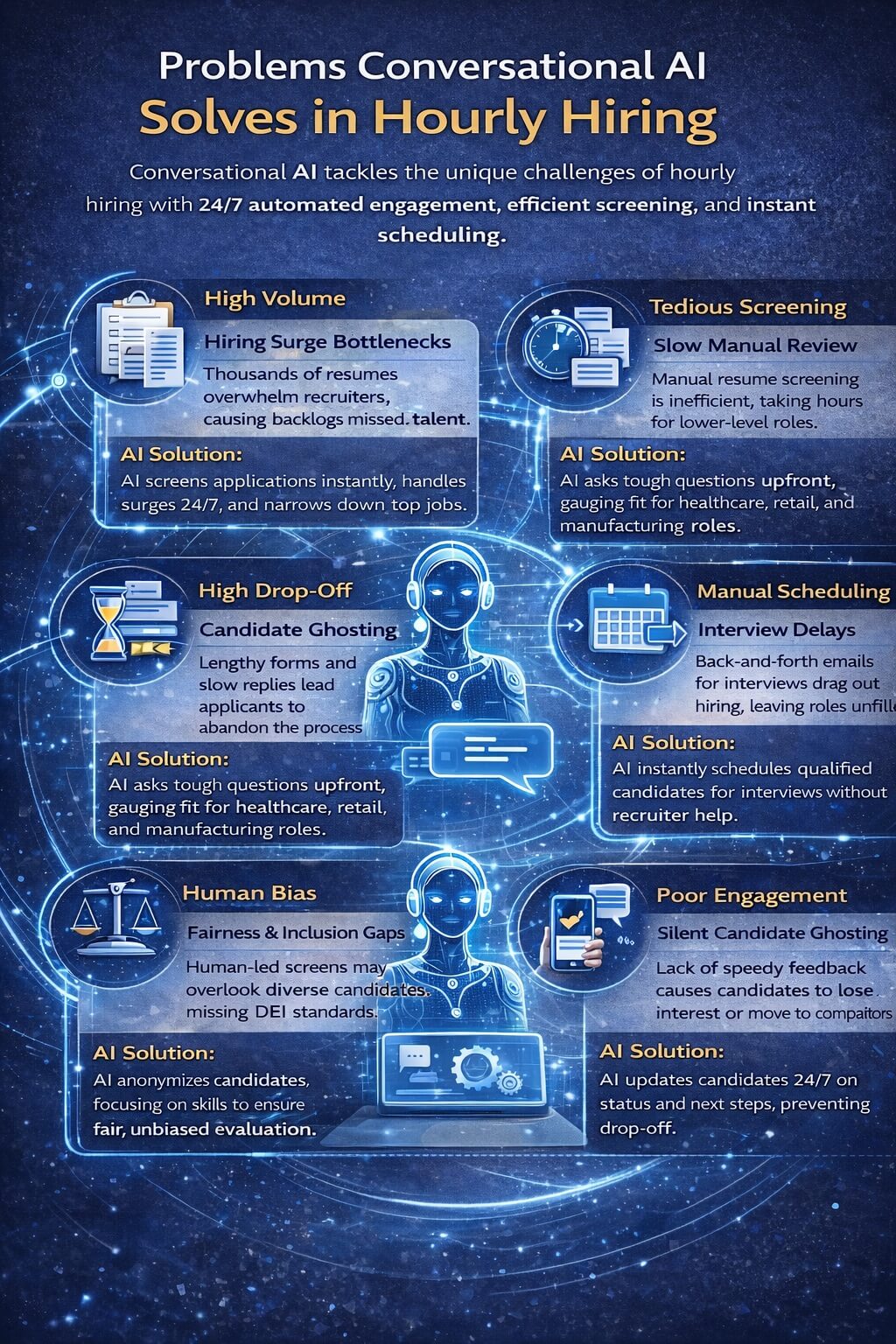
Conversational AI tackles these head-on by automating interactions via chatbots and agents. It screens candidates in real-time through natural dialogues, assessing fit without resumes initially, and handles scheduling instantly. For high-volume sectors, this means processing surges efficiently, reducing administrative burdens, and ensuring fair, consistent evaluations by anonymizing data and focusing on skills. Tools like these provide 24/7 availability, cutting response times and drop-offs while keeping candidates informed, solving the core inefficiencies of manual high-volume recruitment.
The Benefits of Using Conversational AI to Cut Time-to-Hire
Implementing conversational AI yields transformative benefits, particularly for cutting time-to-hire in hourly roles. Studies show reductions of up to 97%, with real-world examples like Chipotle dropping from 12 to 4 days (75% cut) and McDonald’s achieving 65% faster hiring. Burger King saw a 21% decrease, screening and scheduling in under 2 minutes. In healthcare, retail, and manufacturing, this speed translates to filled shifts sooner, minimizing disruptions.
Efficiency skyrockets as AI automates screening, ranking, and outreach, freeing recruiters for strategic tasks. Teams handle high volumes without added headcount, with one study noting 95% automation in processes. Candidate experience improves dramatically—chatbots offer instant, personalized interactions, boosting completion rates by 41% and satisfaction by 65%. Drop-offs plummet by 40%, ensuring robust pipelines.
Cost savings are substantial: reduced ad spend, lower overtime, and up to 75% cheaper screening. Quality of hire rises through bias-reduced assessments, with consistent scoring leading to better fits and higher retention. For HR leaders, analytics provide insights for data-driven decisions, while scalability supports year-round hiring surges. Overall, conversational AI not only cuts time-to-hire but elevates the entire recruitment ecosystem, delivering ROI through faster, fairer, and more engaging processes.
How CloudApper AI Recruiter Helps Cut Time-to-Hire
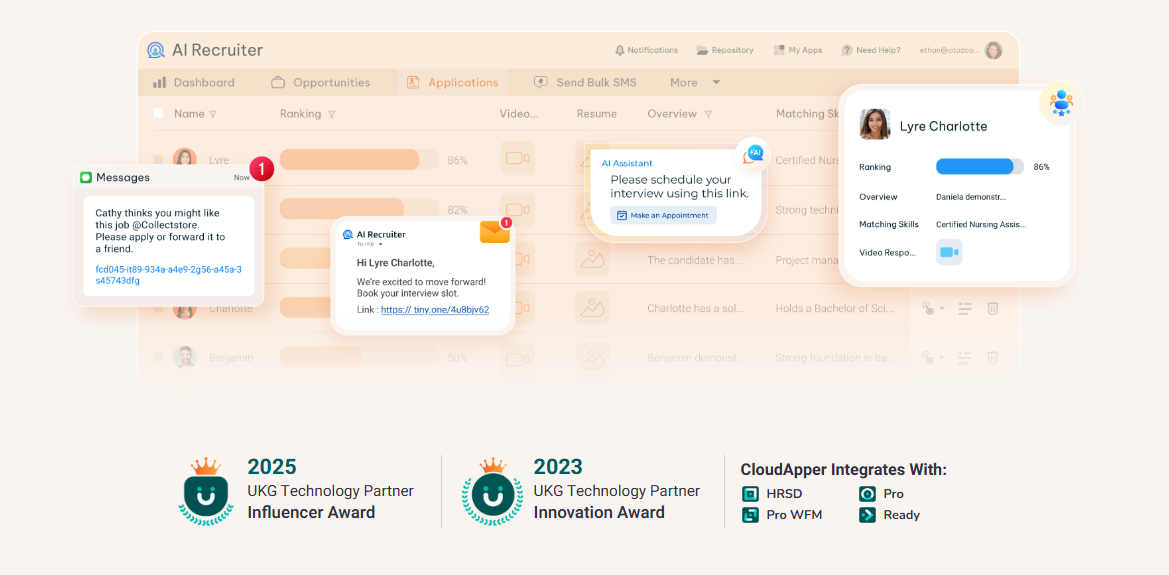
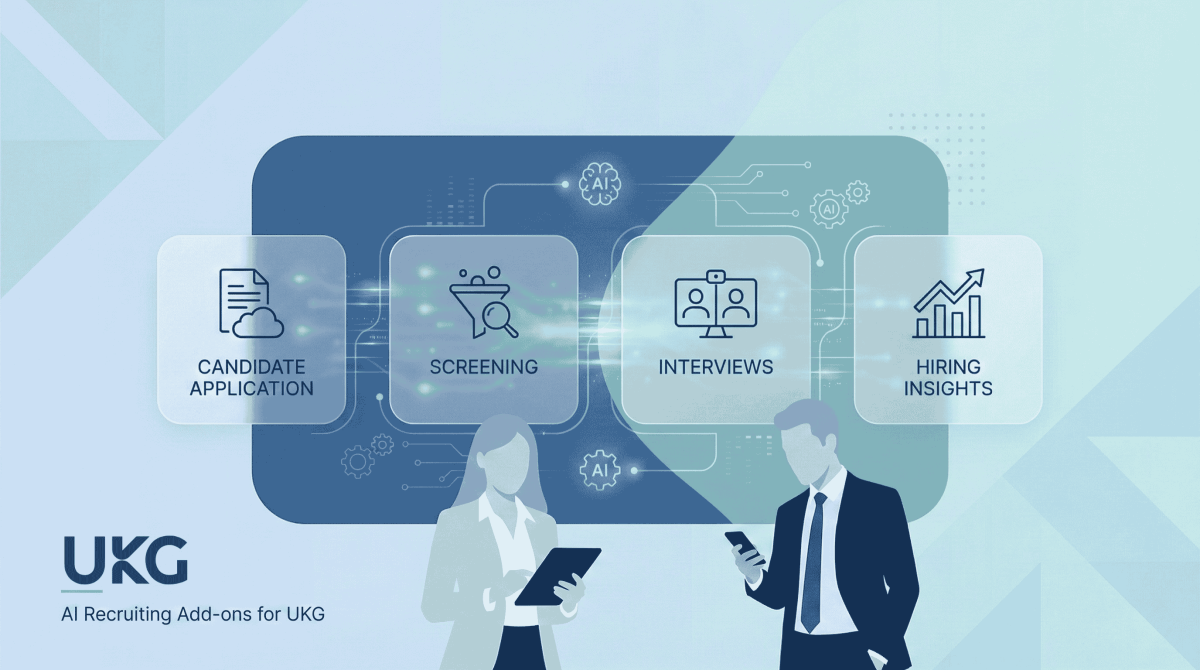
To practically cut time-to-hire by 50% or more, integrate tools like CloudApper AI Recruiter, designed for high-volume hourly hiring in healthcare, retail, and manufacturing. This AI-driven platform uses specialized agents for screening, assessment, communication, scheduling, and analytics, seamlessly integrating with ATS/HCM systems like Workday or UKG.
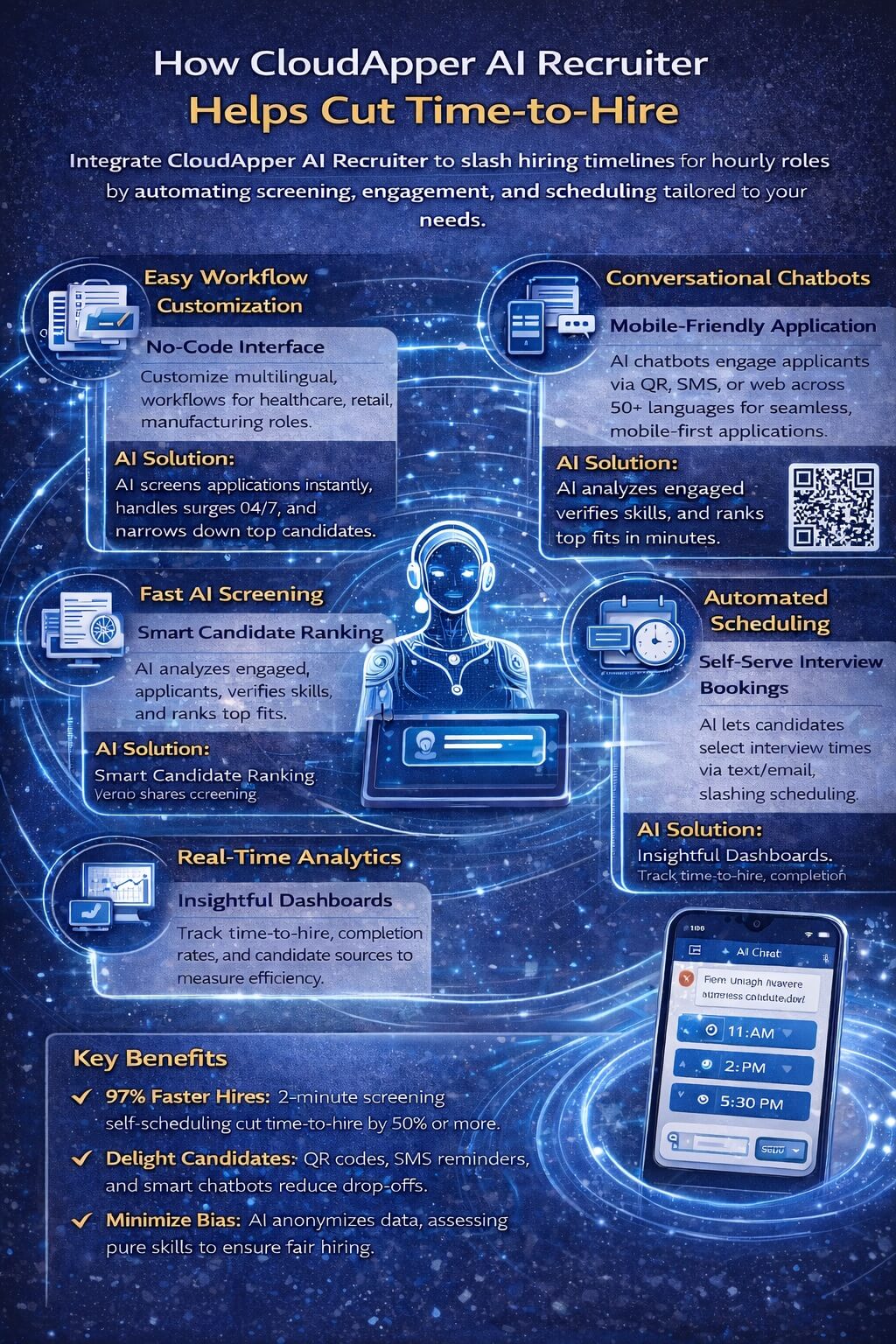
Start by customizing workflows via its no-code interface to match your needs—set role-specific questions and scoring. Deploy conversational chatbots for mobile-friendly applications, guiding candidates through processes in 50+ languages, reducing drop-offs with QR codes and SMS outreach. AI screens resumes contextually, ranks candidates in minutes, and automates self-scheduling, slashing timelines from days to hours.
Benefits include up to 97% faster time-to-hire, with screening in 2 minutes versus 24+ hours traditionally. It minimizes bias through anonymization, enhances engagement with reminders, and provides dashboards for metrics tracking. For US HR teams, this means compliant, efficient hiring that scales for constant demand. Visit CloudApper AI Recruiter to see how it can transform your process.
FAQ: Cutting Time-to-Hire with Conversational AI
What is the average reduction in time-to-hire with conversational AI?
Typically 50-97%, depending on implementation—e.g., from weeks to days for hourly roles.
Does it work for high-volume industries like healthcare?
Yes, it handles thousands of applications, automating screening and scheduling to address shortages.
How does it reduce bias?
By anonymizing data and using consistent, skills-based assessments.
Is it cost-effective?
Absolutely—saves on manual labor and ads, with quick ROI.
Can it integrate with existing systems?
Tools like CloudApper connect seamlessly to major ATS/HCM platforms.
Embrace AI to Stay Ahead
Cutting time-to-hire by 50% with conversational AI isn’t futuristic—it’s actionable today for US HR leaders in high-volume sectors. By solving inefficiencies and delivering benefits like speed and quality, tools like CloudApper AI Recruiter empower teams to hire smarter. Start optimizing your process to build resilient workforces that drive success.